

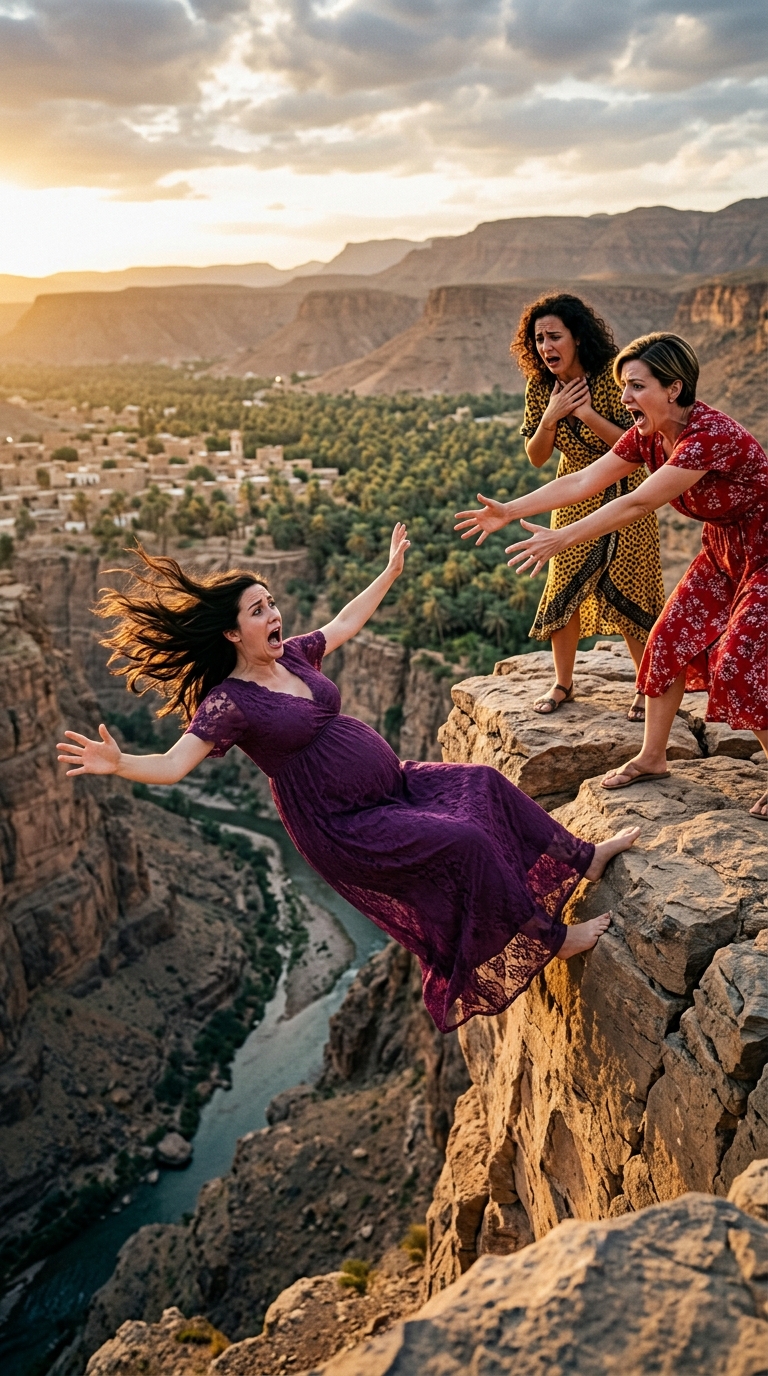
Please, I’m begging you. You are my friends. You are my family. I never asked for the prophecy. I never asked for any of this. Please.
“She stole our destiny,” Ada said. “Push her.”
“Wait,” one of them whispered. “She is our friend. We can’t do this.”
“She took what was meant for us. Do it.”
“Ada, we have been friends since we were six years old. Please.”
She begged them.
They pushed her anyway.
But you cannot push a prophecy off a cliff. And no one was prepared for what came next.
Every village has its daughters. Girls who grow under the same sun, drink from the same stream, and walk the same paths carrying water pots. Girls who learn each other’s laughter before they learn their own names. Girls who share secrets in the dark and grow into women still bound by childhood.
The village of Abara had four such daughters.
For a long time, they were simply friends.
Ngozi was beautiful in a way that made people pause mid-sentence. Her skin carried the deep brown of river clay at dusk, and her eyes seemed to catch light from impossible angles. When she entered a gathering, heads turned toward her the way flowers turn toward the sun. She wore her beauty openly, deliberately, like both protection and invitation.
She was not cruel, but she had learned early that beauty was currency, and no one had ever taught her how to spend it wisely.
Chidima was the daughter of the richest trader across three villages. Everyone knew it, because Chidima made sure of it. Her wrappers were always the finest. Her sandals came from the city. At every ceremony, her family’s contribution was the largest, and her father ensured it was announced. She was generous because generosity had always been easy for her. Giving reminded people what she had.
Ada could outtalk anyone. Not the elders, not the market women, not even the men under the udala tree could match her. She had an opinion on everything, and her voice carried across compounds without effort. She was ambitious in a way the village found both admirable and unsettling. She wanted her name to mean something beyond someone’s daughter or wife. She wanted to be remembered.
And then there was Amara.
Amara did not announce herself. That was the first thing people noticed, though usually only after they had already been noticing her without realizing it. She simply existed in a space, and somehow the space became more honest. She was not the most beautiful, though she was lovely. She was not rich. She was not loud. But when she spoke, people listened.
Elders paused when she gave an opinion. Children followed her without being called. Women who had never confided in anyone found themselves speaking to Amara. She carried something no one could easily name: a quiet authority, a grace that did not compete for space because it never needed to.
She was the fourth friend. The quiet one. The steady one.
None of them yet understood what she truly was.
They had been friends since childhood, small enough to hide behind the same palm tree. They had shared secrets by the river, covered for one another during festivals, and laughed freely in the way young women do before learning caution.
On the eve of the Festival of Ofu, the four sat behind Ngozi’s mother’s kitchen, shelling seeds and talking about everything and nothing.
“I heard the priestess will speak at the gathering tomorrow,” Ngozi said, inspecting her nails. “A real prophecy this time. Not just blessings.”
“She speaks every three years,” Ada replied. “It never means anything.”
“My mother says this one is different,” Chidima said. “The priestess has been fasting for seven days.”
“Seven days?” Ngozi raised an eyebrow. “What could she possibly need seven days of fasting to say?”
Amara did not look up from her work.
“Maybe it is not about what she will say,” she said softly. “Maybe it is about being clean enough to carry what she has been given.”
A brief silence followed. Not uncomfortable—just the kind of pause Amara’s words often created, as though the world needed time to settle them.
Ngozi laughed. “Amara, you always say things that make me feel like I should have thought harder before speaking.”
They all laughed, even Ada, who had been ready to respond sharply.
That was their friendship. It softened edges. It made tension feel temporary, like something that could not truly grow between people who loved each other.
That night, they were simply four women who had once been four girls.
No one was more. No one was less.
But the next day was the Festival of Ofu.
And everything changed.
Some endings begin in laughter. Some separations begin while people are still close enough to touch.
The festival arrived as it always did: with noise before meaning.
By dawn, the village square was alive. Women came with pots balanced on their heads. Men dragged out old wooden benches. The smell of palm oil and roasted yam filled the air. Drums echoed in the distance, still warming like voices clearing their throats.
The four friends arrived together.
Ngozi wore the color of ripe cashew, impossible to ignore. Chidima’s wrapper whispered wealth with every movement. Ada was already speaking before she fully entered, greeting everyone and inserting herself into conversations. Amara walked quietly beside them in deep indigo.
As they passed, two elder women near the entrance stopped speaking. Their eyes moved over Ngozi, Chidima, Ada—and settled on Amara. One leaned in and whispered something.
Amara did not notice.
Her friends did.
By midmorning, the square was full. Then silence began to spread.
The priestess arrived.
Mama Chinyere, called Eze Nwanyi, moved like water through the crowd. She wore white from neck to ankle and touched nothing without changing it.
She closed her eyes in the center of the square.
When she spoke, she began with blessings: harvests, children, rain, protection. The village answered in rhythm.
Then she stopped.
Her expression shifted. The elders straightened.
When she spoke again, her voice was lower.
“Among the daughters who stand here today, one will rise beyond this land. She will sit where decisions are made. Her voice will travel farther than drums, farther than roads, farther than the names of those who built this village.”
The square went still.
“But her rising will be paid for in blood not her own, and in betrayal wearing the face of love.”
No one moved.
“Let the one who knows herself receive this. Let those who fear her look inward. What you do with what you feel is where your destiny is written.”
Then she closed her eyes again.
The drums resumed uncertainly, as if even they were unsettled.
No name had been spoken.
That should have made things easier.
It did not.
The square began doing what villages do when prophecy has no name: it assigned one. Quietly. Quickly. Through glances and silence.
The elder women near the entrance shifted closer to Amara.
They did not speak. They simply turned toward her.
Later, when Mama Chinyere reached the four friends, she touched each of them briefly. But when she placed her hand on Amara’s head, she closed her eyes for three seconds.
Three seconds was enough.
“Did you see that?” Ngozi whispered.
“Everyone saw it,” Chidima said.
“It means nothing,” Amara said gently. “She touches many people.”
“She closed her eyes for you,” Ada said.
Silence followed.
“Please,” Amara said. “Do not turn this into something it is not.”
Ada looked at her.
“You are very calm for someone the whole village is now watching.”
“I was not singled out.”
“No,” Ada said. “Of course not.”
That evening, they walked home separately for the first time.
Not by decision. Not by argument. It simply happened.
Amara walked alone, thinking of the prophecy as one thinks of weather: something that comes, something that passes, something beyond control.
She did not feel chosen.
She did not feel afraid.
She did not yet understand what had begun.
Prophecy does not change people. Watching others react to it does.
That night, jealousy began quietly—in three different homes.
In Ngozi, it came as invisibility.
In Chidima, it came as disrespect.
In Ada, it came as fury.
And in each of them, it began to grow. She had never been invisible. Beauty had been her identity for so long that she no longer knew the difference between being seen and being beautiful. But after the festival, she started noticing something she could not name.
When she entered a space with Amara, people greeted them both. Then their attention settled on Amara. Not the quick admiration Ngozi was used to, but something deeper. Something more lasting. The kind of attention that had nothing to do with appearance and everything to do with what someone carries inside.
One afternoon at the market, an old woman held Amara’s hand and said, “There is something on you, my daughter. Guard it well.”
She did not even look at Ngozi.
Ngozi laughed it off. Then she went home, sat in front of her mirror, and stared at the face that had never once failed her.
“I am the one they have always seen,” she whispered. “Why does she make me feel like I am fading away?”
No one answered.
That was the problem. There was no one to blame. Amara had done nothing wrong. The offense was simply her existence.
And that was the most unbearable kind.
In Chidima, jealousy arrived as disrespect.
She had always been able to buy closeness to importance. Her father’s name opened doors. Her family’s money softened voices. When she supported a village project, her name carried weight. She had mistaken this for value. She had confused being useful with being chosen.
After the prophecy, elders began inviting Amara to sit closer during discussions—not because she demanded it, not because her family placed her there, but because they wanted her near. Young women came to her for advice. Mothers pointed her out to their daughters.
No one pointed Chidima out.
“Mama,” Chidima asked one evening, “do you think the prophecy is really about Amara?”
Her mother didn’t look up from her work.
“The elders seem to think so.”
“But she has nothing. Her family has nothing. How does someone with nothing rise above everyone?”
Her mother answered softly, “Perhaps that is exactly how.”
Chidima said nothing else that night.
She hated the answer.
In Ada, jealousy arrived as fury.
Not the kind that could be spoken and released, but a cold fury with nowhere to go, because naming it would expose everything underneath.
Ada had spent her life pushing toward visibility. Every word, every opinion, every lifted chin had been a step toward recognition, influence, importance—a life beyond Abara’s borders.
And now Amara, who did not push, did not shout, did not demand, had been given in one silent moment everything Ada had been reaching for.
One night, after Amara had gone home early, Ada turned to Ngozi and Chidima.
“Tell me honestly. Do you think she is the one?”
Ngozi hesitated. “The elders believe it.”
“That’s not what I asked.”
Chidima looked away. “Whether we believe it or not doesn’t matter anymore. The village has decided.”
“And when the village decides something, is it always right?” Ada asked. “The village has been wrong before.”
“What are you saying?” Ngozi whispered.
“I’m saying destiny is not a river. It doesn’t have to flow one way. Things change. Circumstances change.”
None of them said what they were really thinking out loud.
But all three understood it.
The confirmation came on harvest day.
The chief elder announced that a young woman among them had been chosen to represent Abara at the regional council. A position of real influence—one that had never gone to someone so young, and never to a woman.
Then he called Amara’s name.
The village erupted in celebration.
Amara stood slowly, stunned, one hand over her mouth. Mama Chinyere nodded once, as if it had already been decided long before.
Amara searched the crowd for her friends.
Ngozi was smiling, but it did not reach her eyes. Chidima clapped slowly. Ada stood completely still, her expression carefully controlled.
Amara saw none of it.
She was too overwhelmed, too full of light and fear to notice what surrounded her.
She would never know what she missed in that moment.
Three days later, Ada came to her with warm eyes and a gentle voice.
“We want to celebrate you before you leave,” she said. “The four of us. One last walk to the old ridge… like when we were younger.”
“You don’t have to do that,” Amara said.
“You’re our friend. Of course we do.”
“It will feel like old times,” Chidima added.
Amara smiled.
“All right. I’d like that.”
She trusted them. She always had—without question, without hesitation, the kind of trust that comes from never having been given a reason to doubt.
That was Amara’s nature. She assumed goodness because she herself carried it.
It had always been her strength.
That evening, it became what they used against her.
The ridge was beautiful in the fading light. They walked in near silence—not the easy silence of before, but something heavy, crowded with what could no longer be spoken.
Amara walked ahead, looking at the view she had loved since childhood. Below, the village spread out in smoke and rooftops. Beyond it, the road that would take her somewhere new.
She did not hear what was decided behind her.
She did not feel the shift.
For one suspended second, she felt hands.
Then air.
Then the violent absence of ground.
Then nothing.
They stood at the edge of the cliff and looked down.
Chidima’s voice shook. “Is she…?”
Ada turned away first.
“We go back. We say she slipped. We say we tried to save her.”
Ngozi didn’t move. She kept staring downward.
“Ngozi,” Ada said sharply. “Now.”
They left.
The village mourned. Search parties were sent. The ravine was too deep, the forest too thick, and after two days, grief slowly turned into acceptance.
Amara was gone.
The prophecy, it seemed, had died with her.
Her three friends cried in public. They held each other. They accepted condolences from people who did not know what they were really mourning.
And in the quiet corners of their minds, each waited for relief.
It never came.
What they did not know was that the ravine led to a river.
And the river led to a stranger.
The stranger had kind eyes, a steady voice, and a home far away enough that news had not yet reached him.
Destiny is not easily erased.
You cannot push a prophecy off a cliff.
You can only postpone what it is going to demand from you.
The river did not kill Amara. It carried her the way rivers carry what they choose to keep—neither gently nor carelessly, but with a direction that belongs to something larger than understanding.
She was found at dawn by a fisherman who ran for his prince.
His name was Kade.
He was not like most princes. He did not announce himself. He listened more than he spoke. There was a stillness about him that people often mistook for distance, when it was really depth.
He reached the riverbank and saw a woman he did not know—barely alive, her indigo cloth torn, her hand still curled as if holding onto something unseen.
He carried her himself.
No servants.
No hesitation.
By the next day, she opened her eyes—dark, steady, unreadable—and looked at the ceiling of a room she had never seen, with the calm of someone who had survived something but could not yet name it.
Kade sat beside her.
“You’re safe,” he said quietly. “You’re in Edu. Do you know your name?”
Silence stretched.
“My name…” Her voice was rough. “I don’t know it.”
“That’s all right. It will come back.”
“How do you know?”
“Because you look like someone who doesn’t lose things easily.”
She didn’t know how to respond.
So she closed her eyes and slept.
Somewhere beneath that sleep, something that had once been a name stayed alive, waiting.
They called her Ada for now. It meant daughter. Nothing more. Nothing less.
She healed slowly, then suddenly—like strong things do. Her body recovered before her memory. The past hovered just out of reach, present but unreachable, like a shape without sound.
She knew only the house in Edu, the unfamiliar quiet, and Kade—who came each day not to interrogate, not to demand, but simply to be there, as though her existence required no justification.
One afternoon, he watched her sorting herbs with the healer’s wife.
“You know what you’re doing with those,” he said. Amara looked down at her hands, surprised.
“I suppose I do.”
“The body remembers what the mind has set down,” Kade said. “It keeps things safe until you are ready.”
“And if I am never ready?”
“Then the body will decide for you. It always does.”
She looked at him in the steady, unguarded way she had always looked at people, the look that made others feel seen and sometimes afraid of being seen.
“You are not what I expected from a prince.”
“What did you expect?”
“More noise.”
He laughed, open and unperformed.
She found she liked the sound.
Time passed the way it does when two people become necessary to each other: slowly, invisibly, then all at once.
Amara sat with the elders when they debated village matters. She said quiet things that reached the center of problems, and they listened the way people had always listened to her, even when they did not know why.
Kade’s father, the king, watched and said nothing.
Not yet.
One evening, Kade stood before him.
“I want to marry her.”
The king was silent for a long moment.
“You do not know who she is.”
“I know exactly who she is. I only do not know where she is from. Those are not the same thing.”
The king studied his son, the one who had never bent under pressure, the one who listened more than he spoke, the finest of his children in all the ways that mattered.
“Bring her to me.”
The meeting was short. The king asked three questions. Amara answered with the quiet honesty that had always been her nature, the kind of honesty that had nothing to prove and therefore proved everything.
When she left, the king looked at his son.
“Wherever she comes from, they lost something when they lost her.”
Her memory returned on an ordinary morning.
She was standing at the edge of the compound, looking south, when the early light shifted. The particular gold of dry season dawn opened something in her mind.
It came back all at once.
Abara.
The Festival of Ofu.
The priestess’s hand warm on her head.
Her name called before the village.
The walk to the ridge.
Three warm voices.
Three women she had loved without condition.
And then the hands.
She stood very still, holding something enormous inside her, and said nothing.
When Kade found her an hour later, he knew immediately. He did not ask if she was all right. He simply stood beside her and waited.
“I remember,” Amara said, her voice steady in the most frightening way. “I remember all of it.”
“What do you need?” he asked.
She turned to the man who had pulled her from a riverbank, waited without demanding, and loved her before she had a name to give him.
“I need to go home.”
“Then we go.”
“It will not be simple.”
“I did not say simple. I said we go.”
She nodded, the quiet, decided nod of a woman who had survived the worst thing and was now walking toward the truth of it.
They arrived in Abara on a still morning.
No procession. No announcement.
Only a woman in clean cloth walking a road she had walked a thousand times, a prince at her side, her memory fully restored and her back straight.
The first person who saw her stopped walking.
Then the word moved through the village like fire through dry grass.
Amara is alive.
Amara has returned.
By the time she reached the village square, a crowd had gathered.
And somewhere inside that crowd, faces drained of color and knees losing their strength, were three women who had stood at the edge of a cliff and believed they had ended something.
They had not ended it.
They had only postponed the moment they would have to face it.
That moment was now.
Destiny does not forget. It does not hurry. It does not tire. It does not negotiate with fear.
It arrives on a still morning wearing the face of the woman you tried to destroy, and it waits for you to decide what kind of person you will be when the truth has nowhere left to hide.
The reckoning had come to Abara.
And it had come wearing indigo.
