

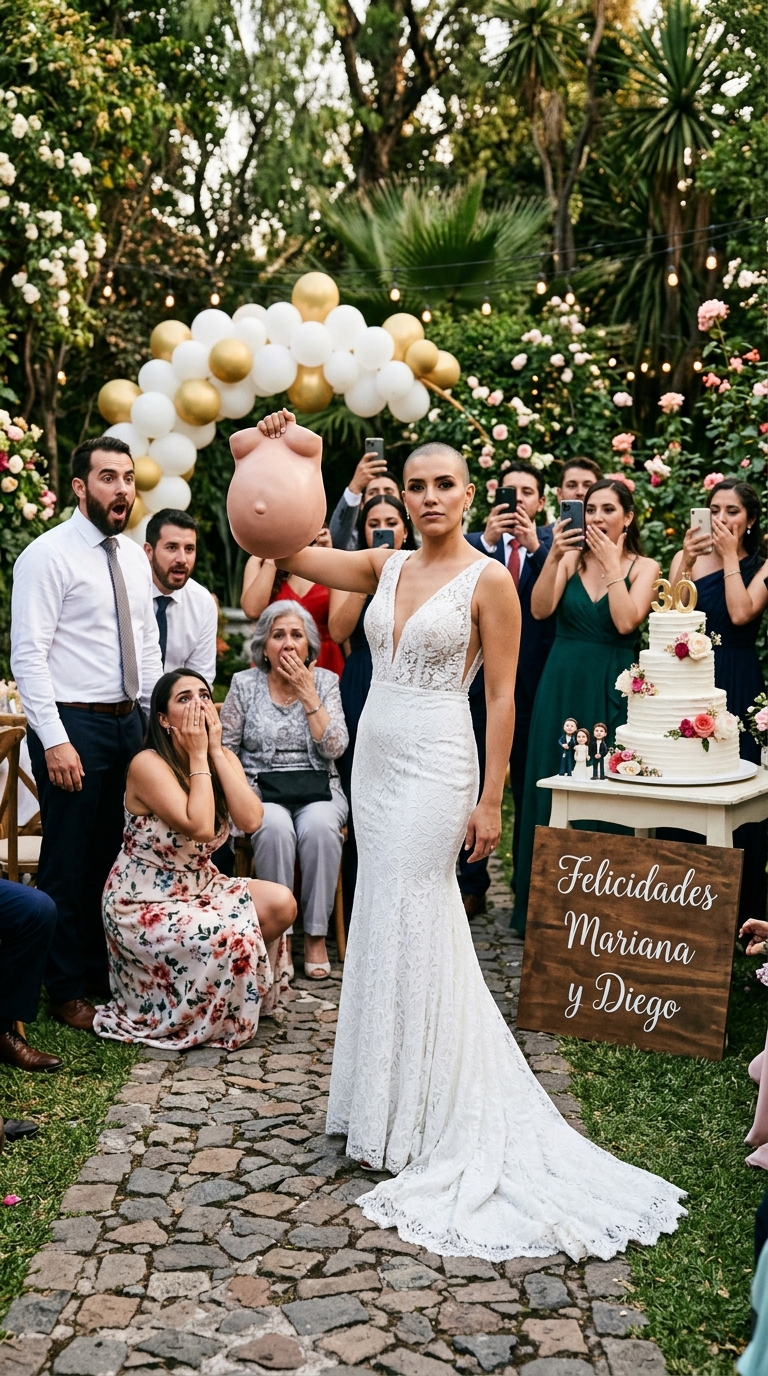
By sunrise, the house was quieter than it had ever been. Not peaceful—quiet in the way a storm becomes before it tears the roof off.
Mariana Whitmore stood in the kitchen of the four-bedroom home in North Dallas, Texas, wearing a silk robe, holding a cup of black coffee she had not touched once, and a shaved head that changed everything.
Her husband, Daniel, came downstairs first, yawning like a man who still believed the world belonged to him. Behind him followed his mother, Elvira Whitmore, in the same floral robe from the night before, smiling as though she had already won. They both paused when they saw Mariana at the counter—calm, still, and hairless.
Daniel blinked. “You’re really going to work like that?”
Mariana turned slowly. “I told you I’m resigning.”
Elvira clapped once, pleased. “Finally. See, Daniel? Sometimes a woman just needs a firm lesson.”
Mariana gave a faint smile. “Yes. I learned a lot last night.”
Daniel looked relieved. That relief told Mariana everything. He had not spent the night worrying about what had happened. He had not lain awake ashamed that his wife had been harmed in her sleep. He had slept soundly because he believed the humiliation had succeeded.
Elvira pulled out a chair and sat at the breakfast table. “Now make eggs. Daniel likes them soft, not dry. And after breakfast, go to the butcher. I want beef bones for broth. A wife at home should know how to feed her family.”
Mariana placed her coffee cup in the sink. “I canceled the grocery delivery.”
Elvira’s smile slipped. “What?”
“And the meal subscription,” Mariana added. “And the cleaning service. And the pool maintenance. And Daniel’s personal trainer.”
Daniel frowned. “Why would you do that?”
Mariana looked at him steadily. “Because I resigned from being your bank.”
For a few seconds, neither of them understood. Then Daniel grabbed his phone from the counter, unlocked it, and opened his banking app. Confusion shifted into irritation, then panic.
“Mariana, why is my card declined?”
Elvira’s chair scraped back. “Declined?”
“I removed you as an authorized user from my credit account at 2:37 this morning,” Mariana said. “Your mother too. I also removed my debit card from your Apple Pay, your gym account, your car insurance, your streaming services, and the Mercedes lease.”
Daniel stared at her. “You can’t just do that.”
“I can,” Mariana said. “They were my accounts.”
Elvira stood, furious. “This is your husband. Everything you earn belongs to this family.”
Mariana stepped closer, and for the first time Elvira took a step back. “No. Everything I earned was used by this family. There’s a difference.”
Daniel slammed his phone down. “You’re acting dramatic because Mom cut your hair. Hair grows back.”
Mariana tilted her head slightly. The overhead light reflected off her scalp, showing a small red scrape near her temple. “You’re right. Hair grows back. But trust doesn’t.”
Elvira pointed toward the stairs. “Go get dressed and stop acting like a victim. You agreed to stay home. You said it yourself.”
“I did,” Mariana replied. “I’m staying home today. I have things to handle.”
Daniel softened slightly. He still believed he could smooth this over with charm, with a kiss, with the familiar apology he used when he wanted peace restored. “Baby, come on. Mom went too far. I admit that. But you know her. She’s old-fashioned. She cares about us.”
Mariana almost laughed. Elvira wasn’t “old-fashioned” when she spent Mariana’s card on a $1,400 designer bag. She wasn’t old-fashioned when she charged spa trips to “family expenses.” She was only old-fashioned when Mariana had control.
Before Mariana could respond, the doorbell rang.
Daniel frowned. “Who’s here this early?”
Mariana walked to the door and opened it. A woman in a navy blazer stood there holding a briefcase. Behind her stood a police officer.
“Mrs. Whitmore?” the woman asked.
“Yes.”
“I’m Attorney Rachel Monroe. We spoke this morning.”
Daniel stepped into the hallway. “Attorney?”
Mariana stepped aside. “Come in.”
Elvira appeared behind him, suddenly silent.
Rachel looked at Mariana’s shaved head but showed no pity. Then she looked Daniel directly in the eye.
“Mr. Whitmore,” Rachel said, “my client has reported an assault that occurred in this home last night. Officer Matthews is here to take a statement and document injuries.”
Daniel’s mouth fell open. “Assault? Are you serious?”
Elvira’s voice cracked. “I was disciplining her.”
The officer’s expression sharpened. “Ma’am, did you say disciplining?”
Mariana watched the realization hit Elvira too late—that she had spoken as if another human being belonged to her.
Daniel raised his hands. “This is a family issue. It got out of hand. Nobody needs police.”
Rachel opened her briefcase. “Your mother restrained my client and shaved her head while she was asleep. According to my client, your response was to blame her and pressure her to resign. That is not a family issue. That is evidence.”
Elvira scoffed. “Evidence of what? A haircut?”
Officer Matthews looked at Mariana’s scalp. “Mrs. Whitmore, may I take photographs?”
Mariana nodded.
The flash went off three times. Each one made Daniel look smaller.
Rachel then said, “There is one more thing.”
Mariana opened her phone and pressed play.
Elvira’s voice filled the hallway:
“If you want to keep living in this house, tomorrow you resign and learn to serve your husband.”
Then Mariana screaming.
Then Daniel’s voice:
“Mom went too far, yes, but you provoked this.”
Elvira lunged forward. “You recorded us?”
Mariana looked at her coldly. “The bedroom camera did.”
Daniel went pale.
He had forgotten about it. Months earlier, after a neighborhood theft, Mariana had installed indoor security cameras. He had mocked her for being paranoid. He never knew they recorded audio when motion activated.
It had captured everything.
Elvira holding her down.
The clippers buzzing.
Mariana crying out.
Daniel choosing his mother.
And that was the moment Daniel finally understood he had not married a weak woman. He had married a patient one.
Rachel turned to the officer. “We will submit the full file.”
Officer Matthews closed his notebook. “Mrs. Whitmore, you can request an emergency protective order.”
Mariana nodded. “I want one.” Daniel snapped, “Against my mother?”
Mariana looked at him. “Against both of you.”
For the first time, silence belonged entirely to her.
By noon, Elvira had been removed from the house, escorted out with two suitcases and humiliation written across her face. Daniel was allowed to collect his clothes and essentials under supervision. He kept insisting Mariana was overreacting, that she was destroying a marriage over hair, that her new promotion had turned her cruel. Mariana stood in the foyer and listened without a word.
When he reached for the framed wedding photo on the console table, she stopped him.
“That stays,” she said.
Daniel let out a bitter laugh. “You want to keep our wedding picture?”
“No,” Mariana replied. “I want to remember the day I ignored my instincts.”
His face twisted. “You think you’re powerful because you make money.”
Mariana stepped closer. “No, Daniel. I’m powerful because I stopped spending it on people who hated me.”
The door shut behind him at 12:43 p.m.
For the first time in three years, the house felt like hers.
But real revenge does not begin with shouting. It begins with documentation.
That afternoon, Mariana sat at the dining table with Rachel Monroe and forensic accountant Paul Greene. They went through bank statements, mortgages, taxes, credit cards, wire transfers, insurance policies, vehicle leases, and household bills. The truth looked different when reduced to numbers on a page.
Mariana had paid $38,000 toward Daniel’s credit card debt over two years. She had covered $19,500 for Elvira’s dental work. She had funded a $12,200 trip to Cabo that Daniel called a “family healing trip” after she discovered his messages to another woman. She had paid the down payment on the house, every mortgage installment, and all property taxes.
Daniel had contributed almost nothing.
Even worse, Paul discovered transfers she never authorized. Small at first—$300, $450, $900—then $2,500 at a time. The money had been moved from a joint account into one under Elvira’s maiden name.
Mariana stared at the spreadsheet. “How much?”
Paul hesitated. “Over thirty-one months, about $64,800.”
Rachel’s expression hardened. “Did you authorize this?”
“No.”
“Did Daniel have access to the account?”
“Yes.”
Paul rotated the laptop toward her. “Some transfers are labeled. ‘Mom meds.’ ‘Roof repair.’ ‘Urgent.’ But there are no matching expenses. I can investigate further.”
Mariana looked at the numbers until they blurred. She remembered twelve-hour workdays, skipped lunches, Sunday calls, and apologizing for being tired. While she worked, they had been draining her and calling it normal.
“Dig deeper,” she said.
Two days later, Mariana returned to her office at Horizon Medical Systems in downtown Dallas.
She wore a cream pantsuit, pearl earrings, and no wig.
Her scalp was bare—intentional, exposed, undeniable. She could have hidden it. Instead, she walked in like a woman refusing to shrink.
The lobby went silent.
Her assistant Jasmine stood. “Mariana…”
“Good morning,” Mariana said calmly. “Did we move the West Coast meeting to ten?”
“Yes, Conference Room B.”
She walked past executives, interns, and a senior vice president who once said she was “too polished to be aggressive.” No one mentioned her hair. They saw the scrape near her temple. They saw her posture. That was enough.
At 10:00 a.m., she entered the conference room, opened her laptop, and stood at the head of the table.
“Before we start,” she said, “some of you may notice I look different.”
Silence.
“My appearance changed because someone in my personal life thought humiliation would make me smaller. It didn’t. Now, let’s discuss the $42 million expansion pipeline.”
By lunch, the story had spread through the building.
That afternoon, CEO Margaret Klein called her in. No gossip. No pity. Just a question.
“Do you need time off?”
“No.”
“Security?”
Mariana paused. “Maybe.”
“Done,” Margaret said.
Then she added, “Twenty years ago, my first husband locked me out during a snowstorm after I got promoted. I slept in my car. The next morning, I closed the biggest deal of my career.”
Mariana looked at her.
“Men threatened by women’s success are common,” Margaret said. “Women who stop negotiating with them are rare.”
“You’re not resigning,” she added.
“No,” Mariana said. “I’m not.”
The following week, Daniel tried apologies.
White roses arrived first. She hated white roses. The card read: “Let’s not let one bad night ruin everything.” She gave them away.
Then came texts:
Baby, Mom is crying.
You know she didn’t mean it.
We can fix this if you calm down.
You’re embarrassing me.
You’re acting like a stranger.
Mariana didn’t reply.
Then came anger—voicemails calling her cruel, cold, greedy, and manipulated by lawyers. He claimed she was financially abusing him by cutting off accounts. He said his mother’s health was failing because she was forced to stay with relatives. He said a real wife wouldn’t destroy a man over hair.
Rachel saved every message.
Two weeks later, the protective order hearing began.
Elvira arrived in black, performing grief. Daniel sat stiff beside her, refusing to look at Mariana. Mariana wore navy. Her scalp showed faint regrowth.
The judge reviewed everything—photos, recordings, and footage.
When he returned, his expression was firm.
“You restrained a sleeping woman and shaved her head without consent?”
Elvira’s lawyer tried to argue. The judge cut in. “The video shows physical restraint.”
The objection died immediately.
Daniel tried to explain. He said he was overwhelmed. That emotions were high. That his mother acted out of concern.
The judge stared at him. “Concern?”
No answer.
The order was granted.
Elvira was barred from contact. Daniel was restricted pending divorce proceedings. Mariana kept the house as sole mortgage holder.
Outside court, Elvira dropped the act.
“You think you won?” she hissed.
Mariana looked at her. “No. I know I won.”
A reporter nearby caught it.
By evening, the quote spread online: Poor behavior has rich consequences.
The forensic accountant then uncovered more. Daniel had used Mariana’s financial documents to secure a $75,000 business loan using her forged signature. The “company” had no clients or revenue. Elvira was listed as staff.
Mariana asked, “Is this criminal?”
“Yes,” Rachel said. “Fraud, forgery, identity misuse.”
“Proceed,” Mariana said.
That same week, Daniel was served with divorce papers and a fraud investigation.
He called from an unknown number.
“You’re ruining my life.”
“No,” Mariana said. “I’m correcting it.”
“Mom could go to jail.”
“She should’ve thought of that earlier.”
“You loved me.”
“I loved who I thought you were.”
His voice cracked—not with remorse, but fear. “What am I supposed to do?”
Mariana looked at her reflection in the glass. “Live within your means.”
She hung up.
The divorce escalated. Daniel claimed emotional contribution to her success. Rachel countered with financial records showing he contributed almost nothing and lived off her accounts. Elvira submitted a statement blaming “corporate feminism,” which was dismissed outright.
But Daniel’s lowest moment came during deposition.
Rachel laid out charges:
$812 at a steakhouse while Mariana was traveling.
$1,300 at a boutique.
$4,700 Miami trip for two.
$940 jewelry purchase.
Daniel shifted. “Those were business expenses.”
“What business?”
“My consulting business.”
“What did you consult on?” He hesitated. “Strategy.”
Rachel slid another document forward. “Is this your strategy?”
It was a screenshot of messages between Daniel and a woman named Kristen, a bottle-service hostess from Miami. In the messages, Daniel referred to Mariana as “the funding source” and joked that his mother could “break her attitude eventually.”
Daniel’s attorney immediately requested a break.
Mariana did not cry. She did not tremble. She looked at the screenshot with a calm sense of confirmation.
That was the strange thing about betrayal—at some point, pain stops feeling like shock and starts looking like evidence. And evidence, eventually, becomes freedom.
Meanwhile, her career exploded.
Mariana’s decision to stop hiding her shaved head became something larger than her. Women across Horizon Medical Systems began reaching out quietly, sharing stories they had never told anyone. One described a husband who sabotaged childcare on her presentation days. Another spoke of in-laws mocking her for paying the mortgage. Another admitted she had been funding a man who called her selfish for working.
Mariana never set out to become a symbol. She simply refused to disappear.
Three months after the assault, CEO Margaret Klein invited her to speak at the national leadership summit in Atlanta. Mariana almost declined. Then she remembered Elvira’s voice telling her to “learn her place.”
So she went.
She stood on stage in front of 900 employees, her hair now grown into a short, dark shadow. Behind her, slides displayed performance metrics, expansion data, and revenue projections. She delivered the numbers with precision.
Then she paused.
“Leadership is not about being liked by people who benefit from your silence,” she said. “Sometimes leadership begins the day you stop apologizing for surviving.”
The entire room stood.
The recording spread quickly beyond the company—women’s groups, podcasts, advocacy circles. Mariana accepted only a few invitations to speak. She wasn’t interested in becoming a public wound. But she did want others to understand what she had learned.
Humiliation survives in secrecy.
Power grows in documentation.
And leaving becomes possible when money is no longer a leash.
Elvira eventually pleaded no contest to misdemeanor assault after prosecutors reviewed the footage. She received probation, counseling, community service, and a permanent record. She left court in sunglasses, refusing questions. Daniel did not attend her sentencing—his lawyer advised him to avoid attention.
That absence broke Elvira more than the verdict.
For years she had centered her identity on her son’s loyalty. But when consequences arrived, Daniel chose himself. He stopped answering her calls. He moved into a small apartment in Irving and told relatives his mother had “gone too far.”
Only then did Elvira understand what Mariana already knew:
Daniel’s loyalty had always belonged to whoever protected him from consequences.
The divorce finalized eleven months after the assault.
Mariana kept the house, her assets, her retirement, and her investments. Daniel received no support. The court ordered partial repayment of stolen funds, though recovery was limited. Mariana no longer focused on what she would never get back.
The real cost had already been paid.
Access to her life.
On the day the decree arrived, she did not celebrate. She went to a small salon owned by a stylist named Tasha, who specialized in clients recovering from hair loss and trauma.
Tasha examined her regrowth gently. “Strong pattern. We can shape this well.”
Mariana looked at herself in the mirror. The hair was short, uneven, and real. No hiding. No covering.
For the first time, she didn’t want to.
“Do it,” she said.
The cut was clean, sharp, intentional. Not softness—but structure. When she looked again, she didn’t see someone broken.
She saw someone finished with surviving.
That evening, she drove home through Dallas with the windows down. The house was quiet, but no longer threatening. It felt like hers.
Room by room, she noticed what had changed. Daniel’s chair was gone. Elvira’s decorations were gone. The space felt lighter, reorganized around her instead of around demands.
On the counter sat a letter from Daniel.
Rachel had forwarded it after review. Mariana almost discarded it unread. Then she stopped.
Not out of longing—but out of closure.
She read it.
Six pages of justification. He blamed upbringing. His mother. Her success. Her independence. Her “tone.” He wrote that he had felt overshadowed, that he needed respect, that he hoped she would forgive him for “not protecting her better.”
Mariana folded it carefully.
Then she burned it.
Not in anger.
In finality.
A year later, she was promoted to Senior Vice President of National Sales. Her income doubled. At the announcement dinner, Margaret raised a glass.
“To women who stop asking permission.”
Mariana laughed—genuinely this time.
Her hair was now a neat pixie cut. She wore tailored black, emerald earrings, and the calm of someone who no longer feared being misunderstood. When people complimented her hair, she simply said, “Thank you. I chose it.”
That word mattered most.
Chose.
Elvira had tried to turn humiliation into control. Mariana turned it into definition.
Daniel tried one last time to reach her after her promotion was featured in the news. He waited outside her office with flowers and rehearsed regret. Security called ahead.
Through the glass, Mariana saw him standing there—wrinkled shirt, tired posture, holding roses bought too late to matter.
Jasmine asked, “Should I have him removed?”
Mariana looked at him for a long moment.
“No,” she said. “Let him understand that doors don’t open just because you knock.”
She left through the back exit.
He waited until security escorted him away.
That night, she visited her mother in San Antonio. They sat on the porch, drinking coffee under the warm Texas air.
Lucia touched her hair gently. “You always hated cuts when you were young.”
Mariana smiled. “I remember.”
“And now?”
“I thought losing it would break me,” Mariana said.
Lucia raised an eyebrow. “And?”
“It showed me what was already gone.”
“Your fear?”
“My patience for disrespect.”
Lucia smiled. “Good. That was too expensive anyway.”
Mariana laughed until it turned into tears.
Years later, people told her story as if it began in that bedroom—with clippers, white sheets, and shock. But Mariana knew better.
The story began long before that.
In unpaid bills disguised as love.
In disrespect called tradition.
In silence mistaken for peace.
The haircut wasn’t the beginning.
It was the receipt.
And when she finally collected what she was owed, she did it not with chaos—but with precision.
Cutting cards.
Cutting access.
Cutting illusion.
Until nothing remained but truth.
One evening, after a leadership talk in Houston, a young woman approached her nervously. She admitted she had left her partner after watching Mariana’s speech.
“He didn’t touch me,” she said, “but he controlled my money. I thought that wasn’t abuse.”
Mariana answered softly, “Sometimes it starts there.”
The woman nodded through tears. “I opened my own account.”
“That’s not small,” Mariana said. “That’s the beginning.”
On her flight home, Mariana looked out at the dark sky. She thought about how many women were still financing their own confinement, mistaking endurance for loyalty.
Her phone chimed.
Rachel.
Subject: Final Payment Received.
Daniel had completed his last obligation through the remnants of his failed business.
Mariana forwarded the payment to the nonprofit she had founded: The Whitmore Fund.
Memo: Hair grows back.
She closed her laptop.
Because it did.
And everything else she had lost had already been replaced with something stronger:
self-ownership.
The next morning, she entered the boardroom. Executives stood as she walked in. Her nameplate sat at the head of the table.
MARIANA WHITMORE
SENIOR VICE PRESIDENT
She touched her hair once—not in memory of pain, but acknowledgment of survival.
Then she sat.
“Good morning,” she said. “Let’s talk about growth.”
And outside, Dallas kept moving—unaware that the woman they once tried to reduce had become something they could no longer define.
Not broken.
Not bitter.
Not owned.
Just free.
