

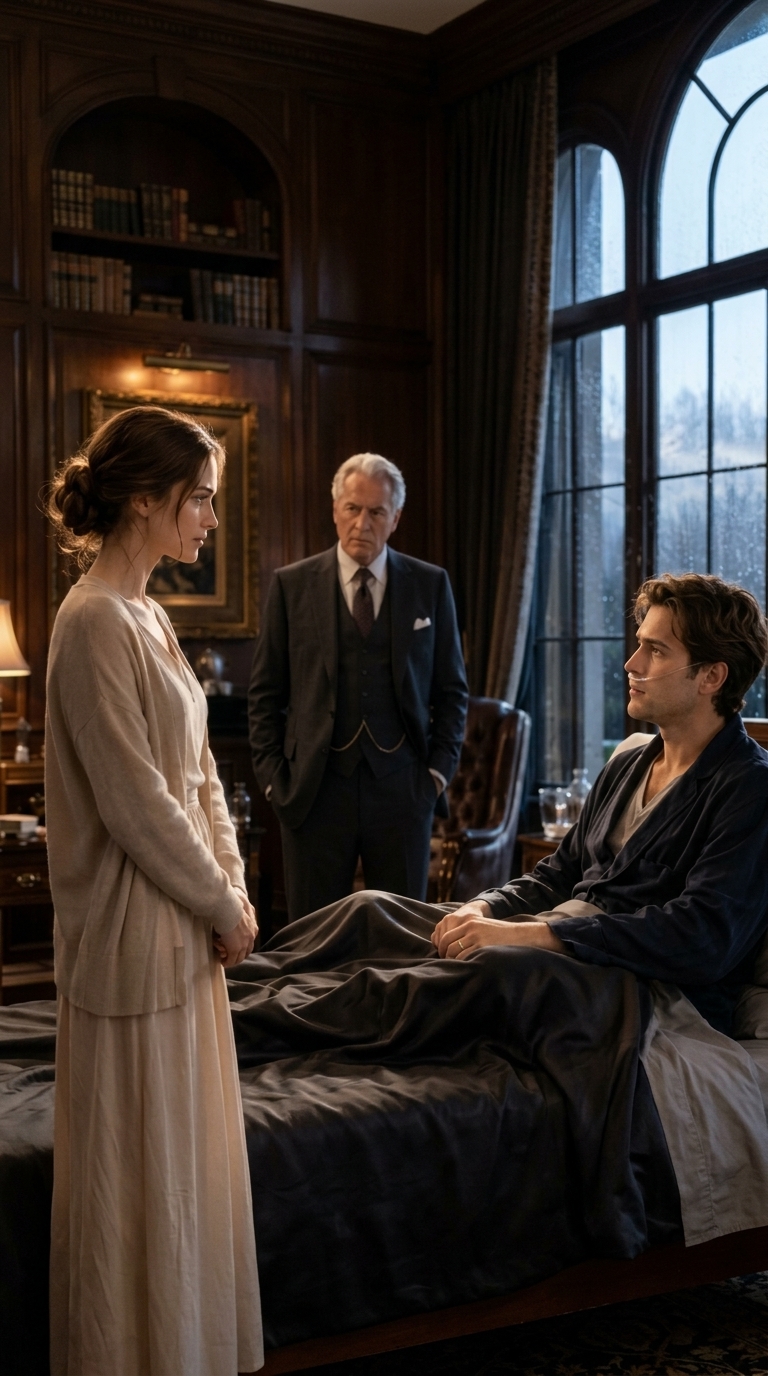
The night Lila Monroe agreed to marry the dying son of one of America’s richest men, the groom’s first act was to order security to remove her.
He didn’t raise his voice. That would have been simpler. He sat in the shadows across a bedroom far larger than Lila’s Queens apartment, one hand on the arm of a leather chair, his face partly obscured by the heavy curtains and rain-streaked windows. His tone was steady, almost indifferent, yet carried the cutting weariness of someone who had faced too many disappointments and now viewed hope as an unwelcome guest.
“Take her back downstairs,” he said. “Tell my father I’m not in the mood to be purchased tonight.”
The security guard shifted uneasily. So did the nurse by the oxygen tank. Lila stayed completely still. She remained in the doorway in her damp thrift-store coat, hair hastily pinned, shoes worn from the walk from the train station after the hired car was halted at the gate. She had anticipated many things from Caleb Whitaker, son of billionaire Victor Whitaker: frailty, resentment, quiet, perhaps even harshness. She had not expected him to meet her gaze with eyes so full of life that they made the room feel brighter.
“Security can stay,” Lila said. “But I’m not leaving just because you rehearsed that line before I arrived.”
The guard stared at her as though she had lost her senses. The nurse froze. Caleb’s fingers tightened on the chair.
After a pause, he asked, “Did my father tell you I’m difficult?”
“He said you were sick.”
“That was polite of him.”
“He also said forty-one women refused before me.”
Caleb’s mouth curved in something that wasn’t quite a smile. “Forty-two, if you count the one who fainted in the hallway before meeting me.”
“Then she doesn’t count,” Lila said. “Fainting isn’t refusal. It’s poor blood pressure.”
For the first time, his expression shifted. Not exactly softened, but disrupted — as if she had reached into the gears of his anger and halted one from turning.
“Who are you?” he asked.
“Lila Monroe.”
“I mean what are you?”
She understood. Victor Whitaker had posed it differently downstairs at a mahogany desk worth more than her yearly rent. He had recited her life from a file like a prosecutor: twenty-eight years old, no living parents, former hospice aide, part-time pharmacy technician, medical debt from her mother’s final illness, overdue rent, younger sister buried three years earlier after eighteen months of cancer. No trust fund, no connections, no name that fit the Whitaker estate on the Hudson.
Lila had allowed it because wealthy men trusted documents more than people. But Caleb wasn’t asking about the folder. He wanted to know what sort of woman would enter a dying stranger’s bedroom after being offered fifty million dollars to marry him.

“I’m someone who knows what it looks like when a person stops fighting,” she said.
The room fell quiet.
Outside, rain tapped the old glass. The nurse looked down. The guard suddenly studied the floor. Caleb stared at Lila with an intensity that made her want to turn away, but she held steady. She had learned in hospitals, funeral homes, and cramped apartments where grief had nowhere else to go that truth only worked when you let it stand fully present.
Caleb finally glanced at the nurse. “Leave us.”
“Mr. Whitaker—”
“Leave us.”
The nurse hesitated until Lila added, “I won’t touch anything. I won’t move him. I won’t open the curtains unless he asks.”
Caleb gave a quiet, humorless laugh. “She’s already better trained than most of you.”
The guard and nurse departed, and the door closed with a soft, final-sounding click.
Lila stayed on her feet.
Caleb observed her from the darkness. He was thirty-two, though sickness had etched deeper lines into his features. His dark hair fell too long at the collar. He wore a gray sweater over a white shirt, sleeves rolled up as if he had meant to do something with his hands and forgotten. Doctors had given him a few months, perhaps fewer if the lung scarring advanced, perhaps more if the new treatments succeeded. But Lila had seen enough prolonged illnesses to understand the body wasn’t the only battlefield. A person could start dying well before the organs gave out.
“You can sit,” he said eventually. “Or you can keep standing there like a defendant.”
“I’d rather sit.” She crossed the room without permission and took the chair facing him.
“You’re bold for someone applying to be a paid wife.”
“I’m not applying.”
“No?”
“I already said yes downstairs.”
His eyes sharpened. “Then you’re worse than bold.”
“Maybe.”
“Do you need the money that badly?”
“Yes,” she said, because lying would insult them both.
He looked almost disappointed by her honesty. “At least you admit it.”
“I need money badly. That doesn’t mean money is why I said yes.”
“That’s convenient.”
“It’s true.”
“Truth is usually convenient to the person saying it.”
Lila folded her hands in her lap. “And despair is usually convenient to the person using it as armor.”
For one tense second, she thought he might order her out again. Instead, he looked away first. The small movement revealed more than Victor Whitaker’s entire medical summary.
Caleb Whitaker was not empty. He was furious that he still cared.
That was something to work with.
Downstairs, Victor waited in the library beneath oil portraits of men who had built railroads, banks, shipping routes, and reputations tinged with smoke. He was sixty-six, broad-shouldered, white-haired, and alarmingly composed — the sort of man whose silence could make executives confess to things they hadn’t done. He had earned his first billion in logistics, his second in real estate, and the rest in areas Lila didn’t fully grasp except that people feared him, flattered him, and monitored markets when he sneezed.
When Lila entered, he glanced up from the fireplace. “He let you stay twenty-seven minutes.”
“You timed it?”
“I notice what matters.”
“He spoke.”
Victor closed his eyes briefly. Anyone else might have overlooked it. Lila didn’t. She had spent years spotting the tiniest signs of a family member breaking: a father’s grip on a hospital chair, a mother’s too-careful lipstick before bad news, a powerful man closing his eyes for a second because hope had caught him off guard.
“He does not speak to strangers,” Victor said.
“I don’t think he considers me a stranger. I think he considers me an insult.”
“That may be progress.”
Lila met his gaze. “Before I agree to anything formal, I have one condition.”
Victor’s face stayed neutral. “You are hardly in a position to negotiate.”
“No. But your son is.”
The fire crackled in the quiet.
Lila continued, “No one in this house treats him like he’s already dead. Not the staff. Not the doctors. Not you. If I’m supposed to stand beside him, I won’t do it inside a mausoleum.”
Victor stared at her long enough that a less desperate woman might have backed down. Lila didn’t.
At last he said, “Forty-one women asked about the payment schedule, the inheritance clause, the press strategy, and whether they would be expected to share his room. You are the first who has asked me to change the house.”
“Then the first forty-one were asking the wrong questions.”
Something shifted behind Victor’s eyes — a grief so old and controlled it had learned to wear a suit.
“The wedding will be private,” he said. “Three days from now.”
“Three days?”
“My son may not have three months.”
Lila absorbed that without flinching, because Caleb deserved at least one person who didn’t.
“Then we shouldn’t waste the days he does have,” she said.
They were married on a Thursday morning in the Whitaker estate’s glass conservatory because Caleb refused the chapel, the ballroom, and “anything involving candles, violins, or my father pretending this isn’t obscene.” The Hudson River flowed gray and cold beyond the winter trees. There were no guests beyond Victor, the family attorney, a judge from Albany, the house manager Mrs. Alvarez, and Victor’s nephew, Grant Mercer, who ran Whitaker Holdings with the smooth patience of a man waiting for someone else’s tragedy to become his opportunity.
Caleb stood beside Lila in a dark suit that made him look almost like the man he had been before illness turned every room into a waiting room. He didn’t tremble. He didn’t cough during the vows. He spoke the necessary words clearly and without warmth. Lila did the same, though when the judge declared them husband and wife, she felt the odd weight of Caleb’s gaze on her face.
“Well,” he murmured, low enough that only she heard, “there it is.”
She couldn’t tell whether he meant the marriage, the humiliation, or the final proof that his life had become something others arranged around him.
“Not all beginnings announce themselves nicely,” she murmured back.
He glanced at her. “Was that meant to comfort me?”
“No. I don’t know you well enough to comfort you.”
Against his will, his mouth twitched.
That tiny almost-smile carried Lila through the first week.
The days that followed were not romantic. They were not even pleasant. They consisted of small battles. Caleb slept poorly, ate little, refused most visitors, and kept the curtains drawn as if daylight were an accusation. Lila arrived every morning at ten with tea because coffee made his hands shake and the staff brewed it as if punishing the leaves. The first morning, he told her to leave it outside. She entered anyway after Mrs. Alvarez unlocked the door with the weary look of a woman who had decided Lila was either courageous or doomed.
“You’re invading my room,” Caleb said from the chair near the window.
“I’m delivering tea.”
“I have staff for that.”
“They make terrible tea.”
“I’m dying, not British.”
“Then you deserve better tea while you’re still alive.”
The word alive landed between them more heavily than she intended. Caleb looked at her over the cup. “You say things like that deliberately?”
“I try to. Sometimes I fail.”
He took one sip, frowned, and looked annoyed that he couldn’t criticize it. “It’s acceptable.”
“High praise from a hostage.”
“I’m not a hostage.”
“You just described your marriage that way yesterday.”
“I was being dramatic.”
“I know. I ignored it.”
By the third day, he stopped telling her to leave. By the fifth, he asked what book she carried in her coat pocket. By the seventh, when she opened the curtains three inches without permission, he said her name with such warning that the nurse in the hallway paused.
“It’s cloud cover,” Lila said. “The sun isn’t attacking.”
“That’s not the point.”
“No. The point is that the room smells like surrender.”
His face went still.
For a moment she thought she had gone too far. Then Caleb looked past her toward the gray winter light. His jaw tightened, but he didn’t tell her to close the curtains. His eyes moved over the lawn, the bare maples, the drained fountain, the rose garden reduced to thorny sticks.
“My mother planted those roses,” he said after a long while.
Lila turned carefully, as if sudden movement might break the sentence. “Did she?”
“She thought every serious house needed something ridiculous in it. My father wanted boxwood. She wanted roses that climbed everywhere and ignored instructions.” His voice altered so slightly that only someone listening for pain would have noticed. “She died when I was eleven.”
“I’m sorry.”
“People always say that.”
“Because there isn’t a better thing to say.”
He looked at her then, and for once there was no sarcasm at the edge of his mouth.
“No,” he said. “I suppose there isn’t.”
Later, when Lila carried the empty cup out, she left the curtains open. An hour later, passing the door, she saw they were still open.
It was not a miracle. Not yet. It was only three inches of light.
But three inches was not nothing.
In the second week, Caleb came downstairs for dinner without warning. Lila was already at the long table, trying not to feel absurd eating soup beneath a chandelier built for twenty-four people and three generations of critical ghosts, when she heard slow footsteps on the stairs. Every servant in the dining room went still. Victor, at the head, lowered his wineglass but didn’t turn too quickly. A father of a sick son learns not to frighten fragile victories by celebrating them too loudly.
Caleb entered in a navy sweater, hair combed, one hand briefly touching a chair as if he resented needing support but accepted the terms. He saw Lila. She saw him. Something passed between them that neither named.
“Good evening,” he said.
“Good evening.”
Victor waited several seconds. Then, with admirable restraint, he asked, “Will you have soup?”
Caleb looked at the bowl in front of Lila. “Is it terrible?”
“It’s soup,” she said. “There are limits to tragedy.”
He sat.
That dinner changed the house. Not dramatically. The Whitaker estate didn’t burst into song. But the staff moved differently, less like mourners, more like people working where tomorrow might exist. Mrs. Alvarez placed fresh flowers in the hall. Victor began taking breakfast in the morning room instead of alone in his office. Caleb came down again two nights later, then the next. Sometimes he spoke. Sometimes he didn’t. But his silence at the table was different from the silence in his bedroom. It was shared, and that made it less dangerous.
One evening, Lila noticed his fingers tapping a pattern against the tablecloth during dessert.
“You play piano,” she said.
His hand stopped. “I used to.”
“Used to means you still know how.”
“Used to means I stopped.”
“Stopping isn’t the same as forgetting.”
He looked at her with irritation that had grown almost familiar. “Do you always turn ordinary sentences into arguments?”
“Only when they’re wrong.”
Victor coughed once into his napkin. It sounded suspiciously like laughter.
The piano sat in the smaller music room under a dust cover that made it resemble a body prepared for burial. Lila found it the next afternoon while wandering because her room felt too large and the house too quiet. She lifted the cover, touched one key, and winced at the brighter-than-expected note.
“You don’t play.”
She turned. Caleb stood in the doorway, leaning lightly against the frame.
“No,” she said. “But you do.”
“That is becoming an old argument.”
“Most true things are.”
He stayed in the doorway so long she thought he would leave. Then he crossed the room, sat on the bench, and stared at the keys as if they had betrayed him by waiting. Lila moved aside to give him space, but he said, “Stay.”
The word was quiet. Not tender. Not yet. But it was the first thing he had asked of her that wasn’t a challenge.
She stayed.
When he began to play, the first notes were unsteady. His left hand faltered. He swore softly, stopped, began again, and then the music found him. It didn’t arrive all at once. It returned like feeling to a numb limb, painful and astonishing. Lila stood near the window, listening as the man who had treated himself like a fading photograph suddenly became vivid. The piece was imperfect. He missed a transition and closed his eyes in frustration.
“That was wrong,” he said.
“I didn’t notice.”
“I did.”
“Then play it again.”
He looked over his shoulder. “You make that sound simple.”
“It is simple. Not easy.”
He stared at her a second longer, then turned back to the keys.
He played the transition seventeen times before he got it right. Lila counted silently, not because the number mattered, but because effort deserved witnesses. On the eighteenth try, his hands moved cleanly through the passage, and though he said nothing, his shoulders changed. The room changed with him.
“You’re smiling,” he said without turning.
“I’m not.”
“The lid reflects the window. You are.”
“Then the piano is a gossip.”
“Why are you smiling?”
“Because you got it right.”
“That’s not worth smiling over.”
“It is to someone who knew you would.”
His hands remained on the keys. In the polished black reflection, she saw his eyes close for one second, just one, as if a compliment had reached some locked place inside him and he did not yet trust it there.
After that, the music room became neutral territory. He played in the late afternoons. She brought tea, sometimes mended clothes, sometimes read, sometimes said nothing for an hour because silence could be good when chosen instead of imposed. Caleb began asking questions at unexpected moments.
“Do you miss the city?”
“Parts of it.”
“Which parts?”
“The corner deli near my old apartment. The owner knew I liked coffee too strong and bagels almost burned.”
“That sounds awful.”
“It was perfect.”
Another day he asked, “If you could go anywhere, where would you go?”
Lila thought of all the places she had never had enough money to properly imagine. “Maine,” she said finally. “The coast. My sister wanted to see it. We kept saying we would go when she got better.”
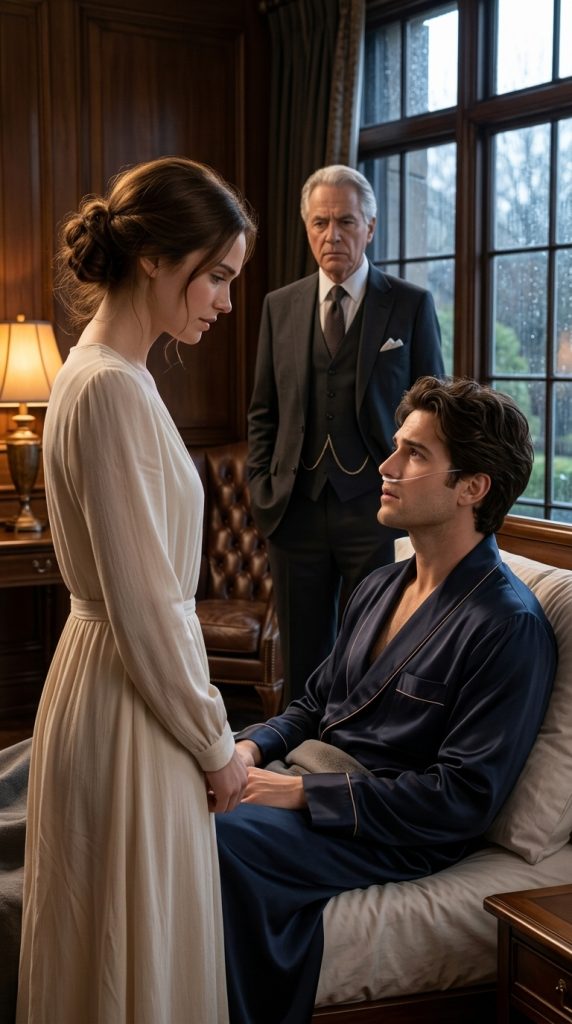
Caleb’s hands paused above the keys. “Did she?”
“No.”
The room held that answer gently, which surprised her.
After a while, he said, “When I’m well enough, I’ll take you.”
She did not correct the when. She carried it with her for the rest of the day like a match protected from wind.
By March, Caleb walked the garden paths with a cane and a coat he never buttoned properly. Dr. Sloane, the pulmonologist who visited every Tuesday from Manhattan, began using phrases like unexpected improvement and cautiously optimistic, though always with the expression doctors wear when they fear being sued by hope. Victor listened to every report with iron control, but Lila once found him alone in the butler’s pantry, one hand braced against the counter, breathing as if he had run a mile.
“Mr. Whitaker?” she said.
He straightened immediately. “I’m fine.”
“That is usually what people say when they aren’t.”
His mouth tightened. For a second, she saw Caleb in him so clearly it hurt.
“My son came downstairs this morning before breakfast,” Victor said.
“I know.”
“He asked me about a company matter. Something tedious about shipping contracts. I nearly wept over freight distribution.”
“You didn’t.”
“No.” Victor looked toward the window, where Caleb was visible in the distance by the rose garden. “But I nearly did.”
Lila did not know then that Victor had been hiding his own diagnosis for six months. She only knew that his relief carried a shadow, and that rich men were often poorest where they most needed support.
The first real fracture came from a whisper.
Lila overheard the housemaids in the back corridor, speaking in the half-hushed tone of people who want to be overheard by everyone except the person they are discussing.
“Forty-one women before her,” one said.
“And she was the one who took the deal.”
“Fifty million, they say.”
“Who wouldn’t marry a dying man for that?”
Lila stopped on the stairs. Her first instinct was not anger, but dread. She had known the truth would surface eventually. Money left fingerprints. Contracts had witnesses. Servants spoke. Lawyers drank. Men like Grant Mercer enjoyed making poison sound like information.
Three days later, Caleb found out.
She knew before he said anything because the curtains were closed again.
The door to his room was locked. The tea tray she had left that morning sat untouched on the floor. Inside, there was no music, no footsteps, no dry remark through the wood.
“Caleb,” she said.
Silence.
“I know you’re awake.”
More silence.
“If you don’t open the door, Mrs. Alvarez has keys.”
At last, his voice came, low and flat. “Go away.”
“No.”
“Lila.”
The way he said her name hurt more than anger would have.
The lock turned. When she entered, the room smelled of old darkness. Caleb stood near the window with his back to her, hands in his pockets, body so rigid it looked assembled rather than alive.
“What did you hear?” she asked.
“Enough.”
“That means not enough.”
He turned. His face was controlled, but his eyes were not. “My father offered fifty million dollars to any woman willing to marry me before I died. Forty-one refused. You accepted. Is any of that untrue?”
“No.”
The word struck him. She saw it.
He laughed once, sharply. “At least we’re being honest.”
“I told you I needed money.”
“You told me money wasn’t why you said yes.”
“It wasn’t.”
“What a beautiful distinction.” His voice remained calm, and that made it worse. “Do you know what I let myself believe? That something here was real. That when you sat beside me at the piano, when you stayed in the room, when you looked at me like I was not already a ghost, it meant something.”
“It did.”
“You were paid to make it mean something.”
Lila stepped toward him. “No. I was offered money to sign a contract. Everything after that was mine.”
His jaw tightened. “And how am I supposed to know the difference?”
“Because you know me.”
“I know what you show me.”
“That’s all anyone knows.”
“Don’t turn this into philosophy.” His voice cracked on the last word, barely, but enough. “I had begun to want things again. Do you understand what that costs a person in my position? Wanting is not harmless when your body is a traitor. Hope is not harmless. You made me hope, and now I don’t know whether I was brave or simply stupid.”
Lila felt the blow because it was not accusation alone. It was confession.
“I never wanted to hurt you,” she said.
“People rarely do. They just want what they want, and the hurt becomes a side effect.” He looked away. “Please leave.”
The please nearly undid her.
She stood there a moment longer, close enough to see the tremor in his hand before he shoved it deeper into his pocket.
“When you’re ready to hear the whole truth,” she said, “I’ll tell you. Until then, I’m not disappearing.”
“You should.”
“I know.”
Then she left, because staying after someone asks you to go is not love. But disappearing because someone expects abandonment is not love either.
For three days, Caleb did not open the door.
Lila brought tea at ten, replaced it when it went cold, and said one thing through the wood each morning. Not speeches. Not defenses. Only proof that she was still there.
On the first day: “The roses are budding.”
On the second: “Dr. Sloane is coming tomorrow. I told him not to use the word miracle unless he can define it.”
On the third day, she stood with her hand flat against the door, remembering another door in another apartment, another silence. Her sister Nora had been twenty-four when the cancer spread to her bones. For months, she had fought with jokes, playlists, lipstick, and stubborn demands for real coffee even when she could barely swallow. Then one week something in her went quiet. Lila had mistaken it for peace. She had given her space because nurses said patients needed dignity, because friends said grief took different shapes, because Lila was exhausted and terrified and too young to understand that silence can be a room filling with water.
Nora died still breathing but already gone.
Lila had never forgiven herself for the days she stood outside her sister’s door and did nothing.
Now, in the Whitaker hallway, with Caleb silent on the other side, she said what she had not planned to say.
“I’ve stood outside a door like this before,” she whispered. “I thought leaving was respect. I thought silence meant the person inside needed time. But sometimes silence means the person inside is drowning and too tired to call it drowning.”
She swallowed. The hallway blurred.
“My sister’s name was Nora. She stopped wanting to live before her body stopped living. I watched it happen, and I didn’t know how to pull her back. So when your father asked why I came here, I told him the truth. I know what it looks like when someone stops fighting.”
There was no sound from inside the room.
“I didn’t come because I thought I could save you,” she said. “I came because I couldn’t bear the thought of someone else being left alone in that place. You can hate me. You can doubt me. You can keep the door locked. But I’m not walking away because doubt is easier for you than trust.”
Her hand slid from the wood.
“I’ll be in the garden,” she said.
Then she went downstairs, through the kitchen, and out into the cold March air before she cried.
The next morning, Caleb came to the garden.
Lila heard the back door open but did not turn. She was kneeling by the rose bed, cutting away dead wood under Mrs. Alvarez’s instructions, pretending the task required all her attention.
Footsteps crossed the wet grass. Slow. Uneven. Determined.
“They really are budding,” Caleb said.
“They are.”
Silence settled between them, but not the old silence. This one had weather in it.
“I said things meant to hurt you,” he said.
“Yes.”
“I believed some of them when I said them. That doesn’t excuse them.”
“No.”
He exhaled. “You make apology very unrewarding.”
“You’re not apologizing for a reward.”
A faint smile touched his mouth and vanished. “No. I’m apologizing because I was wrong. Not about the money. About believing money explained you.”
Lila kept her eyes on the roses because looking at him might make her too soft too quickly.
He continued, “Your sister. Nora.”
She closed her fingers around the pruning shears.
“I’m sorry,” he said.
The words were ordinary. They were also exactly enough.
“Thank you.”
“I wish you had told me.”
“I didn’t want my grief to become evidence in my defense.”
He absorbed that. “I understand.”
“I know.”
He stepped closer, stopping at the edge of the bed. “I don’t trust easily.”
“That’s obvious.”
“I may do this badly.”
“You already have.”
This time the smile stayed. Small, tired, real.
“Will you still sit with me at the piano?” he asked.
Lila looked up then. His face was thinner than it should have been, his eyes shadowed by three hard days, but something in him had opened again, not fully, not safely, but enough.
“Yes,” she said. “But you’re starting with the transition you kept missing.”
“That’s cruel.”
“That’s observation.”
He held out a hand to help her stand. She took it. His fingers closed around hers, not accidentally this time, and neither of them pretended not to notice.
Spring moved through the estate like a rumor becoming fact. The roses thickened with leaves. Caleb’s walks lengthened. Dr. Sloane ordered new scans, frowned at them, ordered more, and finally admitted that the experimental treatment he had previously called “unlikely to reverse the decline” was doing something close to that. Lila learned not to use the word recovery in front of Caleb until he used it first.
He did so in April, on the Maine coast.
They had gone because he remembered his promise. Victor objected, then arranged the safest possible version of the trip: private rail car, medical equipment, nurse nearby, rented house near Cape Elizabeth, emergency plan written in language so detailed it could have survived a congressional hearing. Caleb complained about all of it until Lila asked whether he would rather stay home. He stopped complaining.
The first afternoon, they stood on the rocks above the Atlantic, wind tearing at Lila’s coat, gulls wheeling above the gray water. Caleb leaned on his cane, breathing carefully, but his face had changed. The sky was wide in a way the Hudson Valley sky was not. The ocean made every human fear seem briefly smaller, not because it solved anything, but because it refused to flatter despair with importance.
“Nora wanted to see this,” Lila said.
Caleb looked at the water. “I’m glad you brought her.”
She turned to him.
He did not explain. He did not need to.
For several days, they walked the coast. Sometimes they spoke about ordinary things: bad hotel art, lobster rolls, Caleb’s hatred of motivational quotes, Lila’s belief that every rich house had at least one chair designed to punish the spine. Sometimes they spoke about hard things because the sea air left less room for avoidance.
“You never ask how much time I have left,” Caleb said one afternoon.
“Would the answer change what I do today?”
“It might change what you expect.”
“I try not to build my life around medical guesses.”
“That sounds like something a person says when she is afraid of the answer.”
“It is,” she admitted. “But it’s also something a person says when she has learned that fear can become a full-time job if you let it.”
He looked at her for a long time. “I had given up before you came.”
“I know.”
“I was angry when people acted like it. But I had.”
“I know.”
“Doesn’t that make you angry?”
“It makes me sad. Anger would be easier.”
He reached for her hand then, deliberately, without the startled hesitation of the garden. His fingers laced through hers. The gesture was simple and enormous.
“I am trying not to give up now,” he said.
Lila looked at their joined hands. “I know that, too.”
On their last night in Maine, Caleb found the old upright piano in the rented house’s parlor. It was out of tune, with two stubborn keys and a pedal that complained like an old man. He pretended not to care for an entire day, then sat down after dinner and played for two hours while rain moved in from the sea. The imperfections made the music more beautiful. Lila sat on the floor near the fireplace, knees pulled to her chest, and listened as if the sound were building a bridge plank by plank.
When he finished, he did not lift his hands from the keys.
“Lila,” he said.
“Yes.”
“When we go back, I don’t want to return to the way we were.”
She waited.
“I don’t mean the contract. I don’t mean appearances. I mean us.” He turned on the bench, face uncertain but steady. “I want less distance. More honesty. More of this.”
The fire shifted. Rain tapped the windows. The old house held its breath.
“I want that, too,” she said.
The smile that came over his face was not dazzling. It was better than dazzling. It was hard-won.
When they returned to New York, the world tried to intrude.
Grant Mercer had been patient while Caleb remained ill. A dying heir was manageable. A recovering heir was a threat. Within two weeks of Caleb attending his first Whitaker Holdings strategy meeting by video, rumors appeared in financial columns: questions about Lila’s contract, speculation about Caleb’s competence, anonymous sources claiming Victor Whitaker had “purchased a caretaker bride” to stabilize family optics before transferring control.
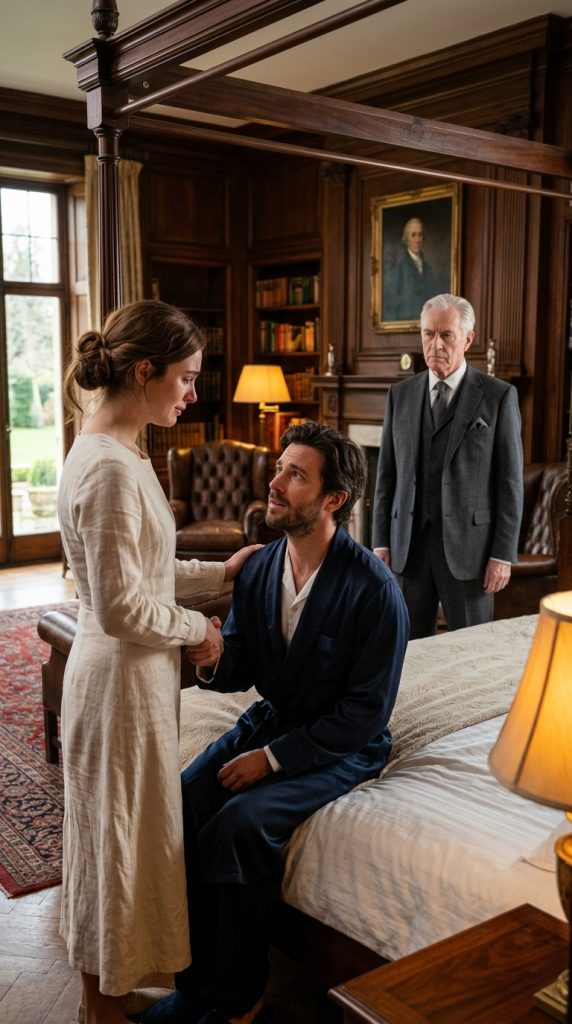
Victor wanted to crush the rumors with lawyers. Caleb surprised everyone by saying no.
“I hid for three years,” he said in the library, seated across from his father, Lila beside him. “I won’t let Grant make my wife sound like a transaction because he’s afraid I can read a balance sheet again.”
Victor’s face hardened. “Grant has been useful.”
“So is a knife until it’s pointed at your ribs.”
Lila looked between them. “You think he leaked it?”
Caleb said, “I think Grant has spent three years being kind to my father in public and measuring my office for curtains in private.”
Victor did not deny it quickly enough.
The confrontation happened at the annual Whitaker Foundation gala in Manhattan, an event Lila had dreaded from the moment Mrs. Alvarez told her that “simple black dress” did not mean what she thought it meant among billionaires. The ballroom glittered with chandeliers, cameras, donors, politicians, and people who smiled at Lila with the bright curiosity reserved for scandals wearing diamonds.
Grant chose his moment well. He approached with two board members and a reporter close enough to overhear.
“Caleb,” he said warmly, “you look stronger than any of us dared hope. Marriage agrees with you.”
Caleb’s hand tightened once around Lila’s.
Grant turned to her. “And Mrs. Whitaker, you must be relieved. Quite a return on a courageous decision.”
The insult was wrapped so elegantly that several people smiled before understanding it.
Lila felt Caleb move beside her, but she spoke first.
“You’re right,” she said.
Grant blinked.
“It was a courageous decision,” Lila continued, her voice calm enough to draw the attention of those nearby. “Not because of the money. Because your family had already mistaken Caleb’s illness for his identity. Someone needed courage enough to disagree.”
The small circle went silent.
Grant’s smile thinned. “How moving.”
Caleb stepped forward. He no longer leaned on a cane. He did not look fully well, not in the careless way healthy people look well, but he looked present. That was more powerful.
“My wife did not marry a dead man,” he said. “She married a man you were counting on staying dead.”
The words spread outward through the ballroom like a glass shattering.
Victor, who had approached quietly, stopped behind them. His face was unreadable, but Lila saw pride break through the control like sunlight through storm clouds.
Grant’s expression changed for less than a second. It was enough.
The next morning, Victor removed Grant from all executive authority pending review. By the end of the week, lawyers discovered what Victor had not wanted to see: delayed medical correspondence, suppressed consultant recommendations, strategic leaks to the press, not enough to have caused Caleb’s illness, but enough to prove Grant had benefited from keeping him isolated, doubtful, and publicly fragile.
The revelation did not cure Caleb. It did something almost as important. It gave shape to a shadow he had been blaming only on himself.
“I should have known,” Victor said one night, after the lawyers left.
Caleb sat across from him in the library. “You were trying to keep me alive.”
“I was trying to control everything because I could not control that.”
“That sounds like being a father.”
Victor looked older than Lila had ever seen him. “It sounds like failing as one.”
“No,” Caleb said quietly. “It sounds like loving badly under pressure.”
Victor’s eyes shone, though no tears fell. “Your mother would have said that better.”
“She would have said it with more insults.”
A laugh escaped Victor, broken and grateful. Lila turned toward the window to give them the mercy of not being watched.
Summer came hot and green. The roses bloomed over the garden walls in reckless color. Caleb improved enough that Dr. Sloane began discussing long-term management instead of decline. Victor, however, grew thinner.
The truth arrived not as an announcement but as a collapse.
He fainted in the library on a humid August morning while reaching for a file. The diagnosis, hidden in private medical records and elite discretion, came into the light: pancreatic cancer, advanced, treated quietly for months, then no longer treatable at all. Caleb received the news with a stillness Lila recognized and feared. But he did not run from the room. He did not lock his door. He sat beside his father’s hospital bed in the east suite and read aloud from business journals Victor pretended were interesting.
One afternoon, Lila paused in the hallway outside Victor’s room when she heard her name.
“She never came for the money,” Victor said, voice weak but steady.
“I know,” Caleb answered.
“I knew before you did.”
A pause.
“She said one sentence in my office. I asked why she was there, and she said she knew what it looked like when someone stopped fighting. There are sentences money cannot teach a person to say.”
Caleb said nothing.
Victor continued, “I offered fifty million because I was a coward. Because I thought if I made the price high enough, someone would stay no matter how hard it became. But she asked for the one thing I had forgotten how to give you.”
“What?”
“A house that believed you were alive.”
Lila closed her eyes.
Victor’s voice softened. “I was not buying you a wife, son. I was buying time. I wanted to see you smile once more before I died. I wanted proof that the boy who played piano in this house had not vanished completely.”
Caleb’s reply came rough. “You should have told me you were sick.”
“Yes,” Victor said. “But then you would have spent your strength saving me instead of yourself.”
“You don’t get to decide that.”
“No. Parents do many arrogant things and call them love.”
Lila moved away before she heard more. Some truths belonged first to the people brave enough to say them.
Victor died in September, on a morning of soft rain.
Caleb sat beside him until the end, one hand around his father’s, Lila close enough to be reached but not so close that grief had no room. When Victor’s breathing changed, Caleb leaned forward and whispered something Lila never asked him to repeat. Afterward, he did not collapse. He did not become the man in the dark room again. He wept, and the weeping frightened him because it was alive, but he allowed it.
That evening, when the house had gone quiet and the rain still moved against the windows, Caleb found Lila in the music room.
“He wasn’t trying to buy me a wife,” he said.
“No.”
“He was trying to buy enough time to see me become someone who wanted to live.”
“Yes.”
Caleb sat beside her on the piano bench. Their shoulders touched. After a while, he said, “He succeeded.”
Lila put her hand over his. He turned it and laced their fingers together.
“They say nothing lasts forever,” she said softly. “But I think love keeps working after death. Not loudly. Not magically. Just in the things it changed while it was here.”
Caleb looked at the piano, then at the rain-dark window, then at her.
“You changed me,” he said.
“No,” she answered. “I stayed long enough for you to remember yourself.”
He kissed her then, not with desperation, but with the tenderness of a man who had learned that love was not a rescue. It was presence. It was witness. It was the person who did not mistake your worst season for your whole life.
Six years later, the Whitaker estate no longer felt like a museum for grief.
The windows were open most mornings. The rose garden had become unreasonable, climbing fences, swallowing trellises, and ignoring every professional gardener Victor would have hired to restrain it. The music room was never dusty now. Caleb played every day, sometimes alone, often with his daughter, Nora Grace Whitaker, who was five years old and had inherited her father’s eyes, her mother’s stubbornness, and her grandfather’s habit of asking questions as if the world were legally required to answer.
“Why do roses come back?” Nora Grace asked one June morning, crouched in front of a bloom nearly as large as her face.
Lila stood beside her, holding two-year-old Owen on her hip. “Because they’re braver than they look.”
Nora considered this seriously. “Is Daddy brave?”
“Very.”
“He says being brave is doing the transition again after you mess it up.”
“That sounds like your father.”
From the house, piano notes drifted through the open windows. Caleb was playing the same piece he had once stumbled through in the dark, the difficult transition smooth now, though Lila still heard in it every failed attempt, every restart, every quiet refusal to surrender. He appeared at the back steps a moment later, sleeves rolled, hair touched with early silver at the temples, Owen immediately reaching for him with the disloyal enthusiasm of a child who preferred whoever was not currently holding him.
“Traitor,” Lila told her son, handing him over.
Owen settled against Caleb’s shoulder with deep satisfaction.
Nora stood and announced, “We are studying courage.”
“Important work,” Caleb said gravely.
“Mom says roses have it. You have it too.”
Caleb looked at Lila, and the expression on his face was the one she had first seen reflected in the piano lid years earlier, when he had closed his eyes because happiness had startled him. Only now it was steadier. It belonged to a man who knew what he had and protected it.
“I learned from your mother,” he told Nora.
Nora nodded as if this confirmed a theory. “She is very bossy.”
“She is,” Caleb said. “It saved my life.”
Lila laughed, and he leaned over to kiss the side of her head without ceremony, the way he had done so often that tenderness had become part of the household weather.
In the library, Victor’s old chair remained by the window. His letters were kept in the desk drawer, along with a copy of the original marriage contract Caleb refused to destroy. Not because money had mattered in the end, but because truth did. The contract was proof of the ugly beginning everyone misunderstood. Beside it lay another document, created one year after Victor’s death: the Nora Monroe Foundation for hospice families, funded with the fifty million dollars Lila had never touched for herself.
“Your father would have liked that,” Lila had told Caleb when they signed the papers.
“He would have pretended it was inefficient,” Caleb said. “Then donated more.”
The foundation became the human answer to a cruel bargain. It paid rent for families sitting beside hospital beds. It covered counseling for siblings. It trained volunteers to recognize the kind of silence that had once taken Nora Monroe away before death did. Every year, Lila spoke at the fundraiser, and every year Caleb stood in the back of the room, listening with the same fierce attention he had given her on the first night, when she told him dead men did not argue about books.
The miracle, Dr. Sloane liked to say, had been medical, emotional, statistical, and impossible to reduce to one cause. Caleb let him say it because doctors needed language the way musicians needed scales. But in his private heart, he knew where the miracle began.
It began in a dark bedroom during a rainstorm, when a woman with tired eyes and scuffed shoes refused to leave just because despair had ordered her out.
It began with three inches of light.
It began with bad tea made properly, a piano transition played eighteen times, roses that looked dead until spring proved otherwise, and a locked door that did not get the final word.
Most of all, it began when Lila Monroe, offered a fortune to stand beside a dying man, asked instead for a house that believed he was alive.
And every morning after that, in the music, in the roses, in the children’s laughter moving through rooms that had once held only silence, Caleb Whitaker kept proving she had been right.
THE END
