

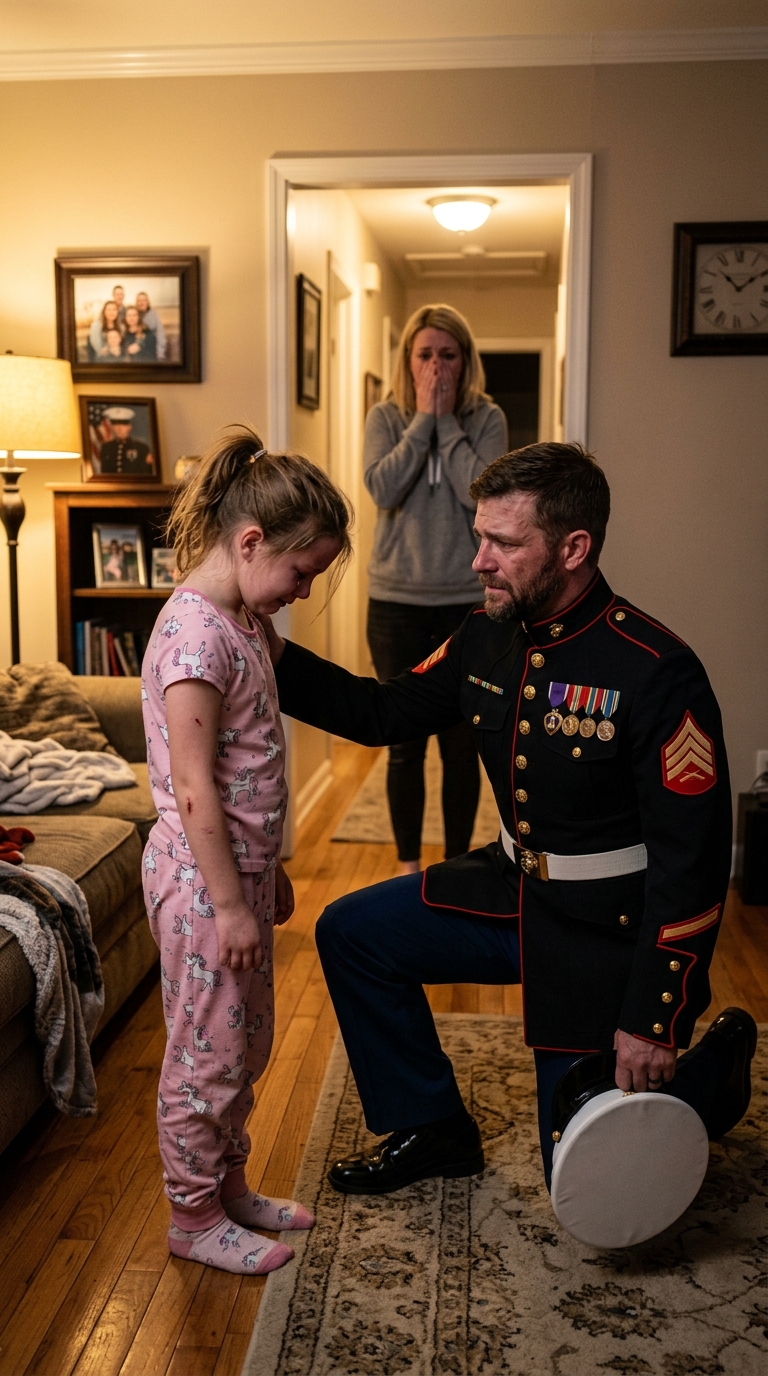
I had only just returned from a work trip when my eight-year-old daughter quietly revealed the secret her mother thought would stay buried.
I’d been home less than fifteen minutes.
My suitcase still rested by the front door. My jacket lay across the couch. I had barely walked inside before I realized something felt terribly wrong.
No little feet running toward me.
No laughter.
No hug.
Only silence.
Then I heard her voice from the bedroom.
Soft. Weak. Barely audible.
“Dad… please don’t be mad,” she said. “Mom said if I told you, things would get worse. But my back hurts… and I can’t sleep.”
I froze in the hallway.
One hand still gripping my suitcase handle. My heart hammering so hard it felt like it was forcing the air from my lungs.
This wasn’t a tantrum.
This wasn’t a child exaggerating.
This was fear.
I turned toward the bedroom and saw my daughter, Lily, standing half-hidden behind the door, like she expected someone to pull her away at any moment. Her shoulders were tense. Her eyes stayed fixed on the floor. She looked far too small for the fear she was carrying.
“Lily,” I said carefully, trying to keep my voice calm. “Dad’s here. Come here, sweetheart.”
She didn’t move.
I slowly lowered my suitcase and walked toward her carefully, as though one wrong move might make her disappear. When I knelt in front of her, she flinched—and a cold wave rushed through my body.
“Where does it hurt?” I asked.
Her tiny hands twisted the hem of her pajama shirt until her knuckles turned pale.
“My back,” she whispered. “It hurts all the time. Mom said it was an accident. She said not to tell you. She said you’d get mad. She said bad things would happen.”
Something inside me shattered.
Without thinking, I reached toward her—but the moment my hand touched her shoulder, she gasped and jerked away.
“Please… don’t,” she whispered. “It hurts.”
I immediately pulled my hand back.
Panic climbed into my throat, but I forced myself to stay calm.
“Tell me what happened.”
She glanced nervously toward the hallway, like she thought someone might be listening.
Then, after a long silence, she spoke the words no parent is ever ready to hear:
“Mom got mad. I spilled juice. She said I did it on purpose. She pushed me… and my back hit the door handle. I couldn’t breathe. I thought… I was going to disappear.”
For one second, I stopped breathing too.
Not because I didn’t understand.
Because I understood perfectly.
Suddenly, everything in the house felt wrong.
The walls.
The silence.
The air itself.
I had walked in expecting a normal evening.
Instead, I found my daughter whispering through pain, afraid of her own mother, begging me not to make things worse simply by learning the truth.
And in that moment, I understood this was only the beginning.
Because when a child says something like that… the truth never stays hidden forever.
I stayed on my knees.
I kept my voice gentle.
“You did the right thing telling me,” I said.
She still couldn’t meet my eyes.
“How long has it hurt?”
“Since yesterday.”
“Did you tell your mom it still hurt?”
A tiny nod.
“What did she say?”
Lily swallowed hard. “She said I was being dramatic.”
Those words hurt more than anything else.
“Can you show me your back?” I asked softly.
She hesitated… then slowly turned around and lifted her shirt…
PART 2
The second Lily lifted her pajama shirt, the world inside my chest stopped.
A dark purple bruise spread across the lower part of her back like spilled ink against her pale skin. The shape was unmistakable. Round. Deep. Violent.
A door handle.
My stomach twisted so hard I thought I might be sick right there on the bedroom floor.
“Oh my God…”
Lily quickly lowered her shirt again, almost embarrassed by the bruise.
“Mom said it looked worse than it was,” she whispered. “She said I scared her when I cried.”
My hands began shaking.
Not from confusion.
From rage.
The kind of rage that narrows your vision until all you can hear is your own heartbeat.
But Lily was staring at me with frightened little eyes, waiting to see if I would explode too.
So I swallowed it.
Every bit of it.
I forced my voice to stay gentle.
“Sweetheart, I need you to put on your shoes, okay?”
Her face instantly turned pale.
“Are you mad at Mom?”
“No,” I lied softly. “I just want to make sure you’re okay.”
She hesitated.
Then she asked the question that completely broke me.
“Am I in trouble?”
I nearly fell apart right there.
I carefully pulled her into my arms, avoiding her back, holding her like she might vanish if I loosened my grip.
“No, baby,” I whispered against her hair. “You are never in trouble for being hurt.”
She started crying silently against my shoulder.
Not loudly.
Not dramatically.
The kind of crying children do when they’ve been frightened for too long.
Ten minutes later, we were driving toward the emergency clinic across town.
My wife still hadn’t come home.
I called her twice.
No answer.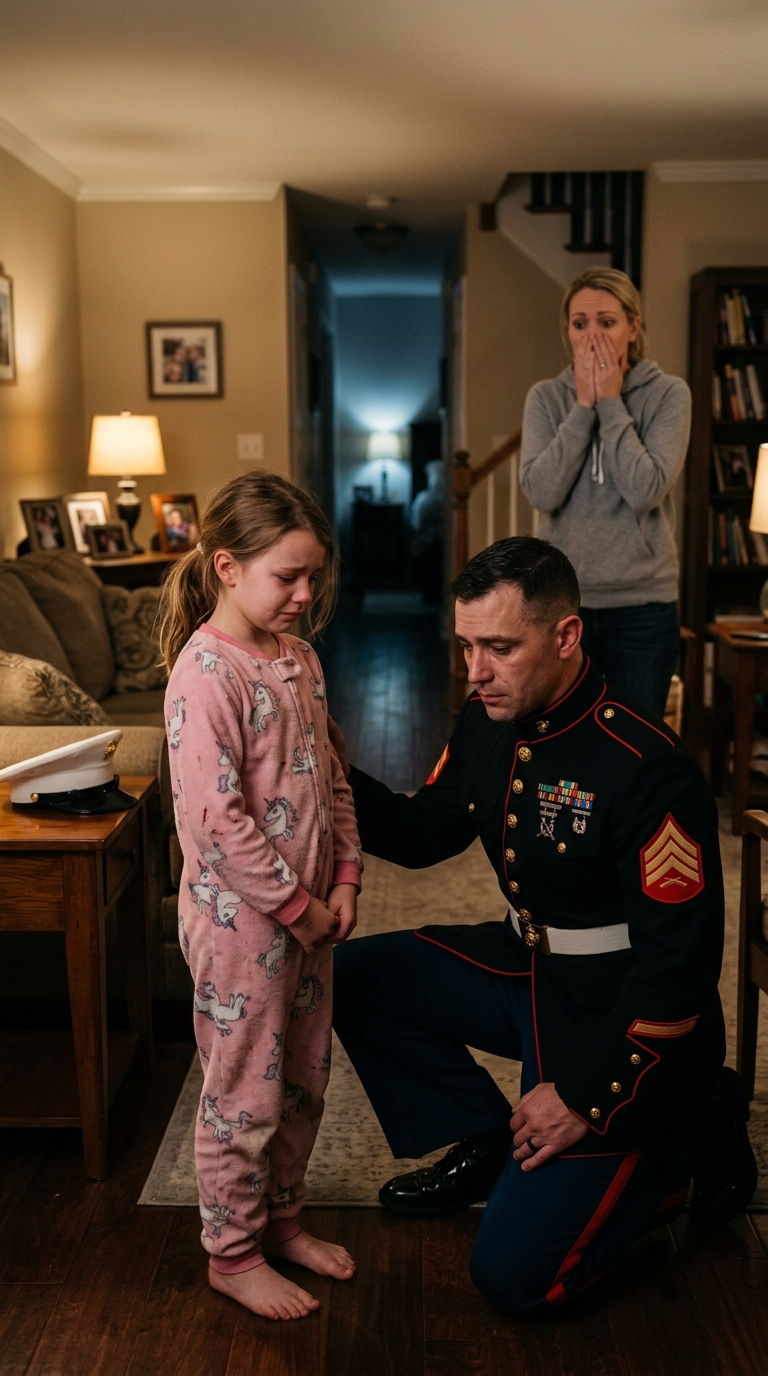
Rain slammed against the windshield while Lily sat curled in the passenger seat clutching her stuffed rabbit against her chest.
Halfway there, she spoke again.
Very quietly.
“Dad?”
“Yes?”
“She didn’t mean to push me that hard.”
Those words hurt more than the bruise itself.
Because eight-year-olds should never already know how to protect the people hurting them.
At the clinic, the nurse took one look at Lily’s back and immediately called the doctor.
Then another nurse quietly asked me to step into the hallway. Her expression had changed.
Professional.
Careful.
Concerned.
“Sir,” she said gently, “we need to ask a few questions about how this injury happened.”
And that was the moment I realized this nightmare was about to become terrifyingly real.
Because through the half-open exam room door, I suddenly heard Lily speaking softly to someone inside.
Fearfully.
“Please don’t tell my mom I told the truth…”
The doctor ordered X-rays immediately.
While we waited, Lily sat beside me in the hospital bed holding my hand with both of hers like she was afraid I might disappear too.
An hour later, the doctor returned with a serious expression.
“There’s no spinal damage,” he said carefully. “But the bruising is severe. We’ve contacted child protective services, and a social worker is on the way.”
Lily’s face went white.
“Am I going home?” she whispered.
I grabbed her hand tighter.
“You’re staying with me.”
Tears filled her eyes instantly.
For the first time that night, some of the fear inside her seemed to loosen.
Then my phone rang.
My wife.
I stared at the screen for several seconds before answering.
“Where are you?” she snapped immediately. “I came home and both of you were gone.”
I looked through the glass window at Lily sitting on the hospital bed.
“At the emergency clinic.”
Silence.
Then her voice changed.
“What did she tell you?”
Not “Is she okay?”
Not “What happened?”
Only that.
“What exactly should she have told me?” I asked quietly.
Another silence.
Longer this time.
“She exaggerates things when she’s emotional,” my wife said finally. “You know how dramatic she can be.”
I closed my eyes.
Because suddenly I understood something horrifying.
This was not the first time she had convinced herself hurting our daughter was acceptable.
“She’s eight,” I whispered. “She thought she was going to disappear.”
My wife inhaled sharply on the other end.
Then, for the first time since I had known her, I heard fear in her voice.
“Please don’t do this.”
But it was already done.
The social worker arrived twenty minutes later.
Then the police.
Lily answered their questions quietly while sitting beside me wrapped in a hospital blanket. She never once tried to lie. But even then, she kept trying to protect her mother.
“She was just mad,” Lily whispered. “I made a mess.”
The officer looked at me with tired eyes.
Children always blamed themselves first.
By sunrise, temporary emergency custody papers had been signed.
Lily fell asleep against my chest in the hospital chair while rain continued tapping softly against the windows.
And sometime around six in the morning, after the longest night of my life, she opened her eyes halfway and whispered something so quietly I almost missed it.
“Dad?”
“I’m here.”
“You stayed.”
My throat tightened so hard it hurt.
I kissed the top of her head gently.
“Always,” I whispered.
Months later, Lily and I moved into a smaller apartment across town.
The bruises on her back faded long before the fear did.
But slowly, little things started returning.
Laughter.
Music.
Drawings taped to the refrigerator.
Sometimes she still woke from nightmares and asked if I was angry.
Every single time, I gave her the same answer.
“No, sweetheart. You are safe now.”
And one night, nearly a year later, as I tucked her into bed, Lily wrapped her arms around my neck and whispered:
“I don’t feel like disappearing anymore.”
That was the moment I finally allowed myself to cry.
Because after everything that happened, my daughter was beginning to believe something every child deserves to know.
That home should never be the place you fear most.
THE END
