


Nathaniel Carter pushed open the heavy iron gate to his backyard on a crisp evening in Aspen, Colorado, the chill of early autumn already settling into the mountain air. The sun had dipped behind the jagged peaks, painting the sky in soft hues of lavender and gold. He loosened his silk tie with one hand, briefcase in the other, steeling himself for the familiar quiet that had become the soundtrack of his life. No laughter. No playful shrieks. No footsteps pattering across the marble floors of the sprawling mansion he had built as a promise of the future.
Instead, on a faded blue blanket spread carefully over the manicured grass, lay his three-year-old triplets—Evelyn, Harper, and Sophie. They were positioned exactly as they had been every afternoon for as long as he could remember: still, quiet, their small bodies barely stirring. But tonight, something was profoundly different.
Their eyes, once distant and vacant, were alive. They tracked a delicate white butterfly drifting lazily above them on the breeze. Tiny hands—fingers that had never reached, never grasped—stretched upward with trembling effort. Nathaniel froze mid-step, his breath catching sharply in his throat. The briefcase slipped from his fingers, landing softly on the dew-kissed lawn.
Three years of profound stillness did not simply vanish. That was what every specialist in Denver, New York, and Switzerland had told him. No neurological damage. No spinal issues. Just a deep, unspoken trauma that had wrapped itself around his daughters like an invisible shroud the day they were born—the same day their mother, Claire, had slipped away forever.
The memory hit him like a cold wind. Three years earlier, the mansion had vibrated with joy. Claire, barefoot and radiant in her flowing maternity dress, had danced across the sunlit living room, waving a handwritten list of baby names. “Evelyn for strength, Harper for song, Sophie for wisdom,” she had teased, spinning toward him with that infectious laugh that could melt his most serious moods. Nathaniel, ever the planner, had already set up college funds and trust accounts before the girls even drew their first breaths. “You’re too serious, Nate,” Claire would say, pulling him into her arms. “Let’s just love them first.”
That laughter ended in the sterile hush of a hospital delivery room. Complications arose suddenly during the cesarean. Claire hemorrhaged. The doctors fought valiantly, but she never came home. Nathaniel returned alone, carrying three fragile newborns and a grief so heavy it threatened to crush the empire he had built in real estate development across the Rockies.
The house transformed into a medical fortress. Private nurses rotated in shifts. Machines hummed softly in the nursery. Experimental therapies arrived from across the globe—physical stimulation devices, sensory integration programs, even consultations with child psychologists specializing in prenatal trauma. Nathaniel buried himself in work, signing multimillion-dollar deals from his home office while avoiding the nursery wing. The silence there was too loud, a constant reminder of the family he had lost before it truly began.
Change arrived unannounced one rainy morning through the service entrance. Her name was Grace Miller. She came recommended by a local agency as the new housekeeper after the previous one retired. Grace was in her late fifties, with calm hazel eyes that had clearly seen hardship, practical worn shoes, and calloused hands that spoke of years spent caring for others. Unlike previous staff who marveled at the chandeliers or whispered about the Carter fortune, Grace simply nodded politely and got to work.
She moved through the mansion with quiet purpose. Windows were thrown open to let in fresh mountain air. Fresh flowers from the garden appeared on tables. But it was her interaction with the triplets that first caught Nathaniel’s attention. Instead of treating them as delicate patients, Grace knelt beside their play mats, speaking to them in soft, melodic tones as if she fully expected responses. “Look at that sunlight, little ones,” she would murmur. “Feels warm, doesn’t it?”
Over the first week, Grace noticed details others had overlooked. While organizing a storage cabinet in the sunroom, she discovered a dusty box of vinyl records. Tucked inside was a worn photograph of Claire dancing in the kitchen, her hair wild, eyes sparkling with unguarded joy. At the bottom lay a sealed envelope addressed to Nathaniel in Claire’s elegant handwriting. Grace didn’t open it. She simply placed it on his desk and continued her duties.
One overcast afternoon, the house filled with music—an old jazz record Claire had loved, the saxophone notes floating gently through the halls. Nathaniel stormed in from his study, his face pale with panic.
“Turn that off,” he snapped, his voice sharper than intended. The melody clawed at wounds he had kept carefully bandaged.
Grace stood by the old record player, unflinching. “They need to hear their mother’s voice, Mr. Carter,” she said quietly, meeting his gaze. “Even if it breaks you open. Music remembers what silence buries.”
Her words landed with unexpected force. Nathaniel stood frozen as the song played on. That evening, for the first time since Claire’s death, he sat on the nursery floor in casual clothes, no phone, no barriers. The triplets lay nearby on their mats. With a trembling voice, he began to speak. He told them about their mother—how she danced barefoot in the kitchen while making pancakes, how she laughed at his overly detailed spreadsheets, how she had whispered fears and dreams the night labor began. Tears streamed down his face. He didn’t stop until the moon rose high over the Aspen peaks.
Grace changed the rhythm of the household in subtle but powerful ways. Mornings now began with sunlight streaming through open curtains rather than clinical routines. Toys were scattered invitingly across soft rugs. Old records played at low volumes during the day. The staff, initially skeptical, began humming along. Nathaniel learned, slowly and painfully, how to be present. He canceled late meetings to read picture books aloud. He let the girls’ hesitant reactions guide him instead of pushing for immediate progress.
Week by week, tiny shifts appeared. Evelyn turned her head toward the sound of her father’s voice. Harper’s fingers curled weakly around his thumb during story time. Sophie made soft cooing sounds that felt like the beginning of words. The nurses documented everything with growing astonishment. The specialists who had once offered cautious pessimism now requested follow-up visits.
Then came that pivotal evening on the faded blue blanket. Nathaniel returned home to find Grace a few steps away, gently blowing soap bubbles that shimmered in the fading light. The triplets, lying on their backs, reached upward with genuine effort, their eyes following the iridescent spheres. Evelyn’s arm lifted higher than ever before. Harper’s small hand opened and closed. Sophie let out a delighted gurgle.
Nathaniel dropped to his knees beside them, no longer the distant millionaire but a father witnessing a miracle in slow motion. He laughed through tears as the butterfly joined the bubbles, its wings catching the last rays of sun.
That same night, after the girls were asleep, Nathaniel finally opened Claire’s letter. There was no grand prophecy or detailed instructions. Just one simple line in her familiar, looping handwriting:
“Live with them. Don’t disappear.”
He cried until his chest ached, releasing three years of suppressed sorrow in the quiet of his study. Grace found him there the next morning and simply placed a hand on his shoulder. No words were needed.
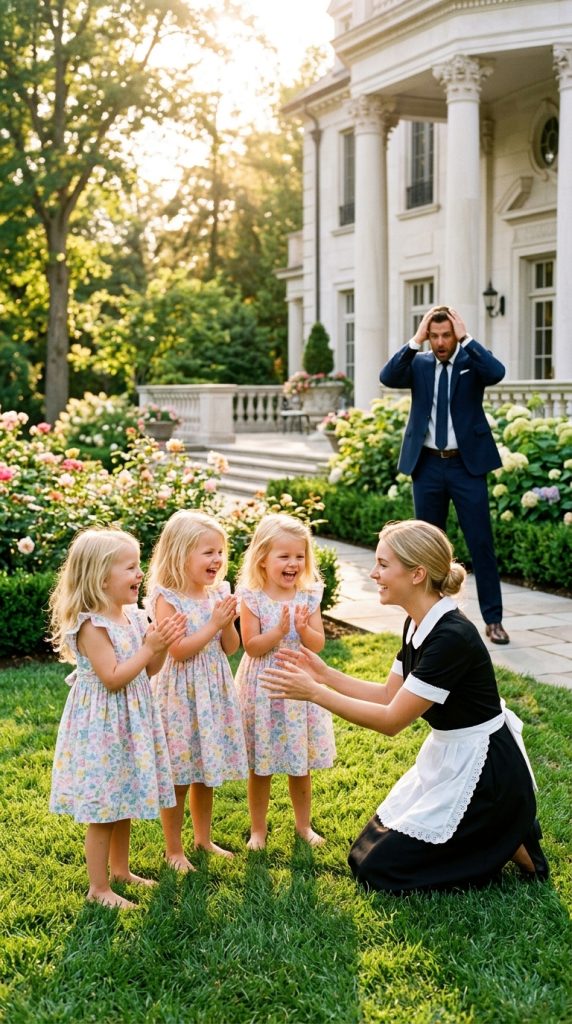
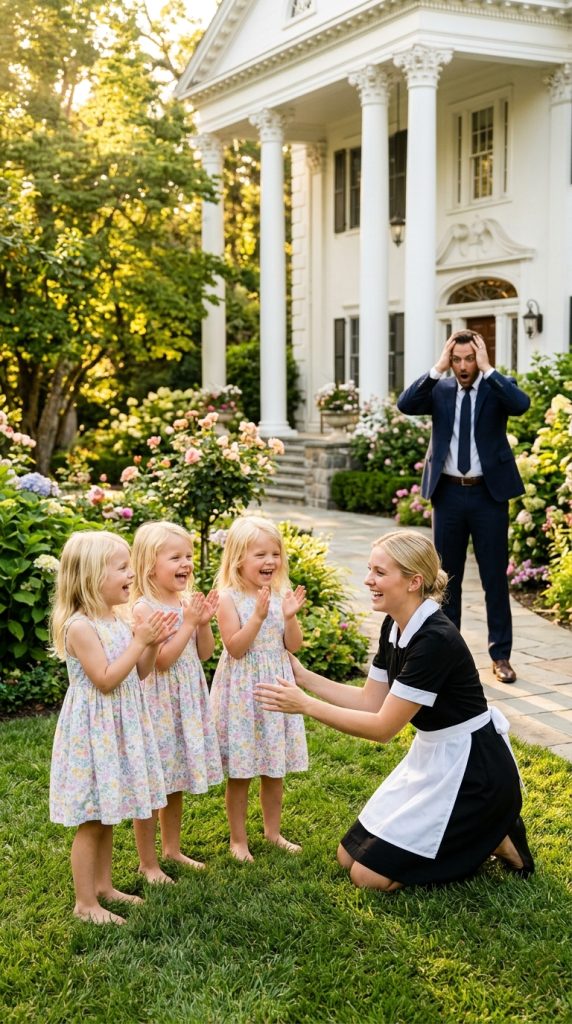
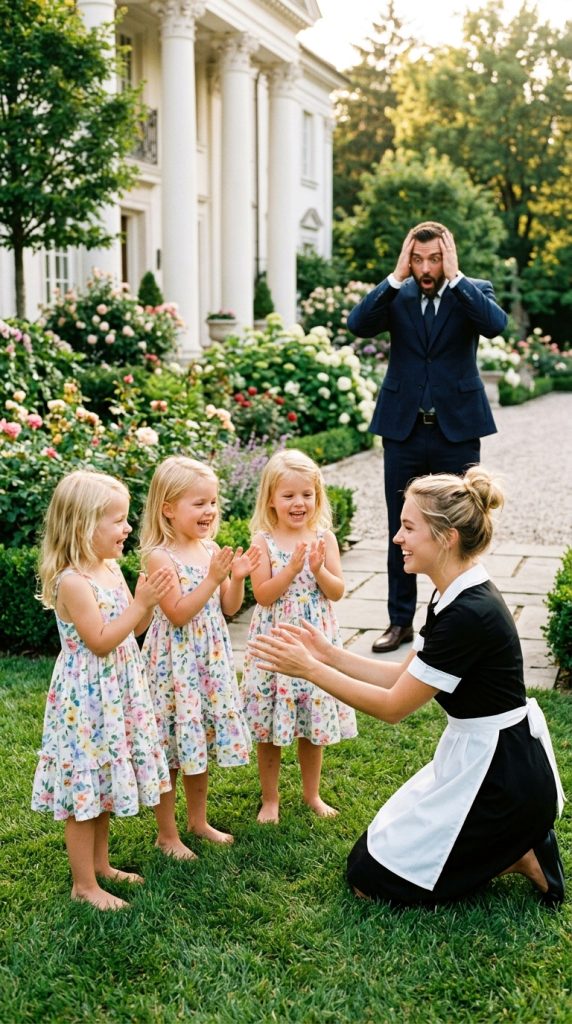
In the months that followed, healing wove itself into the fabric of their days. Physical therapy sessions blended seamlessly with playtime on the lawn. Laughter became routine rather than rare. Grace encouraged Nathaniel to involve the girls in simple daily tasks—feeling the texture of leaves, listening to birds, splashing in shallow pools. The mansion, once a place of clinical quiet, filled with life again.
One bright morning on the wide veranda overlooking the mountains, Nathaniel held each girl’s hands in turn. With Grace watching proudly from the doorway, the triplets took their first unsteady steps. Evelyn wobbled forward first, followed by Harper and Sophie. Their legs trembled, but their faces glowed with determination and joy. Nathaniel wept openly, not from grief this time, but from profound gratitude. He understood at last that grief doesn’t vanish—it transforms when shared with love and presence.
The staff whispered in amazement. Specialists returned, shaking their heads in wonder at the progress. News of the “Aspen miracle” spread quietly through local circles, though Nathaniel kept most details private. He knew the truth: healing had not come from his wealth, the machines, or the endless consultations. It had come from Grace’s gentle insistence on connection, from music that carried Claire’s spirit, and from a father finally choosing to show up.
Grace stayed on, becoming far more than a housekeeper. She was a quiet architect of hope, reminding everyone that patience and love could reach places money never could. The triplets grew stronger with each passing season—chasing butterflies with steadier legs, filling the house with their developing voices, and teaching their father how to dance again, just as Claire once had.
In the end, Nathaniel realized the greatest fortune wasn’t in property developments or investment portfolios. It was in the three small lives that had found their way back to movement and joy. The new housekeeper hadn’t performed a miracle with magic or medicine. She had simply opened windows, played forgotten songs, and reminded a broken family how to live again.
And in that simple act, everything changed.
