

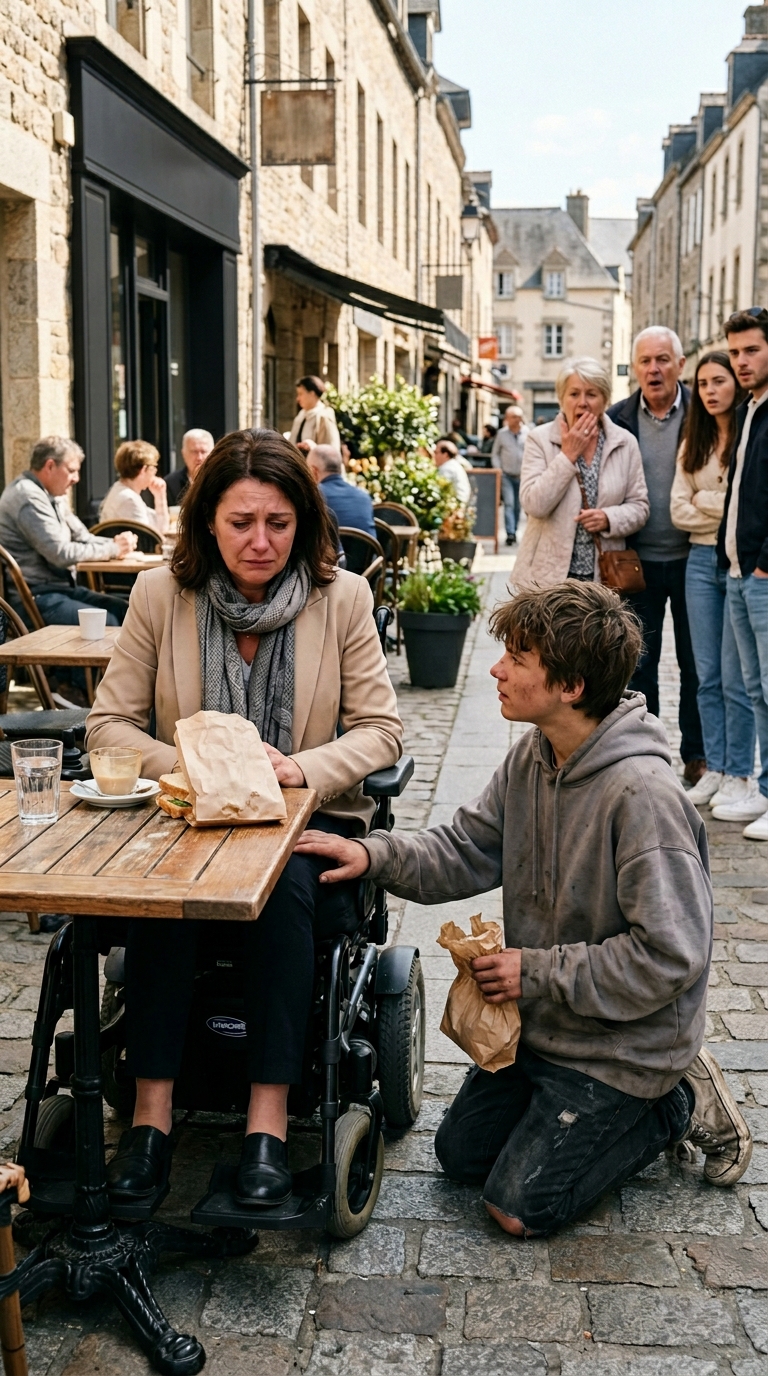
At forty-seven, Rachel had once been a force of nature. She built a successful regional food logistics company from the trunk of her old Honda Civic, negotiating contracts with suppliers and restaurants across New England. Her days were filled with early mornings at warehouses, late nights reviewing spreadsheets, and the simple joy of walking through bustling markets. All of that changed three years ago on a rain-slicked highway outside the city. A semi-truck hydroplaned, slamming into her car. The doctors called it “incomplete spinal cord injury.” After months of surgeries and rehabilitation, she regained some sensation but lost the ability to walk. Lawyers settled the case quickly. Rachel called it the day her old life ended.
Now, she managed her businesses from the wheelchair, her once-athletic frame thinner, her movements more deliberate. She smiled for customers and staff, but in the quiet hours, doubt gnawed at her. The independence she had prized above all else felt like a distant memory.
That particular October afternoon carried the crisp bite of autumn. Golden leaves swirled across the sidewalk as the café prepared to close. An employee stepped out carrying a small paper bag of untouched sandwiches—turkey and cranberry, roast beef with horseradish—and placed it near the trash bin for pickup. Rachel watched absently, her mind drifting to quarterly reports.
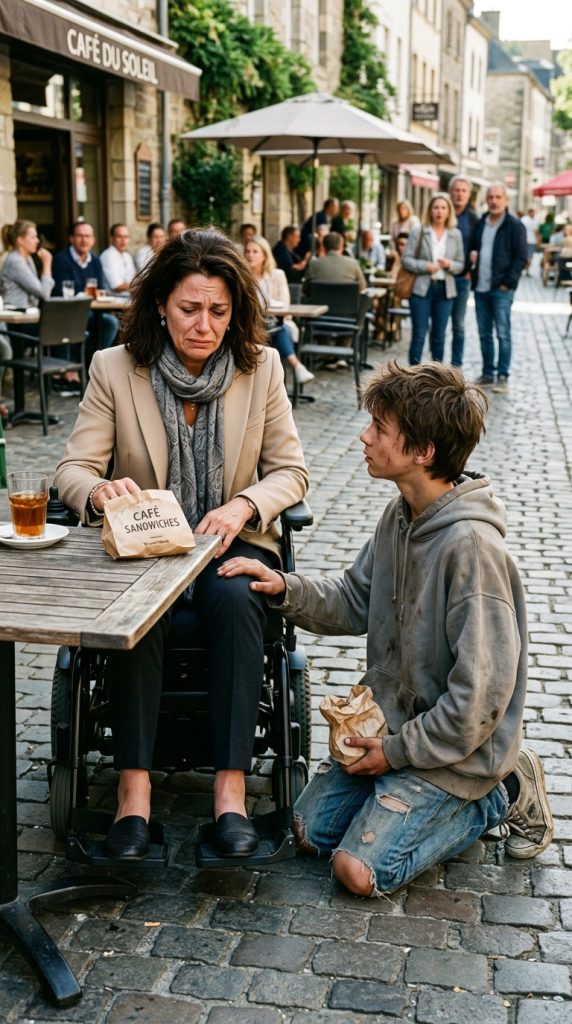
Before she could turn away, a skinny boy stepped forward from the shadows of a nearby alley. He looked about twelve, with warm brown skin, watchful eyes, and a faded hoodie that hung several sizes too big over his narrow frame. His sneakers were split at the seams, and his backpack looked worn from years of use.
“Ma’am,” he said politely, his voice soft but steady, eyes fixed on the bag, “could I have the leftovers? For me and my sister?”
Rachel studied him for a moment. There was no shame in his request, only quiet necessity. She nodded. “Take them. All of them. And tell your sister I hope they’re still warm.”
The boy reached for the bag but paused. He looked at her, really looked, his gaze drifting to her legs and the wheelchair. “I can help you,” he said suddenly. “If you want.”
Rachel offered a tired smile, the kind she had perfected over the last three years. “That’s kind of you, sweetheart, but I don’t need anything. The food is yours.”
He pointed gently toward her right foot. “I think you could walk again.”
The words landed like a stone in still water. The two baristas who had stepped outside froze. Rachel felt heat rise in her chest—not anger exactly, but that sharp, familiar sting of embarrassment and grief. People had offered prayers, experimental treatments, even pity. None had stung quite like this casual certainty from a child.
“And how exactly would you do that?” she asked, keeping her voice even.
“My mom worked in rehab,” he replied without hesitation. “Before she got sick. I watched her help people every day for years. The way you sit, the way your foot turns inward—your muscles still respond. You just stopped asking them to.”
For a long moment, the only sound was the distant hum of traffic and the rustle of leaves. Rachel almost laughed at the absurdity. Instead, her tone hardened. “Take the food, kid. Don’t play games with people who’ve already lost enough.”
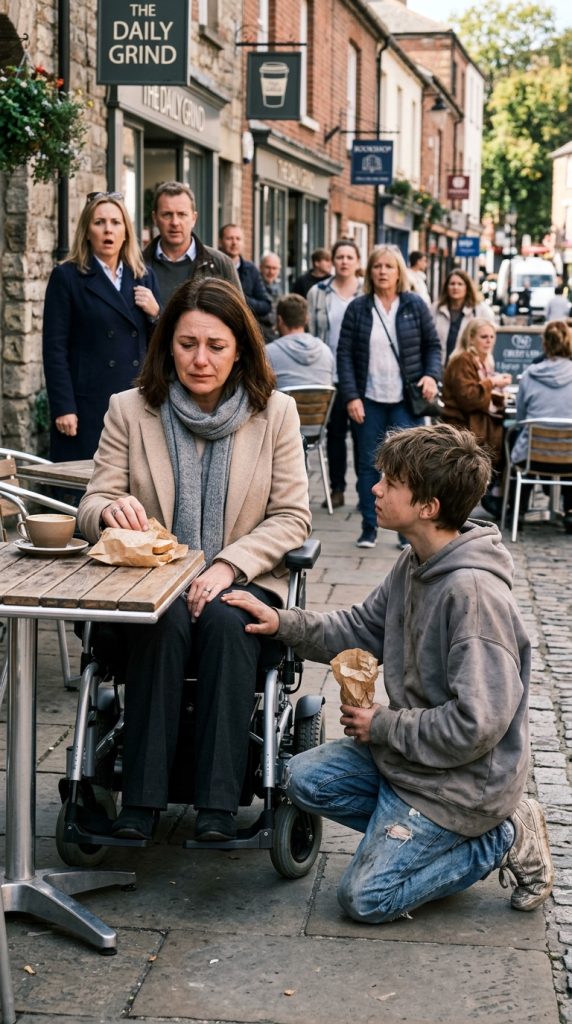
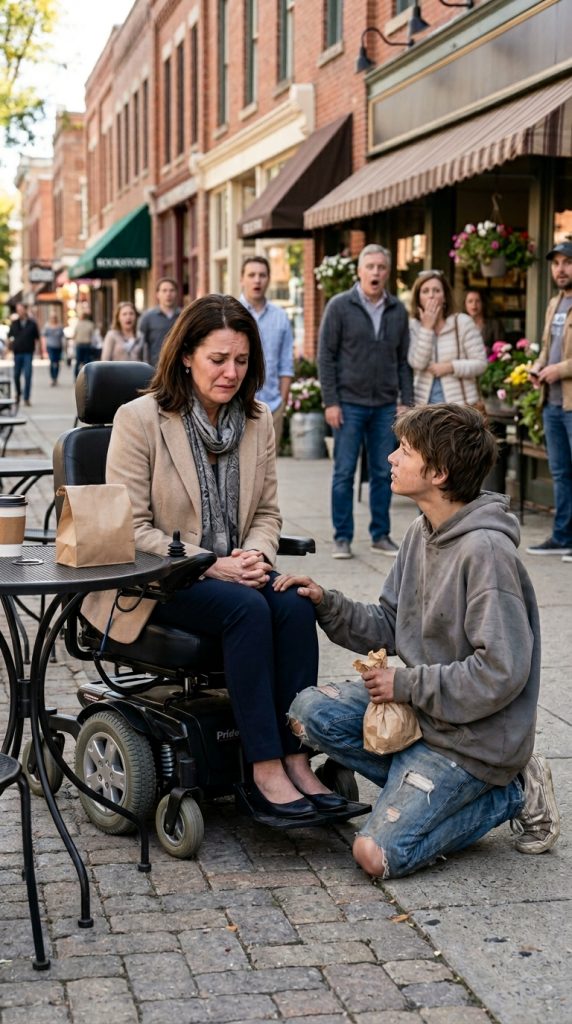
The boy took the bag, but instead of leaving, he knelt carefully in front of her wheelchair. With surprising gentleness, he tapped the side of her calf.
Rachel inhaled sharply. It wasn’t pain. It was pressure—real, distinct pressure. Something she hadn’t felt so clearly in months.
“Do that again,” she whispered, her voice barely audible.
He did. A second tap, then a light press.
Her toes moved. Just barely, but unmistakably. A twitch that sent a jolt through her entire body.
The staff rushed forward. One dropped a tray. Rachel gripped the armrests of her wheelchair, heart hammering against her ribs. For the first time in three years, the impossible didn’t feel so distant.
She insisted the boy come inside. The café’s warm lighting and scent of fresh bread seemed to surprise him. His name was Jamal Turner. Over a hot chocolate and a fresh sandwich she had the kitchen make specially, he told her pieces of his story. He lived with his younger sister, Mia, in a shelter a few blocks away. Their mother had passed away from cancer the year before, after years working as a physical therapy assistant. Jamal missed school often to watch Mia and sometimes to help at the shelter. He asked for nothing except the food to bring home.
When Rachel offered to call a specialist immediately, Jamal shook his head. “They already told you no, right? You stopped trying because they sounded so certain.”
His words lingered long after he left that evening.
The next morning, Rachel did something she hadn’t done in over a year. She called Dr. Laura Mendel, her former physical therapist, the one who had always believed her case was closed too quickly. Dr. Mendel arrived skeptical but curious. Jamal returned in the afternoon, as promised.
There were no dramatic miracles. There was only work—slow, painful, methodical work.
Jamal showed Rachel small, intentional movements that overworked therapists had dismissed as insignificant. He reminded her to breathe deeply, to focus on the faintest signals from her nerves, to listen to her body instead of fighting it. Dr. Mendel watched in growing disbelief, then began documenting every session with renewed energy.
“You were overmedicated in the early stages,” Dr. Mendel admitted after the first week. “And underestimated. The nerves were never completely severed. We just needed the right approach.”
Progress was agonizing. Some days, Rachel cried from frustration as her legs trembled without cooperating. Other days, Jamal didn’t show up because the shelter had been relocated due to funding issues. But he always returned, sometimes with Mia in tow—a bright-eyed seven-year-old who colored quietly in the corner while they worked. He asked only for leftovers to take home, never money.
Rachel began to open up. She told Jamal about the accident, about the fear of never feeling independent again, about how her success had once defined her. In turn, Jamal shared stories of helping his mother with patients, of learning to find hope in small victories. Their unlikely friendship deepened against the backdrop of steaming coffee and the café’s afternoon lull.
Two months later, supported between parallel bars in a rented rehab space, Rachel stood for the first time without full assistance. Her legs shook violently. Sweat poured down her back. Jamal stood in front of her, hands ready but not touching, his eyes steady.
“Tell them to move,” he said softly. “Not to be strong. Just to listen.”
Her right leg lifted an inch. Then her left.
Rachel collapsed back into the chair afterward, sobbing—not from pain, but from the overwhelming realization of how close she had come to giving up forever. Dr. Mendel hugged her tightly. For the first time, real hope felt tangible.
The media caught wind quickly. Local news stations ran headlines about the “remarkable recovery of Boston’s business icon.” Donations poured into paralysis research. Interviews were requested daily. Yet Jamal was rarely mentioned. When Rachel asked her assistant why, the young woman hesitated.
“They think the story works better without the shelter kid angle. It’s cleaner this way—wealthy woman beats the odds through determination and science.”
That night, alone in her spacious apartment overlooking the Charles River, Rachel watched the coverage with a heavy heart. She saw herself portrayed as inspirational, but something vital was missing: the truth.
The next morning, she entered a live press conference at the café. With Dr. Mendel and Jamal beside her, Rachel stood when she could, gripping a podium for support.
“This recovery isn’t mine alone,” she said, her voice clear and steady. “It belongs to a boy most of you wouldn’t have noticed. A boy who traded leftover sandwiches for belief.”
She told them everything. About Jamal’s request for food. About his mother’s work. About how simple attention and compassion had succeeded where expensive treatments and rushed medicine had failed. Cameras flashed as she took two careful, unaided steps forward and called Jamal to her side.
The room fell into stunned silence.
She placed a hand on his shoulder. “Healing isn’t always about cutting-edge technology or money,” she said. “Sometimes it’s about listening to the people society teaches us to ignore. Jamal reminded me that my body hadn’t forgotten how to walk—I had just stopped listening.”
Criticism followed swiftly. Some called it staged. Others questioned Jamal’s involvement. Medical professionals debated the ethics. Rachel welcomed the conversation because real change was already underway.
She used her resources to fund the Turner-Whitman Community Rehabilitation Center, a state-of-the-art facility staffed by licensed therapists but grounded in the patient-centered approach Jamal had shown her. Scholarships were created for children from shelters and low-income families who showed interest in healthcare. Jamal returned to school full-time. His sister Mia moved with him into a stable apartment funded through the program. Rachel became a regular visitor, helping with homework and sharing meals.
Six months later, on a bright spring morning, Rachel walked—slowly, imperfectly, with the aid of a cane—into her café without the wheelchair. The staff cheered. Customers applauded. In the corner booth, Jamal sat doing his homework, a plate of fresh sandwiches beside him.
“You still owe me,” he said with a grin when she approached. “For all that leftover food.”
Rachel laughed, the sound full and genuine. “I owe you much more than that, Jamal. You gave me back my life.”
Their story spread far beyond Boston, not because it was comfortable or polished, but because it forced people to confront who they dismiss every day. It showed how much can change when we stop looking past the boy in the oversized hoodie asking for leftovers, and start truly seeing him.
Rachel still runs her businesses. She still sits outside the café some afternoons. But now she stands up to greet old friends. And every day, she remembers the simple truth a twelve-year-old boy taught her: sometimes the greatest cures begin not with medicine, but with someone willing to listen.
