

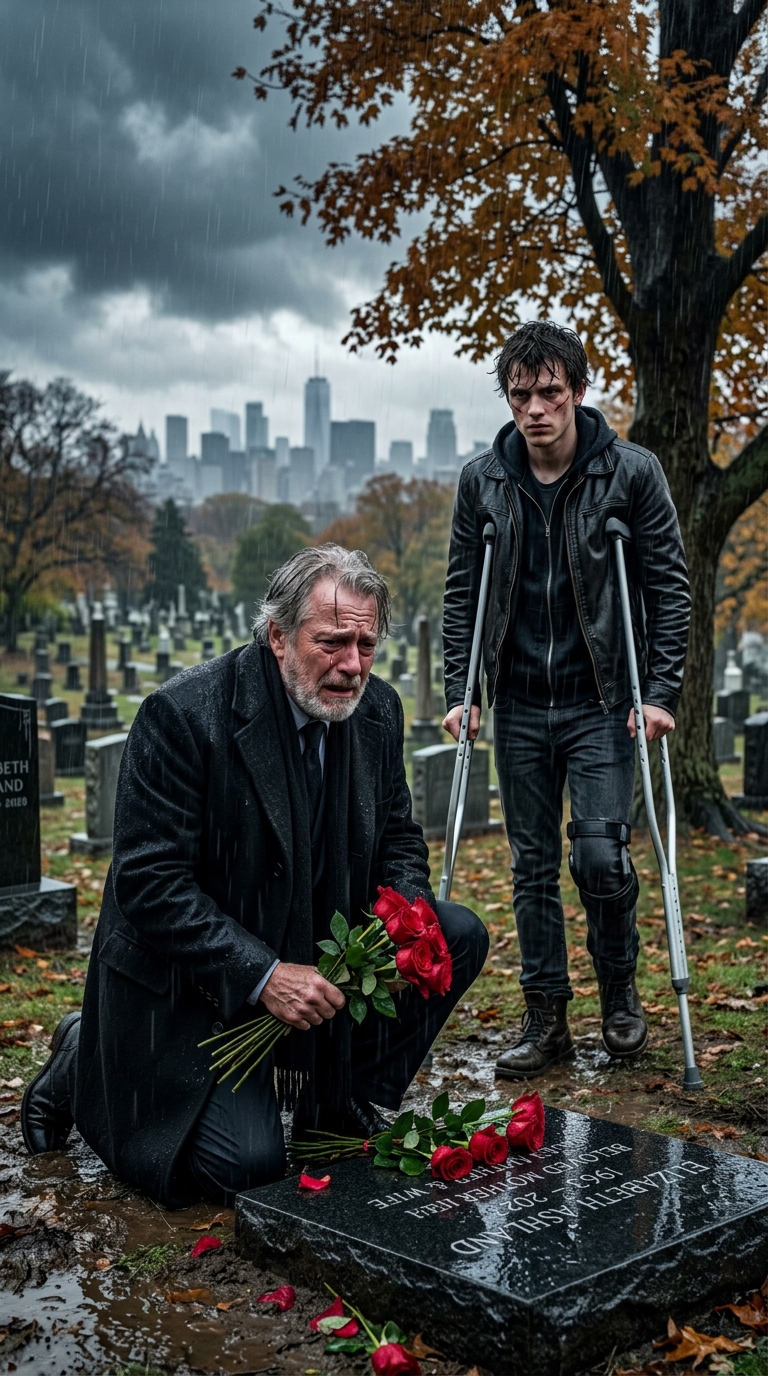
Harrison Sterling heard his dead son speak in the rain.
At first, he thought grief had finally become a living thing.
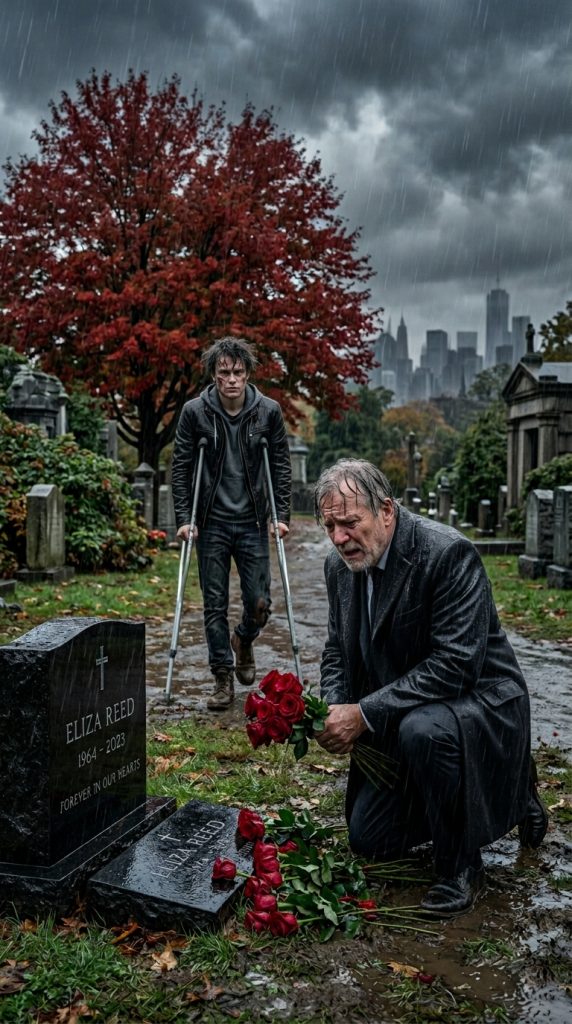
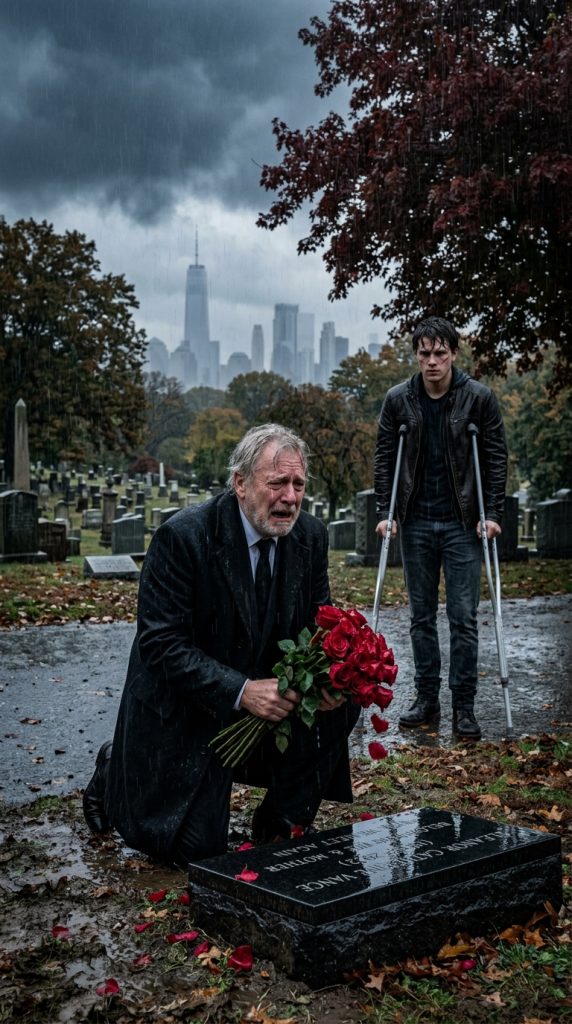
The voice came from behind him, thin and trembling, nearly swallowed by the thunder rolling over Green-Wood Cemetery in Brooklyn. Harrison was on his knees in the mud, his black coat soaked through, a dozen red roses crushed against his chest.
“Don’t cry, Daddy,” the voice said. “I’m alive.”
Harrison froze.
For two years, every Thursday morning at nine, he had stood before the same polished granite headstone and apologized to a boy who could no longer answer him. He had apologized for the fight. For the words he had shouted. For letting a business empire become louder than his son’s music. For not saying, before the door slammed that last night, “I love you more than I love being right.”
Now the rain beat against the cemetery path, and someone behind him had spoken in Julian’s voice.
Slowly, Harrison turned.
A young man stood twenty feet away beneath the leaning branches of an old maple tree. He was too thin, his face marked by small scars, his right leg braced, both hands gripping metal crutches. Rain dripped from his dark hair into eyes Harrison knew better than his own reflection.
Brown eyes. Emily’s eyes.
Harrison’s dead wife had given their son those eyes.
The roses slipped from his hands.
“No,” Harrison whispered. “No, this is cruel.”
The boy took one careful step forward, the rubber tips of his crutches sinking into wet grass.
“It’s me, Dad.”
Harrison shook his head, backing into the headstone. “I buried you.”
“I know.”
“I saw you.”
“You saw what she wanted you to see.”
The words struck with such force that Harrison could not breathe. The young man came closer, dragging one injured leg with controlled pain. His mouth trembled as if he had rehearsed this moment a thousand times and still could not survive it without breaking.
“Dad,” he said, “please. Before you decide I’m a ghost, ask me something only Julian would know.”
Harrison stared at him. Two years of mourning rose inside him like black water. Hope was dangerous. Hope could destroy a man more completely than grief.
He forced himself to speak. “On your sixteenth birthday, I gave you something that belonged to my grandfather. What did I engrave inside it?”
The boy’s face crumpled.
“You wrote, ‘So you never forget the most important time is the time we spend together.’”
Harrison’s knees weakened.
The boy reached into his soaked jacket and pulled out a small gold pocket watch. The chain was broken. The glass had a crack running through it like lightning. But when Harrison opened the lid with shaking hands, there it was: the message, the date, and his own initials scratched beneath the words.
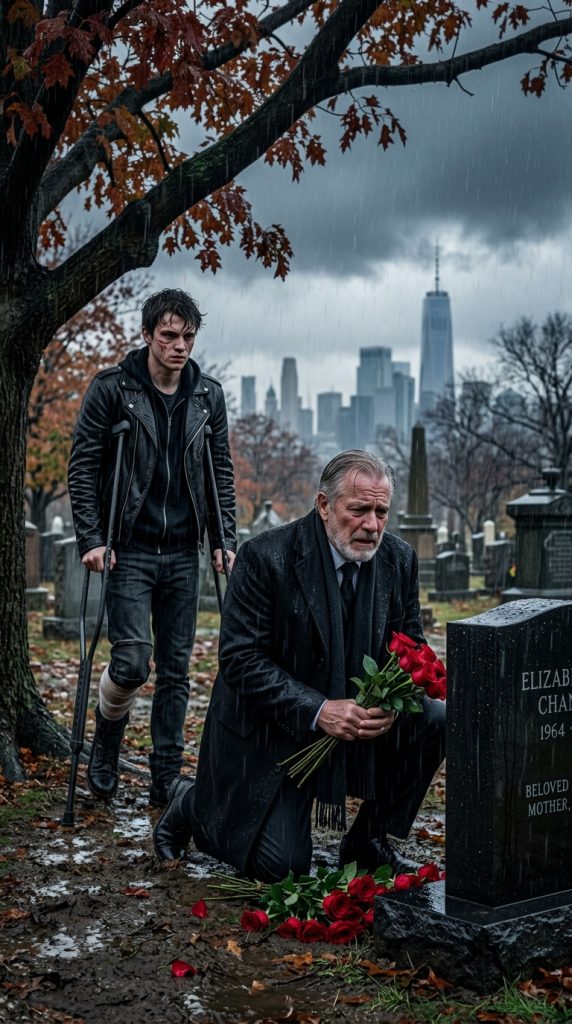
The cemetery blurred.
“Julian,” he said.
His son nodded once. “I never died.”
Harrison crossed the space between them like a man falling forward. He wrapped his arms around Julian carefully at first, afraid of hurting him, then desperately, because the body in his arms was warm and real and shaking.
“I’m sorry,” Harrison sobbed. “Oh God, son, I’m sorry.”
Julian held him with one arm, the other still locked around a crutch. “I missed you, Dad.”
For several minutes they stood in the storm, father and son clinging to each other beside a grave that suddenly meant nothing and everything at once. The rain softened, but Harrison barely noticed. He was listening to Julian breathe.
Finally, Julian pulled back. His face was pale with exhaustion.
“We can’t stay here long,” he said.
Harrison wiped rain and tears from his face. “Who did this?”
Julian looked toward the cemetery gates, as if he expected someone to be watching from behind the iron fence.
“Deborah.”
Harrison went still.
Deborah Vance had been his executive assistant for fifteen years. She had managed his calendar, his correspondence, his public appearances, his private grief. After Julian’s supposed death, she had been the person who handled the funeral because Harrison could not stand upright long enough to choose a coffin. She had brought meals to his apartment, arranged his therapy appointments, kept reporters away, screened family calls, and told him he needed protection from people who wanted to exploit his loss.
“She helped me bury you,” Harrison said.
“She helped bury a lie.”
They found shelter in a small stone maintenance building near the old chapel. Harrison guided Julian inside, closed the door against the rain, and stared at him in the dim yellow light as if blinking might erase him.
“Tell me everything,” Harrison said. “Start with that night.”
Julian leaned against the wall. His hands were raw around the crutch handles.
“That night, after our fight, I walked for hours. I was angry. I wanted you to come after me, but I also wanted you to suffer for not understanding me.”
Harrison closed his eyes. The fight had begun over business school and ended with a wound no father should ever leave in a child. Julian had wanted to leave Sterling Business Institute and study music composition. Harrison, terrified his only son would throw away stability for uncertainty, had called him spoiled, reckless, and ungrateful.
He had said, “If you walk out that door, don’t expect me to keep funding your little fantasy.”
Julian had shouted back, “Maybe I’d rather be poor than become you.”
Then the door slammed.
“I was crossing near Hudson Street when a black SUV jumped the light,” Julian continued. “It hit me first. I remember the headlights. I remember the sound. Then nothing.”
Harrison gripped the edge of an old wooden table. “Deborah’s car?”
Julian nodded. “A company SUV. She’d been drinking at a developer dinner. She hit me, lost control, and struck another kid on the sidewalk. He died before help came.”
Harrison’s stomach turned.
“The body I identified,” he said.
“His name was Evan Price. He was nineteen. A runaway from Queens. He had no close family looking for him fast enough to stop what Deborah did.”
Harrison staggered back. “I looked at that body.”
“You looked at a body after Deborah told you it was me. After she made sure the face was covered except for what she wanted you to see. After she told the hospital you were too unstable to handle details. After she showed them my ID.”
“My God.”
“She took my wallet before the ambulance arrived. My phone, too. Everything. She told the police she found identification on the dead boy. Then she had me transferred under a false name to a private rehabilitation clinic in North Carolina.”
“Why would anyone allow that?”
“Money,” Julian said. “And paperwork. She had your authorization to act on company matters and emergency household matters. You’d signed so many documents after Mom died that nobody questioned her when she came in with forms, payments, and a story.”
Harrison remembered Deborah placing papers before him in the months after Emily’s death. Estate matters. Insurance. Medical authorizations. Travel permissions. Banking updates. He had signed because trusting Deborah had been easier than thinking.
“She told them I was a troubled relative,” Julian said. “She said I had addiction problems and a powerful family that wanted privacy. She paid cash for my treatment and told the clinic staff that if anyone contacted outsiders, she would ruin them.”
Harrison remembered Deborah tightening security after the funeral. She had said, “Grief attracts vultures, Harrison. Let me keep the world away.”
He had thanked her.
Julian shifted painfully. “After sixteen months, I could walk with crutches. Deborah moved me to a cheap apartment outside Asheville under the name Jude Miller. She gave me cash and said if I contacted you, she would have me committed as unstable. She had medical records ready, Dad. Fake addiction notes. Fake psychiatric evaluations.”
Harrison’s hands closed into fists. “She imprisoned you.”
“She tried to make the cage look like mercy.”
“What changed?”
“A mechanic named Arthur Bell.”
For the first time, warmth entered Julian’s voice.
“He owned a repair shop near my apartment. I passed his place during physical therapy walks. One day, he called out, ‘Boy, if you’re going to limp past my garage every morning looking like you lost a fight with God, you might as well come drink coffee.’”
Despite everything, Harrison almost smiled.
“He gave me work. Small things at first. Sorting bolts. Answering phones. Cleaning tools. Then he taught me engines. More importantly, he taught me not to believe every cruel thing someone says when you’re too weak to argue.”
Julian reached into his jacket and pulled out a folded packet of papers sealed in plastic.
“Arthur has a friend who works in county records. They helped me look into the accident, the clinic, and your company. Deborah didn’t just hide me.”
Harrison already knew the next words would be worse.
“She’s been stealing from you.”
The papers contained lists of shell companies, payment dates, property records, and overseas transfers. Harrison recognized his company’s name, Sterling Infrastructure, again and again. Vance Logistics. D.V. Consulting. Northline Materials. Hollow vendors receiving six-figure payments for services Harrison had never approved.
Then he saw the deed transfer for his family brownstone in Brooklyn Heights.
His home.
The home Emily had restored room by room. The home where Julian had learned piano in the front parlor. The home Deborah had convinced him to leave because “the memories were keeping him sick.”
“I never sold this,” Harrison said.
“Deborah did. Using a power of attorney.”
“She told me the proceeds went into a protected account.”
Julian shook his head. “Most of it went through a shell company. Some of it went overseas.”
Harrison stared at the papers until the words became meaningless.
“How much?”
“At least twelve million that we can trace. Arthur’s friend thinks closer to fifteen.”
Harrison wanted to rage. Instead, he felt a cold clarity he had not felt in years.
“She wasn’t comforting me,” he said. “She was managing me.”
“She was isolating you. She needed you grieving, dependent, and obedient.”
A memory surfaced: Deborah pouring wine in his apartment, telling him Canada might be good for him. A fresh start. A quieter life. She had already contacted brokers in Vancouver and lawyers abroad.
“She wants me out of the country,” Harrison said.
Julian nodded. “Soon.”
Harrison turned toward the cemetery door. Through the dirty window, the false grave stood under a gray sky.
“We go to the police now.”
“No,” Julian said sharply.
Harrison looked back.
“Dad, she’s had two years to prepare. If you confront her without evidence strong enough to freeze accounts and protect witnesses, she’ll run. Or she’ll say I’m an impostor. Or she’ll use the clinic records to claim I’m mentally unstable.”
“You think she’d hurt you again?”
Julian’s silence answered.
Harrison’s face hardened. For two years he had been a grieving father. In that room, he became something else again: the man who had built bridges across rivers, towers over Manhattan, and a company from a rented office with one phone line.
“All right,” he said. “Then we do this correctly.”
Julian breathed out. “There’s one person you can trust.”
“My brother.”
“Uncle Graham?”
Harrison nodded. “Graham is a financial crimes attorney. Deborah hates him because he never trusted her.”
“Then call him from a phone she can’t monitor.”
Harrison looked at his son, amazed by the steel in him. The boy who had once stormed out over music had come back wounded, hunted, and strategic.
“You’ve grown up,” Harrison said softly.
Julian’s mouth bent into a sad smile. “I had to.”
Before they separated, Harrison held him again.
“I thought losing you was my punishment,” he said. “But the truth is worse. You were alive, and you thought I had abandoned you.”
Julian’s eyes filled. “We both believed lies because they were built on our worst fear. Mine was that you didn’t love me unless I became what you wanted. Yours was that I left angry and died before you could fix it.”
Harrison touched the cracked pocket watch. “No more lies.”
“No more,” Julian said.
Harrison returned to his downtown apartment just after noon.
Deborah was in his kitchen making soup.
She wore a cream blouse, pearl earrings, and the calm expression of a woman who had appointed herself guardian of a broken man. She looked up with practiced concern.
“You’re soaked,” she said. “Was the cemetery terrible?”
Harrison heard Julian’s voice in his mind: Act normal.
“It was difficult,” he said, removing his coat. “As always.”
Deborah crossed the room and touched his arm. For two years, that touch had felt steadying. Now it felt like a spider testing a web.
“You keep reopening the wound,” she said. “Julian wouldn’t want this.”
Harrison nearly flinched at his son’s name in her mouth.
“No,” he said quietly. “Maybe he wouldn’t.”
Her eyes sharpened for a fraction of a second. “What does that mean?”
“Only that I’m tired.”
She softened immediately. “Then let me help you. I’ve been thinking more about Vancouver. A smaller place. Less noise. Fewer ghosts. We could leave before summer if you’re ready.”
We.
The word sat between them like a signed confession.
“Maybe,” Harrison said. “But I need time.”
“Of course.” She smiled. “I’ve waited this long.”
He went to shower, locked the bathroom door, and gripped the sink until his knuckles whitened. His face in the mirror looked older than fifty-four. Grief had hollowed him. Trust had blinded him. But beneath the exhaustion, anger had lit a pilot flame.
At Sterling Infrastructure, Harrison borrowed a senior engineer’s phone and called Graham.
His younger brother answered on the second ring.
“Harrison? Whose number is this?”
“I need to see you today. Not at my office. Not at my apartment. Somewhere Deborah doesn’t know.”
A pause.
“What happened?”
“I can’t say on the phone.”
“Harrison.”
“Graham, please.”
Two hours later, they sat in the back of a crowded Italian coffee shop on Mulberry Street. Graham Sterling had the same gray eyes as his brother but none of the softness grief had carved into Harrison’s face. He listened without interrupting as Harrison said the impossible.
“Julian is alive.”
Graham’s expression changed from concern to alarm. “Harry—”
“I know how it sounds. I know.”
“Have you slept?”
Harrison placed the pocket watch on the table.
Graham stopped.
He picked it up, opened it, and read the engraving. His jaw tightened.
“Where did you get this?”
“From my son.”
Graham stared at him for several long seconds. “Tell me everything.”
Harrison did. The cemetery. The accident. Deborah. The clinic. The shell companies. The house sale. By the time he finished, Graham was no longer looking at him like a worried brother. He was looking at him like a lawyer staring at the outline of a massive criminal conspiracy.
“If this is true,” Graham said, “we’re looking at identity fraud, embezzlement, forged instruments, unlawful restraint, obstruction, and possibly vehicular manslaughter.”
“She killed another boy,” Harrison said.
“Then we also need to identify him properly.”
“His name was Evan Price.”
Graham wrote it down. “Where is Julian now?”
“A small hotel under another name.”
“Not safe. He comes to my house tonight.”
Harrison exhaled. “Thank you.”
“I’m not doing this as a favor. I’m doing it because if Deborah did even half of this, she is more dangerous than you understand.”
“I understand enough.”
“No,” Graham said. “You don’t. A thief steals when no one is looking. A predator builds a world where only her version of reality exists. Deborah didn’t just take money. She rewrote your life.”
That sentence stayed with Harrison as he returned home and found Deborah waiting with contracts spread across the dining table.
“There you are,” she said. “I was getting worried.”
“I stopped by the office.”
Her gaze flickered. “You should have told me. I would’ve gone with you.”
“It was quick.”
She tapped the papers. “Good timing. These need your signature.”
Harrison picked up the top contract. Vance Logistics LLC. Materials supply. Four hundred eighty-seven thousand dollars. A P.O. box in Delaware. No warehouse address. No corporate history older than six months.
“New supplier?” he asked.
“Excellent references,” Deborah said smoothly.
“Did you visit them?”
“Last week.”
Harrison looked up. “Last week?”
“Yes.”
He remembered last week clearly. Deborah had spent every day in his apartment, claiming he should not be alone near the anniversary of Julian’s death.
“I’ll review these tomorrow,” he said.
Her smile tightened. “The deadline is tonight.”
“Then they should have arrived earlier.”
“Harrison, you usually trust me with these things.”
“I’m trying to be more present in the company.”
The silence that followed was small but dangerous.
Then Deborah laughed softly. “Of course. That’s healthy. I’m proud of you.”
He carried the contracts to his study, closed the door, and photographed every page with a device Graham had given him.
That night, Harrison met Graham and Julian at a restaurant on the far West Side. Seeing Julian in ordinary light was somehow more painful than seeing him in the rain. He was alive, yes, but altered. His body carried the price of every lie.
Graham hugged his nephew for a long time.
“You look like your mother,” he said gruffly.
Julian laughed through tears. “You still look like you’re about to sue someone.”
“I am.”
They spent three hours building the foundation of their case. Julian produced documents Arthur’s friend had gathered. Graham identified the missing pieces: bank authorizations, original vendor files, clinic records, police reports, property transfers, and proof that Deborah had personally benefited.
“We need federal help,” Graham said. “The overseas transfers make this bigger than a local complaint.”
“Arthur knows someone,” Julian said. “An FBI agent. Mitchell Thorne. Financial crimes.”
Graham lifted an eyebrow. “Your mechanic has an FBI contact?”
“Arthur knows everyone. He fixes half the county’s cars and hears the other half confess.”
For the first time all day, Harrison laughed.
The laugh broke something open. The three of them sat there, not healed, not safe, but reunited in purpose.
Then Julian said, “There’s something else.”
Harrison looked at him.
“When Arthur and I traced Evan Price, we found his mother. Lena Price. She’s a school cafeteria worker in Queens. She filed a missing-person report two years ago, but because Evan was nineteen and had run away before, nobody prioritized it.”
Harrison’s face fell. “She doesn’t know?”
“She doesn’t know her son is in my grave.”
The words silenced the table.
Graham removed his glasses and rubbed his eyes. “Then this isn’t only about us.”
“No,” Julian said. “Deborah stole a son from you and a truth from her.”
Harrison looked at the folder of evidence. Until that moment, his anger had been personal. Now it widened into something heavier. Another parent had been left waiting because Deborah found a dead boy useful.
“We find her,” Harrison said. “And we make it right.”
The plan moved faster than any of them expected because Deborah made her first mistake the next afternoon.
Arthur called Julian in a panic.
“A woman came by the shop,” he said. “Fancy coat, expensive car, smile like a knife. Said she was your aunt.”
Julian’s blood went cold. “Deborah.”
“She asked where you went. I told her you left without saying. She didn’t believe me.”
“Did she threaten you?”
“She tried charm first. Then she said people who hide troubled young men can get themselves into legal trouble.”
Julian closed his eyes. “Arthur, listen to me. Don’t be alone tonight.”
“Son, I’ve handled worse than a woman with pearls.”
“Not this woman.”
Julian called Graham, and Graham drove straight to Sterling Infrastructure. He found Harrison in his office, watching Deborah through the glass wall as she spoke sharply into her phone.
“She found Arthur,” Graham said.
Harrison’s stomach clenched. “Then she knows Julian came back.”
“Maybe not for certain, but she suspects. We move now.”
Deborah looked up from the hallway. Her eyes met Harrison’s through the glass. For one second, her expression held no warmth, no grief, no concern. Only calculation.
Then she smiled and waved.
Harrison waved back.
The performance sickened him.
Graham leaned close. “Get your passport, the vendor contracts, and anything from your safe. We leave through the garage.”
“What do I tell her?”
“Nothing.”
They reached Graham’s house just before dusk. Julian was waiting in the kitchen, surrounded by papers. When Harrison entered, Julian stood too fast and nearly lost his balance.
“Dad.”
“I’m here.”
They embraced. Graham locked the door behind them and made the call to Agent Mitchell Thorne.
By eight-thirty that night, father, son, uncle, and evidence sat inside a federal building in Lower Manhattan.
Agent Thorne was in his fifties, square-shouldered, with the patient eyes of a man who had listened to too many people describe betrayal by someone they trusted. He did not interrupt. He asked precise questions. Dates. Names. Locations. Account numbers. Clinic staff. Vehicle records. Vendor addresses.
When Julian finished, Agent Thorne looked at Harrison.
“Mr. Sterling, are you willing to state under oath that Ms. Vance used your grief to obtain signatures and access you would not knowingly have granted?”
“Yes.”
“Are you willing to cooperate in a controlled operation?”
Harrison glanced at Julian.
“What kind of operation?”
“We need her to expose intent. A direct confession would help, especially regarding the identity switch and the funds. She may already be preparing to flee. If we arrest too early, we have documents. If we let her speak, we may get motive, knowledge, and destination.”
Graham frowned. “You want Harrison to meet her?”
“In a monitored setting,” Thorne said. “With agents nearby.”
Julian gripped his crutch. “No.”
Harrison turned to him.
“She already took you from me once,” Julian said. “I don’t want her near you.”
Harrison’s voice softened. “Son, for two years you survived because other people were brave when they were afraid. Martha. Arthur. Now it’s my turn.”
The next evening, Harrison returned to his apartment wearing a recording device beneath his shirt.
Deborah was waiting in the living room with two suitcases.
Not packed for a future move. Packed now.
Her face brightened when she saw him, but the brightness was strained.
“There you are,” she said. “I was so worried.”
Harrison glanced at the luggage. “Going somewhere?”
“We are.”
He set his keys down slowly. “Are we?”
“I moved the Vancouver timeline up. There are complications at the company, and I think it would be healthiest if we left tonight.”
“Complications?”
“Graham is stirring things up. He’s always resented my place in your life.”
Harrison walked deeper into the room. Every lamp was on. Papers had been removed from drawers. A shredder near the desk was warm.
“What place is that, Deborah?”
She smiled. “The place of the person who stayed.”
“My son would have stayed if he could.”
The room changed.
Deborah’s smile did not disappear. It hardened.
“Harrison,” she said carefully, “you’ve had a difficult week.”
“Have I?”
“You’re vulnerable around the anniversary. You imagine things.”
“Like what?”
“Like forgiveness from the dead.”
Harrison’s pulse pounded in his ears. “That’s an interesting phrase.”
She stepped closer. “I know you went to see Graham.”
He said nothing.
“I know someone has been asking questions in North Carolina.” Her voice lowered. “If some damaged young man has approached you with a story, you need to be careful. Grief makes men easy to deceive.”
“Did you think I would never recognize my own son?”
Deborah stared at him.
The mask fell.
Not completely. Worse. It slid just enough for him to see the person underneath.
“You recognized a corpse when I told you to,” she said.
Harrison felt the sentence pass through him like a blade.
“You switched them.”
“I saved you.”
“You hid my child.”
“I removed the thing that was destroying you.”
“My son was destroying me?”
Her eyes flashed. “He was ungrateful. Weak. He broke your heart while you handed him the world. I was there every day, Harrison. I built your life while he played piano and cried about dreams.”
“You hit him with your car.”
“A mistake.”
“You left another boy dead.”
“A tragedy.”
“You stole his name and buried him under my son’s.”
Deborah’s mouth tightened. “Nobody was looking for that boy.”
Harrison’s voice shook with controlled fury. “His mother was.”
For the first time, uncertainty crossed her face.
He stepped closer. “What was the plan? Take me to Canada? Move the money again? Marry me before I noticed my company was bleeding?”
Deborah recovered quickly. “I loved you.”
“No. You wanted possession.”
“I gave you everything.”
“You gave me a grave to cry over.”
“And you needed it!” she snapped. “You needed Julian gone before you could become whole again.”
Harrison stared at her, horrified by the sincerity in her madness.
Behind him, the apartment door opened.
“Federal agents,” Agent Thorne called. “Deborah Vance, step away from Mr. Sterling.”
Deborah turned white.
Within seconds, agents filled the room. One secured the shredder. Another collected the suitcases. A third took Deborah’s phone as she began shouting.
“Harrison, tell them!” she cried as they cuffed her. “Tell them I protected you. Tell them what he did to you. Julian poisoned you against me!”
Harrison did not answer.
Then Julian appeared in the doorway.
He had insisted on waiting in the hall with Graham. Thorne had agreed only after placing two agents beside him. Now he stood tall despite the crutches, raincoat still damp, his face pale but steady.
Deborah saw him and went utterly still.
Julian looked at her for a long moment.
“You told me my father was ashamed of me,” he said.
Deborah’s lips parted.
“You told him I was dead,” Julian continued. “You told a mother in Queens nothing, because her son’s body was useful to you. You lied to everyone because the truth was the one thing you couldn’t control.”
Deborah’s eyes filled with tears, but they were tears of defeat, not remorse.
“You ruined everything,” she whispered.
Julian shook his head. “No. I survived it.”
The agents led her away.
The aftermath did not heal quickly.
Truth, Harrison learned, was not a magic word that repaired what lies had broken. It was a door. Once opened, everyone still had to walk through the wreckage on the other side.
The FBI froze several overseas accounts within forty-eight hours. A full audit uncovered nearly sixteen million dollars diverted through shell vendors. The Brooklyn Heights brownstone had been sold through forged and manipulated authority, but the family who bought it had done so in good faith. Harrison refused to punish them for Deborah’s crime. He bought them a comparable home and regained his own months later through a settlement.
The clinic in North Carolina came under investigation. Martha Cole testified, her voice shaking but firm.
“I knew that boy didn’t belong hidden away,” she said. “I should have spoken louder sooner, but I was afraid. I’ll live with that. But I will not be afraid today.”
Arthur Bell drove up from Asheville in his old blue pickup to sit beside Julian during the hearings. When Harrison met him, he expected to feel jealousy toward the man who had fathered his son through the hardest season of his life. Instead, he felt gratitude so deep it humbled him.
Arthur shook his hand and said, “Your boy saved himself, Mr. Sterling. I just kept the porch light on.”
Harrison pulled him into an embrace.
“You kept it on when I didn’t know where to shine mine.”
The hardest meeting came three weeks after Deborah’s arrest.
Lena Price arrived at Graham’s office wearing a faded green coat and shoes polished for dignity rather than wealth. She was smaller than Harrison expected. Her hands held a folder of missing-person flyers, each one showing Evan’s face beneath the words HAVE YOU SEEN MY SON?
Harrison stood when she entered.
For a moment, no one spoke.
Then Harrison said, “Mrs. Price, my family owes you the truth, and I owe you more than an apology can carry.”
Lena looked at Julian. Her eyes moved over his scars, his braces, his crutches.
“You’re the boy they thought was dead.”
Julian nodded. “Yes, ma’am.”
“And my Evan?”
Harrison’s voice broke. “He was the young man buried under Julian’s name.”
Lena closed her eyes.
The sound she made was not loud. It was worse than loud. It was the sound of a mother whose hope had been kept alive just long enough to be killed properly.
Julian began to cry. “I’m sorry.”
Lena opened her eyes and looked at him with astonishing gentleness.
“You didn’t do this.”
“No, but I lived because he didn’t.”
She stepped forward and touched his cheek.
“Then live well,” she said. “Don’t waste what my boy lost.”
Harrison paid for Evan’s proper burial, but Lena refused anything that felt like hush money. What she accepted was a scholarship fund in Evan Price’s name for runaway and homeless young musicians.
“He played guitar,” she told Julian. “Badly, but with his whole heart.”
Julian smiled through tears. “Then I’ll write something for him.”
He did.
The piece was called “For the Boy Who Carried My Name.” It began with a single guitar line, uncertain and wandering, then grew into piano, strings, and a melody that sounded like grief learning to stand.
Months passed. Deborah’s trial became a national story, not because Harrison was rich, but because the crime was intimate in a way strangers understood. A woman trusted with calendars, keys, signatures, and grief had turned access into a weapon.
Her defense claimed obsession, emotional disturbance, and unrequited love. The prosecution showed planning, offshore accounts, false medical records, forged documents, and the recorded confession in which she dismissed Evan Price as “nobody.”
The jury took less than five hours.
Deborah Vance was sentenced to eighteen years in federal prison, with additional state proceedings tied to the crash and identity fraud. When the sentence was read, Harrison felt no triumph. Only a tired closing of one terrible door.
Outside the courthouse, reporters shouted questions.
“Mr. Sterling, do you forgive her?”
Harrison paused.
Julian stood beside him, leaning on one crutch now instead of two. Months of therapy had strengthened his legs, though doctors said pain would visit him for life.
Harrison looked into the cameras.
“Forgiveness is not pretending evil didn’t happen,” he said. “Forgiveness is refusing to let evil decide what we become. My family is choosing to rebuild. That is all.”
Rebuilding began at home.
The brownstone felt different when Harrison and Julian returned. The piano in the front parlor was out of tune. Dust lay along the staircase. Emily’s garden had gone wild behind the house.
Julian stood in the entryway, one hand on the banister.
“I used to think this house was a museum of everything we didn’t say,” he admitted.
Harrison set down a box. “Then we’ll make it a home of everything we say now.”
That night, they ordered pizza and ate it on the floor because the dining table had not yet been delivered. Harrison asked about Julian’s music, not as a challenge, but as a father learning his son’s language.
“What do you hear when you compose?” he asked.
Julian thought for a moment. “Usually the emotion first. Then a shape. Then I try to find notes that fit the shape.”
“What shape is this year?”
Julian looked around the room where grief, fraud, memory, and hope all seemed to breathe together.
“A bridge,” he said. “Broken in the middle, but still standing.”
Harrison smiled faintly. “I know something about bridges.”
“Yes,” Julian said. “But this one we build together.”
Harrison reduced his role at Sterling Infrastructure and created a family oversight board with Graham and two independent auditors. Every major payment required multiple approvals. Every vendor had to be verified. The company survived, then steadied, then became stronger because its owner finally understood that trust without accountability was not kindness. It was negligence wearing a gentle face.
Julian enrolled at a music conservatory in Manhattan.
On the first day, Harrison drove him there. Julian laughed when he saw his father gripping the steering wheel like a man delivering a child to kindergarten.
“Dad, I’m twenty now.”
“I missed two years,” Harrison said. “Allow me to be embarrassing.”
Julian’s smile softened. “Okay. But only moderately embarrassing.”
Before Julian got out, Harrison stopped him.
“The night you left,” he said, “I was afraid. Not angry first. Afraid. Your mother had died, and the company was the only thing I still knew how to control. When you chose music, I heard it as losing you too.”
Julian listened quietly.
“That doesn’t excuse what I said,” Harrison continued. “It explains the weakness Deborah used. I should have loved you with open hands.”
Julian looked down at the cracked pocket watch he now wore on a new chain.
“I should have told you I was scared too,” he said. “I acted like your business was a prison, but really I was afraid I’d fail at music and prove you right.”
Harrison reached across the console and squeezed his shoulder.
“Then fail honestly if you must. I’ll still be in the front row.”
Julian laughed, but his eyes shone.
“You better be. My first recital is going to be rough.”
“It will be the finest rough recital in New York.”
Years later, people would tell the Sterling story as if the miracle happened in one moment: a boy on crutches speaking to his father in the rain.
But Harrison knew the real miracle was slower.
It was Julian learning to walk across a room without apologizing for pain.
It was Lena Price sitting in the front row when Julian performed Evan’s song and weeping without being alone.
It was Martha Cole receiving a nursing ethics scholarship in her name and saying, “Courage late is still courage, but courage early saves more.”
It was Arthur Bell visiting Brooklyn and refusing Harrison’s offer of a luxury car because, as he put it, “I trust my truck more than most politicians.”
It was Graham coming to Sunday dinner every week, no longer as the suspicious brother at the edge of Harrison’s life, but as a pillar in the center of it.
It was Harrison listening before advising.
It was Julian forgiving without forgetting.
Five years after the cemetery reunion, father and son returned to Green-Wood on a bright Thursday morning. The false headstone had been removed. In its place stood a simple stone bench beneath the maple tree.
A plaque read:
For every family separated by lies.
For every truth that finds its way home.
For every second chance we do not deserve but receive with gratitude.
Julian arrived without crutches that day. He still walked with a limp, especially in cold weather, but he walked on his own.
Harrison noticed and said nothing at first. He had learned that not every victory needed to be seized aloud. Some deserved quiet reverence.
Julian sat on the bench and looked across the cemetery.
“I hated this place before I ever saw it,” he said. “I used to imagine you here, crying over a grave, and part of me was angry. I thought, ‘Why mourn me if you didn’t come find me?’”
Harrison sat beside him. “You had the right to be angry.”
“No,” Julian said. “I had the right to be hurt. Anger was just easier.”
A breeze moved through the leaves.
Harrison took the gold pocket watch from his coat and placed it between them.
“It still runs,” he said.
Julian smiled. “Stubborn little thing.”
“Like its owner.”
“Which one?”
“Both.”
They laughed, and the laughter did not erase the past. It joined it, softened it, gave it another ending.
Julian looked at his father. “Do you ever wonder what life would’ve been like if none of this happened?”
“Every day,” Harrison admitted. “Then I remind myself not to build a home in the impossible. We live here. After. And after can still be beautiful.”
Julian nodded. “I’m writing a symphony.”
“About what?”
“Us. Mom. Evan. Arthur. Martha. Even Uncle Graham, though I may need a very stern bassoon for him.”
Harrison laughed.
“What will you call it?”
Julian looked at the bench, then at the sky, then at the man who had once been too proud to listen and had become humble enough to change.
“Home,” he said.
Harrison’s eyes filled, but he did not hide the tears this time.
Julian leaned his shoulder against his father’s.
“Don’t cry, Dad.”
Harrison smiled through the tears.
“I’m not crying because I lost you.”
“Then why?”
Harrison closed the pocket watch and held it in his palm, feeling the delicate heartbeat of time still moving.
“Because you came back,” he said. “And because this time, I know what to do with the time we have.”
Together they sat in the sunlight, no longer prisoners of the grave behind them, no longer servants of the lies that had brought them there. The world had taken two years, but it had not taken love. It had not taken truth. It had not taken the stubborn, sacred bond between a father and the son who found his way home on broken legs and an unbroken heart.
THE END
