


The final time I saw my sixteen-year-old son, Ethan, he stood in the hallway lacing up his sneakers with his backpack hanging loosely from one shoulder.
“Did you finish your history assignment?” I called from the kitchen.
“Yeah, Mom.” He grabbed his jacket and leaned in to kiss my cheek. “See you tonight.”
Then he walked out the door.
I remember standing by the window watching him head down the street like I always did. It seemed like such an ordinary moment that I never imagined it would become the last normal memory I would have of him.
That evening, Ethan never came home.
At first, I tried not to panic. Ethan occasionally stayed after school to play guitar with friends or spent extra time at the nearby park. Usually he would send a text, but I convinced myself his phone had probably died.
I kept clinging to that explanation while I made dinner, while I sat alone eating, and while I washed dishes with his plate still warming in the oven.
But once night settled in and his bedroom remained empty, fear twisted deep inside me.
I called his phone.
Straight to voicemail.
By ten o’clock I was driving around the neighborhood searching for him.
By midnight I was inside the police station filing a missing person report.
The officer asked routine questions while scribbling notes.
“Teenagers leave sometimes,” he said calmly. “Arguments at home, wanting freedom. It happens.”
“Ethan isn’t like that.”
He glanced up. “What makes you so sure?”
“He’s kind. The sort of kid who apologizes when somebody bumps into him.”
The officer gave me a polite nod. “We’ll start the report, ma’am.”
But I could already tell he thought I was another frightened parent refusing to see reality.
I had no idea how much more complicated the truth actually was.
The following morning I rushed to Ethan’s school.
The principal kindly let me review the security footage from the cameras near the entrance.
I sat in a cramped office watching students pour out of the building in loud groups, laughing and shoving each other.
Then I saw Ethan.
He was walking beside a girl.
At first I didn’t recognize her. Then she turned slightly and I saw her face.
“Lily,” I whispered.
Lily had visited our house before. Quiet, respectful, careful with every word she spoke.
In the footage, Ethan and Lily exited through the gates together and walked toward the bus stop. A city bus arrived. They stepped on board and disappeared from view.
“I need to talk to Lily,” I said quickly.
The principal hesitated.
“Lily transferred schools,” she explained quietly. “That was actually her last day here.”
I drove straight to Lily’s house.
A man answered the door.
“Can I please speak with Lily?” I asked. “She was with my son the day he disappeared. I just need to know if he mentioned anything.”
The man stared at me for several seconds. His expression turned cold.
“She’s not here,” he replied. “She’s staying with her grandparents for a while.”
He began shutting the door, then paused.
“If she knows anything, I’ll have her contact you.”
Then the door closed.
I stood frozen on the porch with a terrible feeling in my chest, certain something about the conversation was wrong.
But I didn’t know how to prove it.
The months afterward were unbearable.
Friends helped me hang flyers. I posted online everywhere I could. Police searched nearby towns and neighborhoods.
But over time the investigation slowed.
Eventually people began calling Ethan a runaway.
I refused to believe it. Ethan would never disappear without a word.
And I never stopped searching.
Nearly a year later, I traveled to another city for a work meeting. Life had slowly dragged itself forward—work schedules, grocery shopping, phone calls with my sister—but the ache of Ethan’s absence followed me everywhere.
After the meeting, I stopped at a small café for coffee.
While waiting at the counter, the front door opened behind me.
An older homeless man shuffled inside, bundled against the cold. He carefully counted coins in his hand as if unsure he could afford anything.
Then I saw the jacket.
My heart nearly stopped.
He was wearing Ethan’s jacket.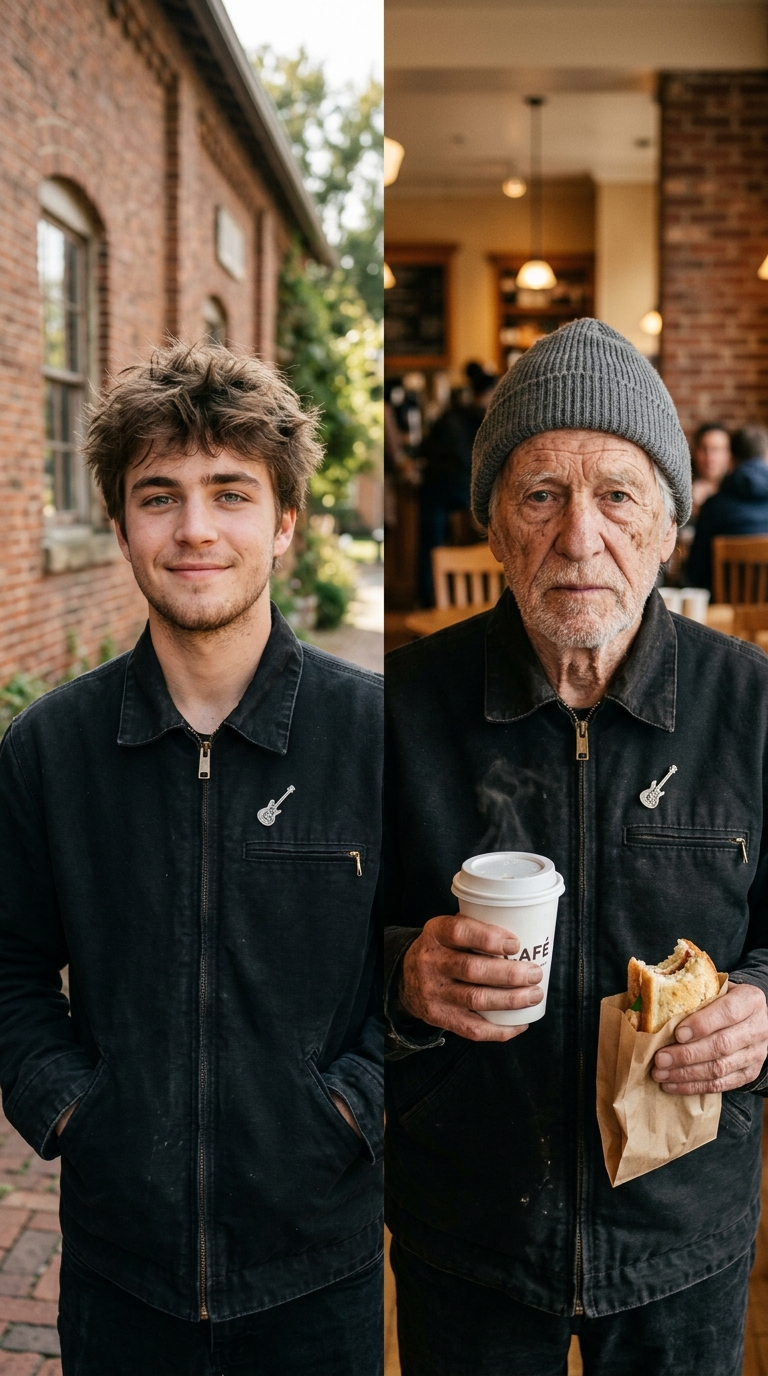
Not a similar one—the exact same jacket Ethan wore the day he vanished.
I knew because of the guitar-shaped patch sewn onto the sleeve where it had once ripped. I had stitched that patch myself. There was also a faded blue paint stain across the back.
I turned toward the barista.
“Please add that man’s tea and a bun to my order.”
The barista nodded.
The old man smiled gratefully at me.
“Thank you, ma’am, that’s very—”
“Where did you get that jacket?”
He glanced down.
“A boy gave it to me.”
My pulse thundered.
“Brown hair? Around sixteen?”
He nodded.
Before I could ask more, customers crowded between us. By the time I pushed through them, the old man had already stepped outside.
“Wait!”
I hurried after him.
The sidewalks were packed, making it difficult to catch up.
But then I noticed something strange.
He wasn’t begging.
He wasn’t eating the bun or drinking the tea.
He walked with purpose.
So instead of stopping him, I followed quietly behind.
We crossed block after block until we reached the outskirts of the city.
There, he stopped outside an abandoned house swallowed by weeds and overgrown grass.
The old man knocked softly.
I stayed hidden behind a nearby tree and watched carefully.
The door creaked open.
“You told me to let you know if anyone ever asked about the jacket…” the old man said.
I leaned slightly around the tree.
And my entire body froze.
“Ethan!”
My son stood in the doorway.
His eyes widened in shock.
Then movement appeared behind him. Ethan glanced backward—and suddenly bolted.
“Ethan, wait!”
I sprinted toward the house.
I burst through the doorway and chased him down a hallway. A back door slammed open, and I saw Ethan and a girl running toward the woods.
“Ethan!”
I ran after them screaming his name.
But they moved too fast.
Within seconds, they disappeared among the trees.
I drove straight to the nearest police station and explained everything.
“Why would he run from you?” the officer asked.
“I don’t know,” I whispered shakily. “But please help me find him before he disappears again.”
Hours later, close to midnight, the officer approached me.
“We located him near the bus station. They’re bringing him in now.”
Relief hit me so hard my knees nearly gave out.
“And the girl?” I asked.
“He was alone.”
They brought Ethan into a small interview room.
The second I saw him, tears filled my eyes.
“You’re alive,” I whispered. “Do you understand how terrified I’ve been? Why did you run?”
He stared silently at the table.
“I wasn’t running from you.”
“Then why?”
“Because of Lily.”
Slowly, Ethan explained everything.
Weeks before disappearing, Lily had confided in him. Her stepfather had become violent and unpredictable, screaming and breaking things almost every night.
“She was scared to stay there,” Ethan said quietly.
I thought about the man who answered the door at her house.
“He told me she was with her grandparents.”
Ethan shook his head.
“He lied.”
Lily had come to school that day carrying a packed bag. She planned to leave for good.
“I tried talking her out of it,” Ethan admitted. “But she wouldn’t stay.”
“So you went with her.”
“I couldn’t let her go alone, Mom.”
“Why didn’t you call me?”
He swallowed hard.
“I promised Lily I wouldn’t tell anyone where we were. She thought they’d force her to go back.”
“And today?”
“I thought if police found me, they’d find her too.”
I remembered the jacket.
“What about the old man?”
Ethan looked embarrassed.
“I gave him the jacket and asked him to tell me if anyone asked about it.”
“Why?”
He hesitated.
“I thought maybe someday you’d recognize it.”
“You wanted me to find you.”
“Maybe,” he admitted softly. “I didn’t want you believing I was gone forever.”
A few days later, police located Lily.
After speaking privately with her, they launched an investigation. Her stepfather was removed from the home, and Lily was placed somewhere safe.
For the first time in a long while, she could finally breathe without fear.
A few weeks later, I stood in my living room watching Ethan and Lily curled up on the couch together sharing popcorn while a movie played.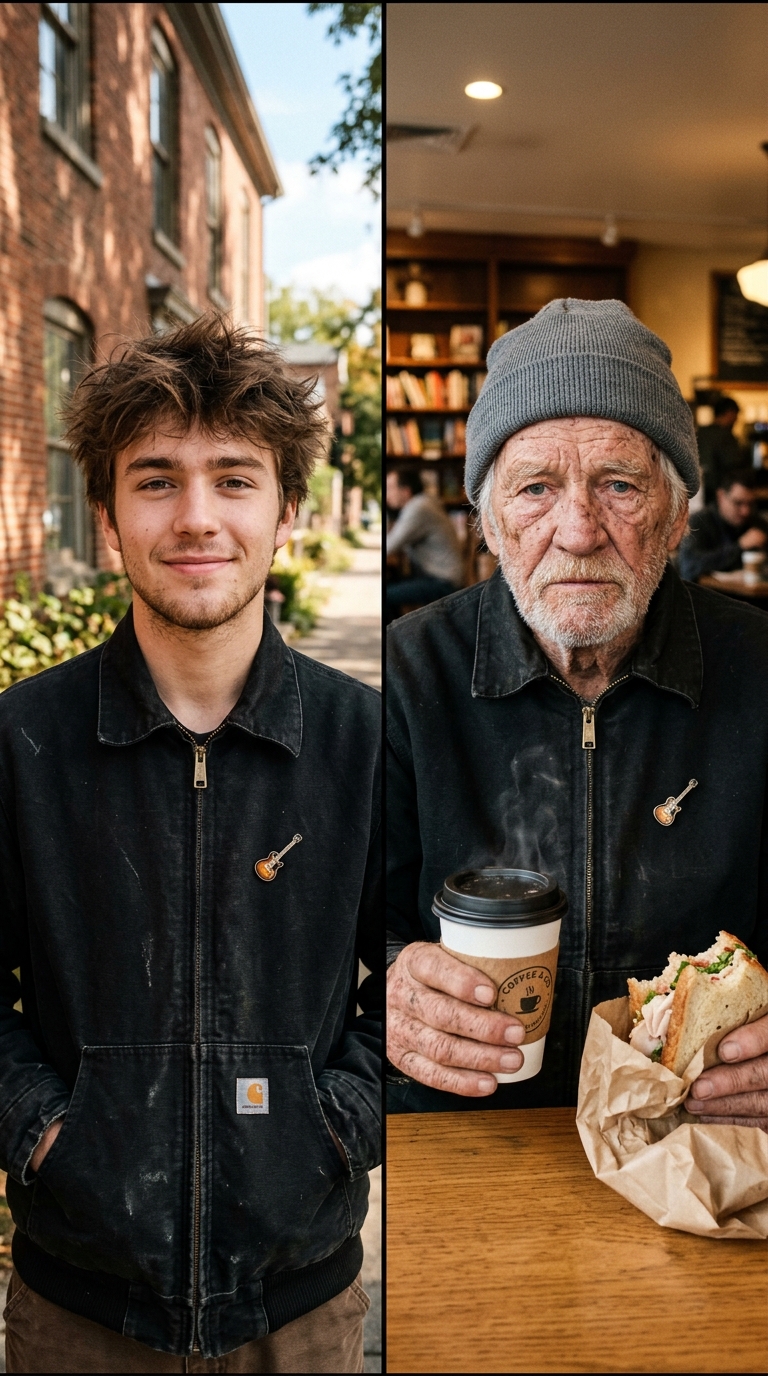
They looked like ordinary teenagers.
For almost a year, I believed my son had disappeared from the world.
But he hadn’t vanished.
He had stayed beside someone who was terrified—moving between shelters, abandoned houses, and unfamiliar cities—because he was the kind of boy who could never leave someone behind.
And he was also the kind of boy who left behind one small clue for the person who loved him most.
A jacket.
I’m grateful I followed it.
