

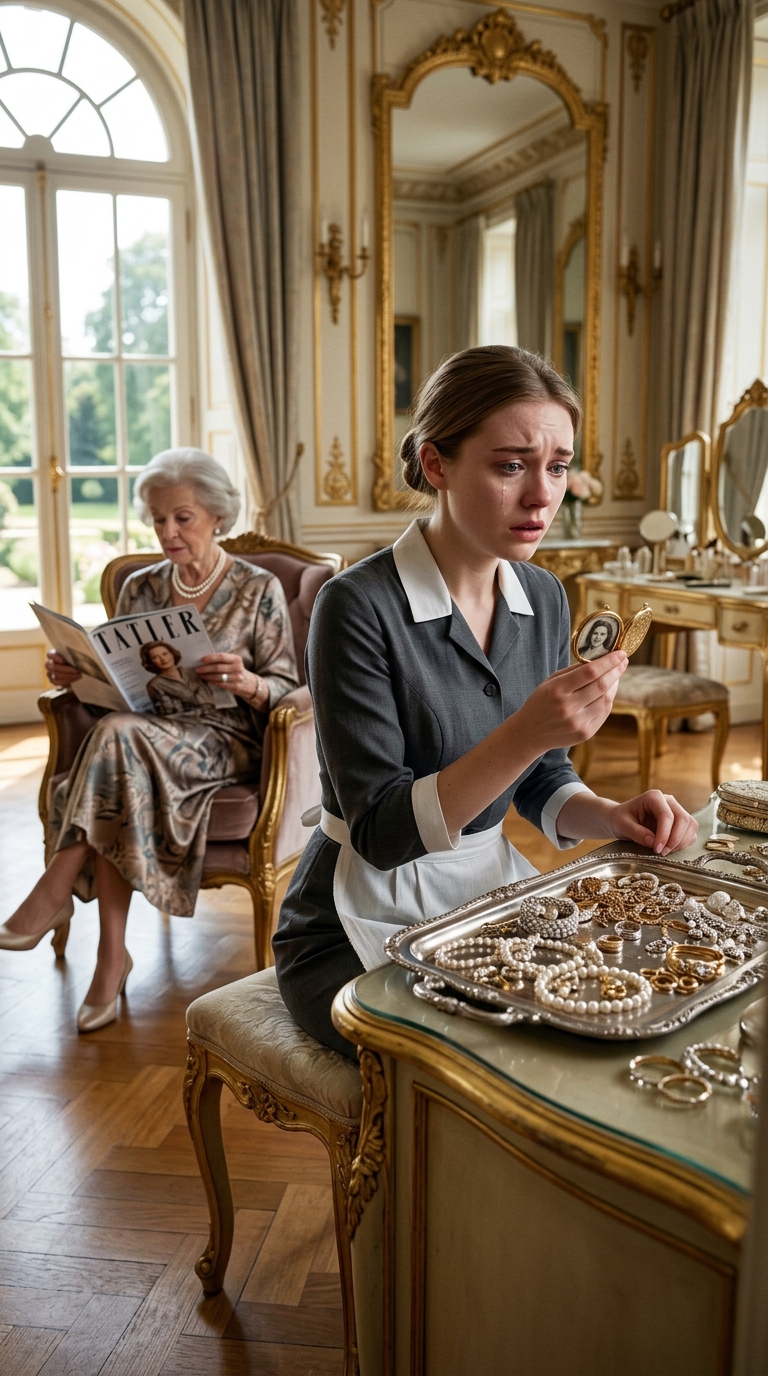
Clara lived her life in the shadows of others. As a housemaid for the city’s elite, her days were spent scrubbing floors that cost more than her apartment and polishing silver she would never be allowed to touch. She was a ghost in a world of gold, a girl who had grown up with very little but carried a heart full of unbreakable love for her mother, Sarah.
Sarah had been the center of Clara’s universe. She was a woman of immense grace and a soft, haunting voice that could calm the fiercest storm. Yet Sarah had always been a woman of mysteries. She never spoke of her parents, never showed Clara any old photographs, and lived with a lingering sadness that no amount of love could fully erase. Sarah had raised Clara in a small rented cottage, working three jobs to give her daughter an education. She had always told Clara that she was a “gift from the universe,” but she never explained where that gift had come from.
When Sarah passed away five years ago, she left Clara with nothing but a small wooden box containing a few pieces of lace and a single, heartbreakingly honest letter. The letter told Clara that she was loved beyond measure, but that her true history was a secret that had to be kept to protect her. It was a mystery Clara had spent years trying to solve, a puzzle with missing pieces that left her feeling like a stranger in her own life.
Then, Clara was hired by Mrs. Evelyn Montgomery.
Evelyn Montgomery was the matriarch of one of the oldest and wealthiest families in the country. She lived in a sprawling estate that felt more like a fortress of solitude than a home. Evelyn was a woman of iron and ice. She didn’t believe in friendships; she believed in alliances. She didn’t experience emotion; she experienced status. To Evelyn, the staff were not people, but tools. She treated Clara with a cold, distant professionalism, never remembering her name and referring to her only as “the girl.”
Clara didn’t mind. She had grown up in the silence of her mother’s secrets, and the silence of the Montgomery estate felt familiar. She worked with quiet diligence, moving through the house like a breeze, cleaning dust from the chandeliers and grime from the corners of a life lived in absolute luxury.
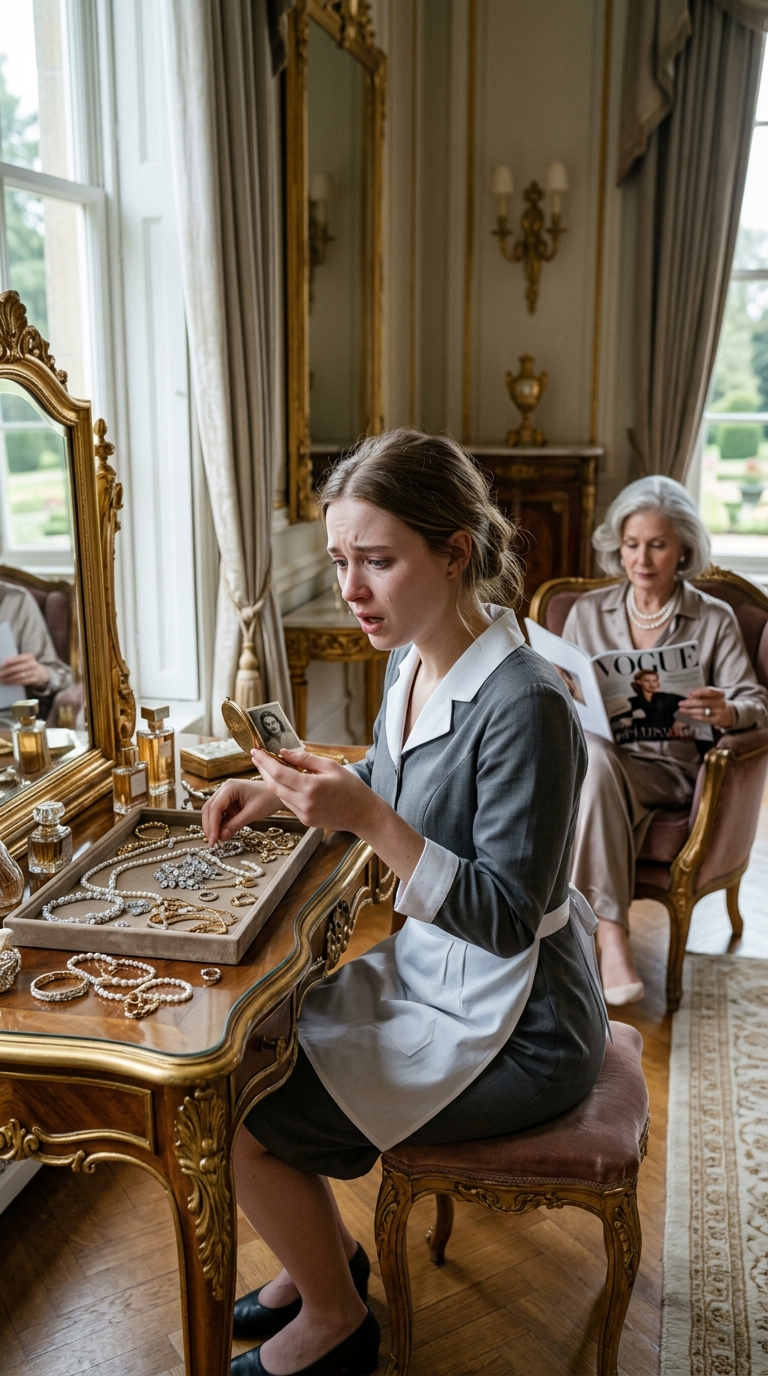
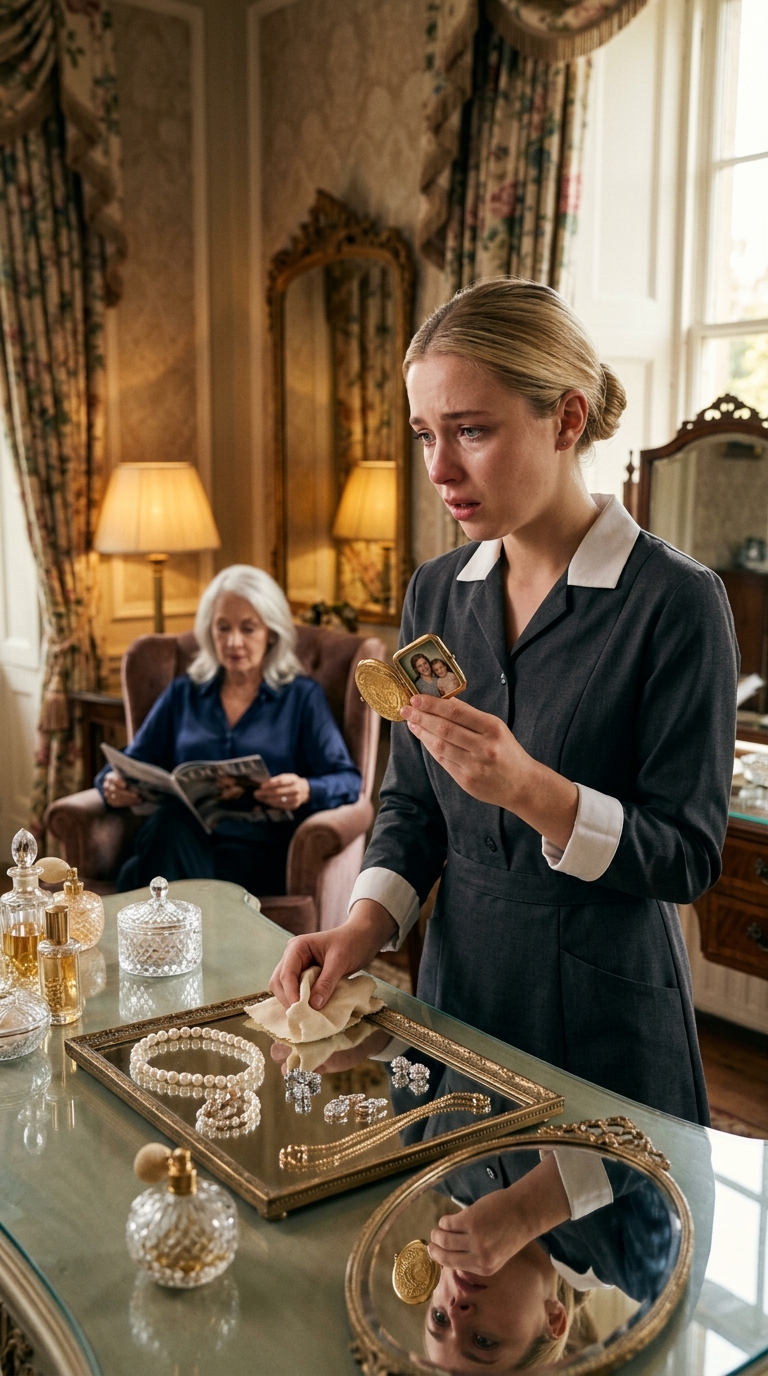
The tension reached a breaking point on a sunny Tuesday afternoon. Evelyn had asked Clara to clean her jewelry collection—a dazzling array of gems that could fund a small city. The jewelry was laid out on a velvet tray, sparkling under the midday sun.
As Clara worked, her fingers brushed against a small, antique gold locket. It was different from the other pieces; it wasn’t a diamond or a ruby. It was simple, weathered, and looked as if it had been held and kissed a thousand times. Out of a sudden, inexplicable curiosity, Clara clicked the locket open.
The world stopped.
Inside the locket was a tiny, faded photograph of a young woman. She had the same almond-shaped eyes as Clara, the same gentle curve of the lips, and the same haunting gaze that Clara saw every time she looked in the mirror. It was Sarah. It was her mother, twenty-five years younger, looking radiant and hopeful.
Clara’s breath hitched. Her heart hammered against her ribs like a trapped bird. The shock was so violent it felt physical. How was it possible? Why did the wealthiest woman in the city possess a photograph of a woman who had lived and died in poverty? Why had her mother never mentioned this woman?
Clara looked up at Mrs. Montgomery, who was sitting in a velvet armchair, reading a fashion magazine. The elderly woman looked up, seeing the maid’s frozen expression.
“What is it?” Evelyn asked, her voice sharp and impatient. “Is there a scratch on the gold? Speak up, girl.”
Clara’s hand began to shake. She held the locket out, the gold chain dangling between them. Her voice was a fragile whisper, broken by a surge of emotion she couldn’t contain.
“That is a photograph of my mother,” Clara said. “When she was young.”
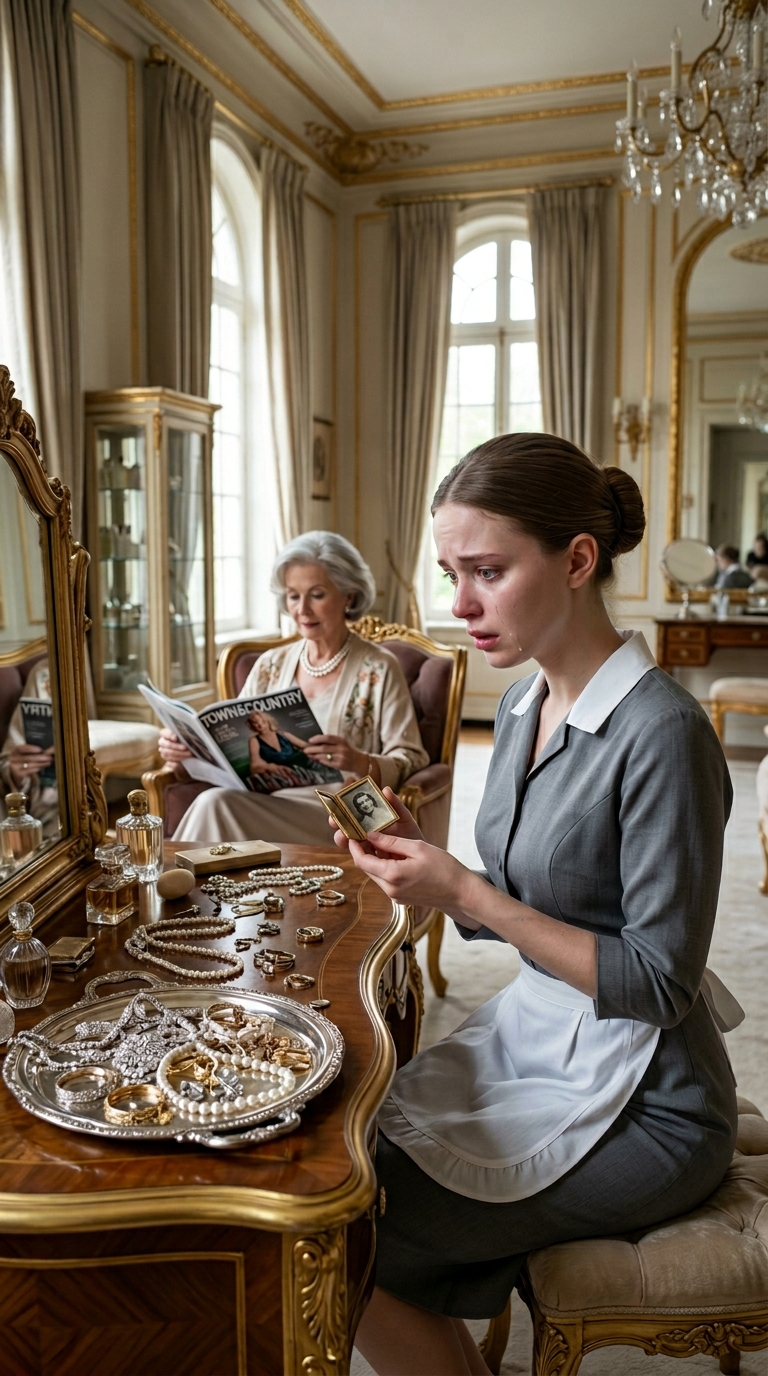
The effect was instantaneous. The magazine slipped from Evelyn’s fingers, landing with a soft thud on the carpet. The mask of ice that Evelyn had worn for decades didn’t just crack; it shattered. She stood up abruptly, her face turning a ghostly, translucent white. For the first time in her life, the powerful Mrs. Montgomery looked small. She looked terrified.
The truth came out in a flood of tears and whispered confessions.
Thirty years ago, Evelyn had not been the cold matriarch of a dynasty. She had been a young woman trapped in a marriage of convenience to a man who was a monster of control. Her husband, a man of immense power and cruelty, had forbidden her from having children, fearing that an heir would complicate his control over the family fortune. But Evelyn had fallen in love—a secret, forbidden love with a young gardener who worked on the estate.
It was a love born in the shadows of the rose garden, a desperate, stolen passion that had resulted in a pregnancy. When Evelyn’s husband found out, he didn’t just punish her; he waged a war of psychological torture. He threatened to destroy the gardener, to have him imprisoned or killed, if Evelyn didn’t give up the child.
In a moment of absolute, crushing terror, Evelyn had made a choice. To save the man she loved and to protect her baby from the monster she was married to, she had agreed to give the child away. She had paid a distant agency to ensure the baby was placed with a family who would love her, but she had insisted on one thing: she wanted to keep a photograph.
The agency had lied to her. They had told her the child had been adopted by a wealthy family in another state. But the truth was far darker. The agency had been corrupt, taking the money and placing the baby with a struggling woman in a poor district, ensuring that Evelyn could never find her daughter.
Evelyn had spent thirty years living in a gilded prison, mourning a daughter she believed was a stranger. She had kept the locket as her only connection to the love she had lost, wearing it close to her heart during the nights when the silence of the mansion became unbearable. She had become cold and cruel as a defense mechanism, convincing herself that love was a liability and that emotions were a weakness.
She had hired Clara not by chance, but by a subconscious pull. She had seen Clara’s face in the interview and felt a spark of recognition that she couldn’t explain. She had been drawn to the girl’s quiet dignity, but her own fear of the past had made her treat Clara with coldness. She was afraid that if she let the girl in, the pain of her lost daughter would consume her.
“I spent my whole life thinking I had failed you,” Evelyn sobbed, her voice breaking. “I thought I had abandoned you to a life of luxury where you would never know me. I didn’t know you were suffering. I didn’t know you were right here, in my own house, cleaning my floors while I ignored your soul.”
Clara collapsed into the arms of the woman she had feared for months. The hierarchy of the house vanished. The uniforms and the silk dresses no longer mattered. There were only two women, separated by thirty years of lies and pain, finally finding each other in the wreckage of a broken family.
The reconciliation was a slow, healing process. Evelyn didn’t just give Clara her inheritance; she gave her her heart. She spent the rest of her days making up for the years of silence, filling the mansion with laughter, music, and the warmth of a grandmother’s love. She used her wealth to build shelters and support systems for single mothers, ensuring that no other woman would ever be forced to choose between her child’s safety and her child’s presence.
Clara no longer wore the grey uniform. She didn’t become a socialite, but she became the guardian of the Montgomery legacy. She turned the estate into a place of healing, a sanctuary where the “invisible” people of the world were welcomed and valued.
They discovered that the locket wasn’t just a piece of jewelry; it was a bridge. It had connected a girl who felt she had no history with a woman who had spent her life mourning a ghost. It proved that no matter how deep the secret or how long the silence, the bond between a mother and daughter is a thread that can never be fully severed.
Clara and Evelyn spent their final years together, sitting in the garden where the forbidden love had once bloomed. They looked at the photographs of Sarah, the woman who had bridged the gap between them, and they thanked her for her strength. They realized that while the past cannot be changed, the future can be rewritten with love, honesty, and a willingness to forgive.
The mansion was no longer a museum of coldness. It was a home. And the gold locket, once a symbol of a tragic separation, now hung on a small velvet ribbon around Clara’s neck—a reminder that the most precious things in life are not those we buy, but those we find again after they were thought to be lost forever.
