

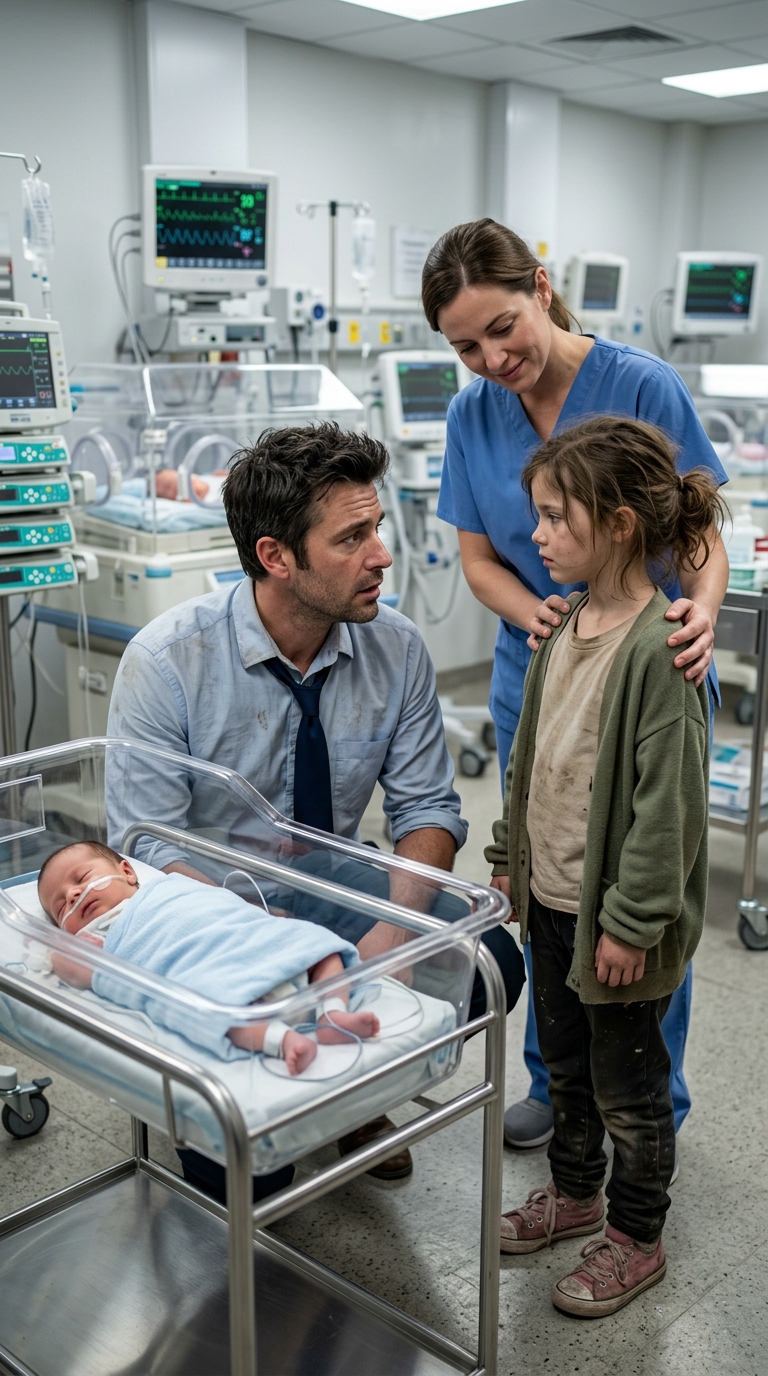
Nathaniel Brooks had trusted numbers his entire life, but nothing in that hospital room could be solved with numbers anymore.
He stood beside his son’s crib with his hands braced against the rail, staring at the tiny rise and fall of Julian’s chest as if sheer focus could hold the child to the world. The monitors continued their steady work. The ventilator hissed softly. The IV pump clicked with mechanical indifference. Every sound in the pediatric intensive care unit belonged to medicine, protocol, and grim precision.
Then there was the little girl.
She stood near the foot of the crib, small and oddly still, with one worn sneaker half untied and both hands folded in front of her as though she had stepped into a church instead of a critical care room. The nurse behind her looked apologetic, tired, and prepared to guide her out at the slightest sign of protest.
Nathaniel should have said no.
He knew that.
He was exhausted, frightened, and dangerously close to the brittle edge where hope becomes anger. He did not want comfort from a child. He did not want a sweet distraction. He did not want one more fragile gesture from the universe when what he needed was a cure.

Yet when the girl asked, “Can I sing for him?” he found himself looking at Julian instead of her.
His son’s skin still had that terrible softness that belonged to newborns and to the desperately ill. His eyelashes looked too delicate to survive the night. His fingers, curled against the blanket, were no larger than the metal clips attached to the monitor leads.
Nathaniel swallowed.
“One song,” he said quietly.
The nurse blinked in surprise.
The girl nodded once, as if she had expected nothing less.
“Thank you,” she said.
Her voice was soft but steady. It was not the voice of a child asking permission. It was the voice of someone accepting responsibility.
The nurse stepped back toward the door, uncertain whether to stay or leave. Nathaniel did not look at her. He only watched as the girl moved closer to the crib and placed one hand on the plastic edge, careful not to disturb anything.
“What’s your name?” Nathaniel asked.
“Sadie,” she replied.
He nodded. “I’m Nathaniel.”
“I know,” she said.
That made him look at her sharply.
Sadie did not appear embarrassed. She simply glanced at the card clipped to Julian’s crib and added, “It says Brooks right there.”
Nathaniel exhaled through his nose. Fatigue was making him strange. For a second, he had felt something almost like a chill.
Sadie leaned slightly forward and looked at Julian’s face with a seriousness that belonged to someone much older.
“Hi, Julian,” she whispered. “My brother says hospitals sound like sad robots, but you don’t have to listen to them if you don’t want to.”
Nathaniel opened his mouth, then closed it.
The nurse gave him a tentative look that asked whether this had gone too far. He shook his head very slightly.
Sadie began to sing.
It was not dramatic.
It was not polished.
It was not the kind of performance that would stop a room because of beauty alone.
It was something stranger than that.
Her voice was clear, low, and unhurried, carrying a melody Nathaniel did not recognize. It sounded older than a nursery rhyme and softer than prayer. The words were simple, almost circular, about stars returning home, about the sea carrying little boats, about light finding the window even when the house was dark.
Nathaniel had expected to endure the song politely.
Instead, after the first few lines, he realized the room itself felt different.
The monitors still beeped, but not with the same frantic edge. The air, stale from filtered heat and sleepless panic, seemed to settle. Even the fluorescent lights above the crib felt less cruel.
He looked instinctively at Julian.
His son’s breathing had not become normal.
It had not become strong.
But it had changed.
It was more even.
Only slightly. Only enough for a parent who had been measuring life in fractions to notice. But Nathaniel noticed. He noticed everything.
The nurse noticed too.
Her eyes flicked up to the monitor screen, then back to the baby, then back again.
Sadie kept singing.
By the time she finished, no one in the room had moved for nearly two full minutes.
The silence afterward was not empty.
It was listening.
Nathaniel looked at the monitor. Julian’s oxygen saturation had edged upward by two points. It was not a miracle. It was not recovery. It was not even enough to mean anything clinically definite.
But in that room, after hours of slow decline, it was the first movement in the right direction.
The nurse stepped forward, suddenly all business, checking lines, settings, and waveforms with renewed alertness.
“That could be coincidence,” Nathaniel said, though he heard how badly he wanted someone to disagree.
The nurse did not answer immediately.
She looked at Julian again and then at Sadie.
“What song was that?” she asked.
Sadie shrugged. “My grandma used to sing it.”
Nathaniel rubbed a hand over his face. “Is your grandmother a musician?”
Sadie shook her head. “She was a night nurse.”
The nurse stilled.
“At Lakeshore?” she asked.
Sadie nodded.
The nurse’s expression changed in a way Nathaniel could not quite read.
“What was her name?” she asked carefully.
“Evelyn Ross.”
For a moment, the nurse simply stared.
Then she whispered, almost to herself, “No way.”
Nathaniel frowned. “You knew her?”
The nurse looked at him, still visibly unsettled. “I never met her. She retired before I started.” A pause followed. “But people here still talk about her.”
Sadie looked pleased but not surprised. “Grandma said hospitals remember songs better than people do.”
Nathaniel would have dismissed that as childish if the nurse had not gone pale.
“Mr. Brooks,” she said, “I’m going to get Dr. Levin.”
Before Nathaniel could respond, she hurried out.
The room fell quiet again.
Sadie remained beside the crib, looking at Julian with an odd tenderness. Nathaniel studied her more carefully now. There was nothing extraordinary about her face except calm. Nothing mystical in the way she stood except certainty. And yet he could not shake the feeling that she had entered the room carrying something none of the machines could measure.
“You really think he can hear you?” Nathaniel asked.
Sadie nodded.
“I think babies hear the part of you that grown-ups forget to use,” she said.
He gave a tired, humorless laugh. “And what part is that?”
She looked up at him.
“The part that doesn’t quit just because it gets scared.”
Those words landed harder than they should have.
Nathaniel looked away first.
He had not left the room in hours except to speak with doctors in the hallway. He had answered calls from family without hearing his own voice. He had signed forms he could not remember. He had told himself that staying rational was the only useful thing left.
But fear had been hollowing him out from the inside.
Dr. Levin arrived less than a minute later, moving quickly with the nurse at his side. He was a compact man in his fifties with careful eyes and the exhausted efficiency of someone who had delivered too many bad updates to too many families. Nathaniel had come to respect him because he never lied and never offered false comfort.
Now Dr. Levin looked from the monitor to Julian to Sadie.
“Who’s this?” he asked.
“This is Sadie,” Nathaniel said. “She sang.”
The sentence sounded ridiculous the moment he said it.
Dr. Levin glanced at the monitor. Then he stepped closer to the crib and checked Julian himself.
“Interesting,” he murmured.
Nathaniel straightened. “What does that mean?”
“It means,” Dr. Levin said cautiously, “that your son’s respiratory effort appears slightly less erratic than it did an hour ago.”
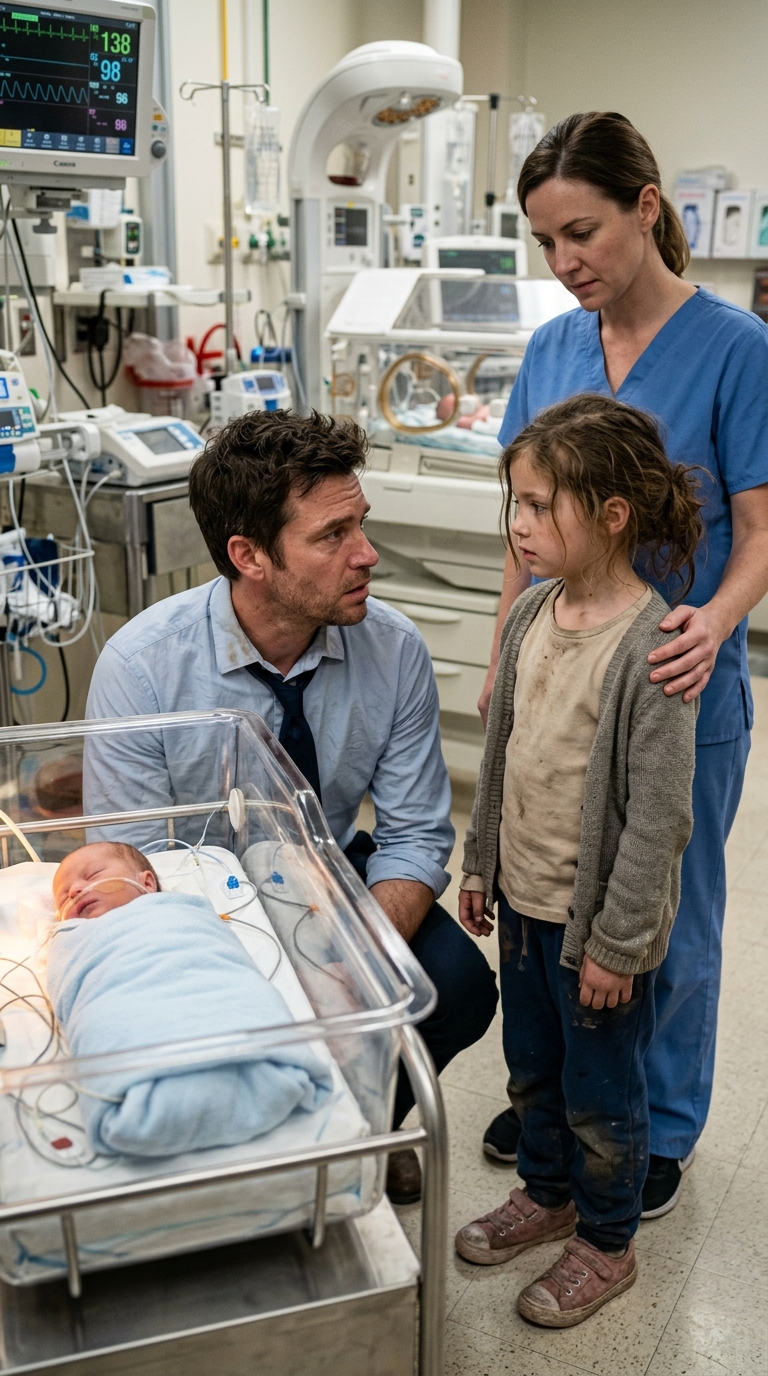
Nathaniel’s pulse jumped.
“Is that good?”
“It is better than worse.”
That was the sort of answer Dr. Levin always gave, and today it sounded almost generous.
Sadie tilted her head. “He doesn’t like the loud machine.”
Dr. Levin gave her the same polite smile adults give children when they are humoring them. “Most patients don’t.”
Sadie pointed, not at the ventilator, but at a small monitor module Nathaniel had barely noticed mounted beside the infusion pumps.
“That one,” she said.
Dr. Levin’s smile faded.
“That is not making sound,” he said.
Sadie’s eyes stayed on it. “Not to us.”
Nathaniel felt the hair rise on the back of his neck.
Dr. Levin approached the device and frowned. “It’s a cerebral oximetry unit. It shouldn’t be producing anything audible.”
Sadie nodded. “I know.”
The nurse shifted uneasily. “Doctor?”
Dr. Levin pressed a few controls, then looked more closely at the screen. His expression changed almost immediately.
“What’s wrong?” Nathaniel asked.
Dr. Levin did not answer for two seconds, which was long enough to turn the air into ice.
Then he said, “This sensor has been miscalibrated.”
Nathaniel stared. “What?”
Dr. Levin called for another nurse. Within seconds, two people were adjusting leads, comparing outputs, and speaking in clipped, technical phrases Nathaniel was too tired to fully follow.
The result arrived fast and mercilessly.
One of the readings they had been using to guide Julian’s treatment for the past six hours had been off.
Not wildly. Not enough to count as negligence at first glance. But enough to matter. Enough to shift medication thresholds. Enough to make a fragile situation more fragile.
Nathaniel felt the room tilt.
“You’re telling me,” he said, very slowly, “that a machine error changed how my son was being treated?”
Dr. Levin faced him directly. “We are correcting it now.”
“That is not what I asked.”
The doctor held his gaze. “Yes.”
Nathaniel’s hands began to shake.
He had spent his career building systems meant to prevent precisely this kind of failure. Redundancy. Verification. Tolerance analysis. Layered safety logic. All of it. Yet here, in the place where his son lay fighting for air, a bad reading had quietly bent the entire decision-making chain.
He nearly laughed from the cruelty of it.
Sadie reached out and touched the side of the crib again.
“Now sing to him yourself,” she said.
Nathaniel looked at her as if she had spoken another language.
“I don’t sing.”
She shrugged. “Then talk.”
The nurse was swapping equipment now. Dr. Levin was issuing new orders. The room had become urgently alive. And in the middle of that movement, Sadie’s calm felt impossible.
Nathaniel looked down at Julian.
At the tiny mouth.
At the soft skin.
At the life that had nearly been managed into silence by one small unnoticed error.
His voice came out rough. “Julian.”
The baby did not move.
Nathaniel tried again.
“Hey, buddy. It’s Dad.”
The word caught in his throat because it still felt new and enormous and terrifying.
He leaned closer.
“I’m here,” he whispered. “I know I’ve been standing here like an engineer instead of a father, but I’m here.”
The confession came without planning.
No equations. No composure. No carefully chosen language.
Only truth.
“Your mom is downstairs trying to be brave, and I’ve been pretending numbers make me brave, but they don’t.” He swallowed hard. “So you can be scared if you need to be. You just can’t leave. Not yet. Not before I get to know you.”
A wet sound came from somewhere behind him. The nurse was crying quietly while pretending she was not.
Nathaniel did not stop.
“I don’t care if you hate my voice,” he said. “You’re stuck with it. I’m going to tell you about airplanes and thunderstorms and why people should never trust gas station coffee. I’m going to teach you how to look at the sky and know where you are.” His breath shook. “You just have to stay.”
Julian’s fingers moved.
It was tiny. Barely more than a twitch.
But Nathaniel saw it.
Sadie smiled.
“There,” she whispered. “He heard the important part.”
Dr. Levin checked the updated monitor readings again. Then he looked at Nathaniel with something dangerously close to surprise.
“His blood gases may have been responding to the adjustment already,” the doctor said carefully, “but his oxygenation is definitely stabilizing.”
Nathaniel could not process the words all at once.
“Stabilizing?”
“For now,” Dr. Levin replied. “Yes.”
For now.
It was not a promise. It was not safety. But it was a bridge where there had only been a cliff.
Nathaniel sat down heavily in the chair beside the crib. For the first time in two days, he felt something other than panic.
Not relief.
Not yet.
But space.
Enough space to breathe one full breath.
When he looked up again, Sadie had stepped back toward the door.
“Wait,” he said. “Thank you.”
She gave a little nod, then glanced at Julian one last time.
“He likes your voice more than mine,” she said.
Nathaniel almost smiled. “You started it.”
Sadie’s expression turned oddly thoughtful.
“No,” she said. “He was already trying.”
Then she slipped out into the hallway.
Nathaniel stood immediately, wanting to ask one hundred things at once. He stepped into the corridor just in time to see the nurse who had first brought Sadie in speaking to an older woman near the waiting area.
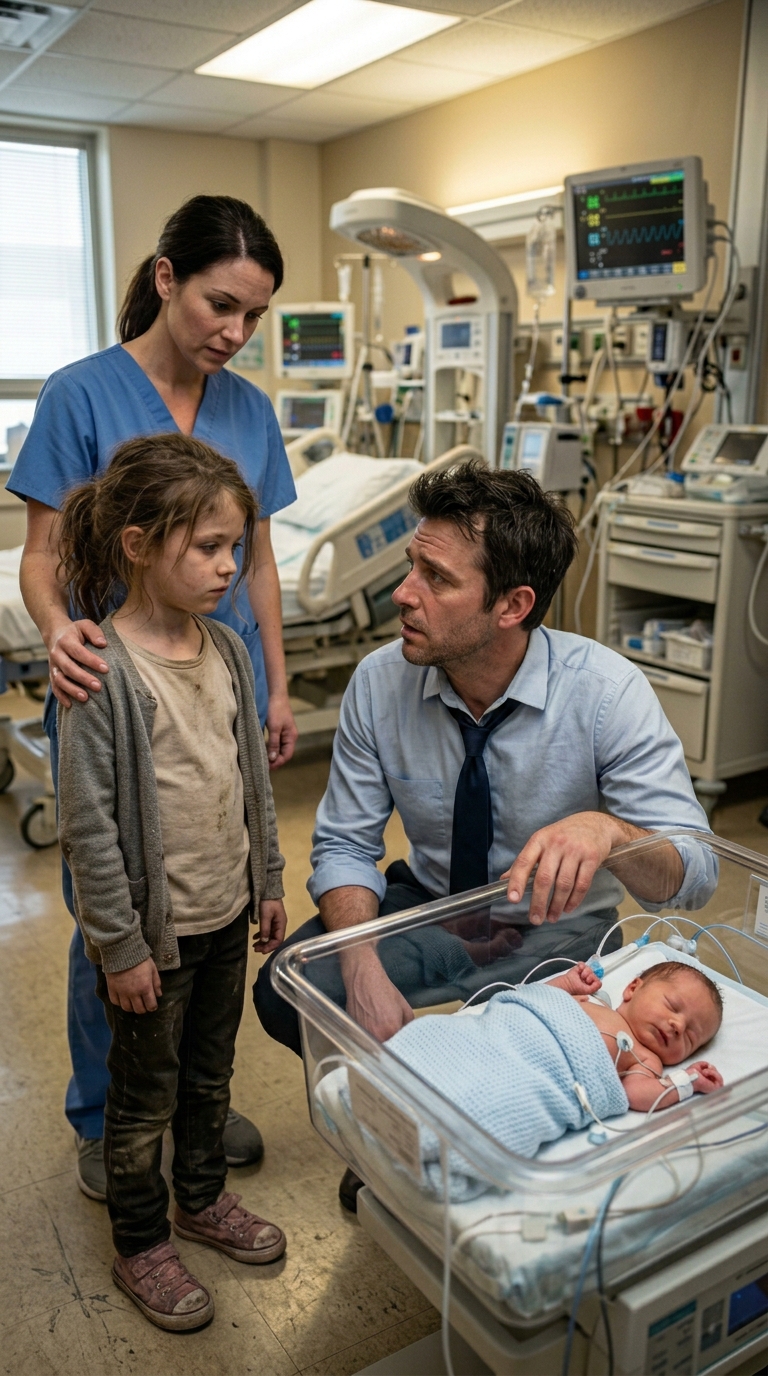
The woman was crying.
Not loudly. Not dramatically.
The silent, stunned kind of crying that belongs to people whose world has just split open.
The nurse saw Nathaniel and came toward him.
“What happened?” he asked.
The nurse’s face was pale. “Sadie’s little brother coded twenty minutes ago.”
Nathaniel frowned. “But you said he was being treated in this wing.”
“He was,” she said. “They couldn’t bring him back.”
Nathaniel stared at her, uncomprehending.
The nurse looked over her shoulder toward the older woman.
“That’s his grandmother.”
A terrible stillness passed through him.
“Where’s Sadie?” he asked.
The nurse’s lips parted, but no answer came.
Nathaniel turned.
The hallway was empty.
No small figure.
No mismatched sneakers.
No child slipping around corners.
Only polished floors, fluorescent lights, and the distant echo of hospital wheels.
He walked quickly toward the waiting area.
The grandmother looked up as he approached, grief hollowing her face. In her trembling hands she held a faded photograph.
Nathaniel stopped when he saw it.
The picture showed a younger woman in nurse’s scrubs, smiling beside two children on a porch.
One child was a little boy.
The other was a girl with loose light brown hair and two mismatched sneakers.
Nathaniel looked from the photograph to the woman.
“Is that Sadie?” he asked.
The grandmother’s eyes filled.
“That was Sadie,” she whispered. “She died here eight years ago.”
The world seemed to drop out from under him.
He stared at the photograph again.
Same face.
Same calm eyes.
Same impossible stillness.
The grandmother pressed a hand to her mouth. “She used to sing to sick babies when I worked nights. She always said some children were too little to be left alone with machines.”
Nathaniel could not speak.
Behind him, from inside Julian’s room, one of the monitors gave a clear, steady tone.
Not an alarm.
Not distress.
A stable rhythm.
He turned back toward the doorway with his heart slamming against his ribs.
Dr. Levin was inside, checking the screen with disbelief written plainly across his face.
“Nathaniel,” he said, “your son just took three full breaths on his own.”
Nathaniel looked at Julian.
At the tiny chest rising.
At the fragile life still here.
Then he looked toward the hall again.
It was empty.
Completely empty.
But near the base of Julian’s door, caught against the wall as if someone small had brushed past it moments ago, lay a single worn shoelace.
One side dark.
One side faded.
Nathaniel bent slowly and picked it up with shaking fingers.
And suddenly he understood something far more frightening than a miracle.
Sadie had not come because Julian was dying.
She had come because someone else in that hospital was not supposed to.
He turned toward the grandmother, who was now staring past him in silent horror.
Nathaniel followed her gaze.
Down the corridor.
Toward the dim end of the wing.
Where a little girl with light brown hair stood holding the hand of a boy no one else had noticed.
A boy in a hospital gown.
A boy with Sadie’s same eyes.
Her brother.
They both looked at Nathaniel.
Sadie raised one finger to her lips.
Then the hallway lights flickered.
And they were gone.
Nathaniel stood frozen, the shoelace in his hand, while behind him his son kept breathing.
Then Dr. Levin’s voice cut through the silence, changed now, urgent in an entirely new way.
“Nathaniel,” he said. “You need to see this.”
Nathaniel turned.
On Julian’s monitor, beneath the corrected readings and stabilizing numbers, a new patient note had appeared in the electronic chart.
No one had typed it.
No one in the room had touched the computer.
The cursor blinked once under a single line of text.
HE WAS NEVER THE ONE SHE CAME FOR.
Nathaniel felt the blood leave his face.
Because in the reflection of the darkened monitor, just over his shoulder, he could see the door to the next room slowly opening by itself.
The door to the next room opened with a soft, deliberate click, as though the latch itself had decided the time had come.
Nathaniel stood motionless, the single worn shoelace still pinched between his fingers like a talisman he didn’t dare drop. Behind him, Julian’s monitors continued their new, steadier song—beeps no longer edged with desperation. Dr. Levin’s voice had gone quiet, the kind of quiet that meant even seasoned doctors had run out of scientific explanations.
Nathaniel turned slowly toward the open doorway.
The room beyond was dimly lit, reserved for the most critical cases. A single bassinet stood near the center, surrounded by the same forest of machines that had guarded his own son only hours earlier. Inside it lay a tiny girl, no more than a few days old. Her name card read “Emery Callahan.” The numbers above her bed told a brutal story: oxygen plummeting, heart rate erratic, the same slow slide Julian had been making before Sadie arrived.
No one was inside with her. The chair beside the bassinet was empty. A half-drunk coffee sat cold on the side table, as if her parents had stepped out for a moment they never intended to stretch this long.
Nathaniel stepped into the hallway, drawn forward against his better judgment. The air felt heavier here, thicker with the same unnatural stillness Sadie had carried with her. He stopped at the threshold.
A faint melody drifted through the room—not loud, not forceful, but familiar. The same circular lullaby about stars finding their way home. It came from nowhere and everywhere at once, as if the walls themselves had decided to remember Evelyn Ross’s old song.
Emery’s chest rose and fell in time with the unseen voice.
Nathaniel’s throat tightened. He thought of Sadie’s calm certainty, of her brother waiting patiently at the end of the corridor, of the photograph in the grandmother’s hands. Sadie had not come to save Julian. She had come because the hospital was bleeding again—another small life slipping through the cracks of machines and protocols and exhausted adults. Julian had simply been close enough to hear the song.
A soft footstep sounded behind him.
He turned. The grandmother—Evelyn Ross herself—stood a few paces away, eyes red but no longer crying. She looked at the open door, then at Nathaniel, and gave the smallest nod of understanding.
“She always did that,” Evelyn whispered. “Even when she was alive. She’d wander the halls at night and find the ones who needed the song most. After she passed… the stories never stopped. Babies who turned corners no medicine could explain. Nurses who swore they saw mismatched sneakers disappearing around corners.”
Nathaniel looked down at the shoelace in his palm. The colors seemed to shift under the fluorescent lights—dark and faded, like two halves of the same broken promise.
Inside Emery’s room, the monitors began to settle. Not dramatically. Not with trumpets or divine light. Just the quiet mercy of numbers moving in the right direction, the same fragile gift Julian had been given.
Dr. Levin appeared at Nathaniel’s shoulder, staring into the room with the same stunned expression he’d worn minutes earlier.
“We didn’t call a code on this one yet,” he said quietly. “Her parents are speaking with the ethics team down the hall. They… they were preparing to let her go.”
Nathaniel closed his fingers around the shoelace.
“Not tonight,” he said.
A breeze—impossible in a sealed hospital wing—brushed past them. It carried the faint scent of crayons and strawberry shampoo, the small, ordinary smells of a child who should have grown up drawing pictures instead of haunting corridors.
When Nathaniel looked again, two small figures stood at the far end of the hallway.
Sadie and her brother.
The boy leaned his head against her shoulder, tired but peaceful. Sadie lifted her hand in a small wave—not farewell exactly, but acknowledgment. The kind two travelers might give each other after sharing a brief, necessary shelter.
Then the lights flickered once more, softer this time, like a gentle exhale.
They were gone.
Nathaniel walked back into Julian’s room. His son’s eyes were half-open now—cloudy, newborn blue, but unmistakably focused on his father’s face. The ventilator had been turned down to minimal support. Julian was breathing mostly on his own.
Nathaniel sank into the chair and reached through the plastic crib rail, placing one large hand beside the baby’s tiny fist. Julian’s fingers twitched, then curled weakly around his father’s thumb.
“I’m here,” Nathaniel whispered again, voice raw. “We both are.”
Outside in the corridor, Evelyn Ross stood for a long moment at Emery’s doorway, listening to the faint lullaby that still lingered in the air. Then she smiled—the tired, grateful smile of someone who had just been reminded that love does not always obey the rules of departure.
Somewhere deeper in the hospital, another monitor began to change its rhythm.
But that was another story, for another night.
In Julian’s room, Nathaniel Brooks—engineer, father, witness—closed his eyes and let himself believe, just for a little while, in the part of him that didn’t quit even when it was scared.
