

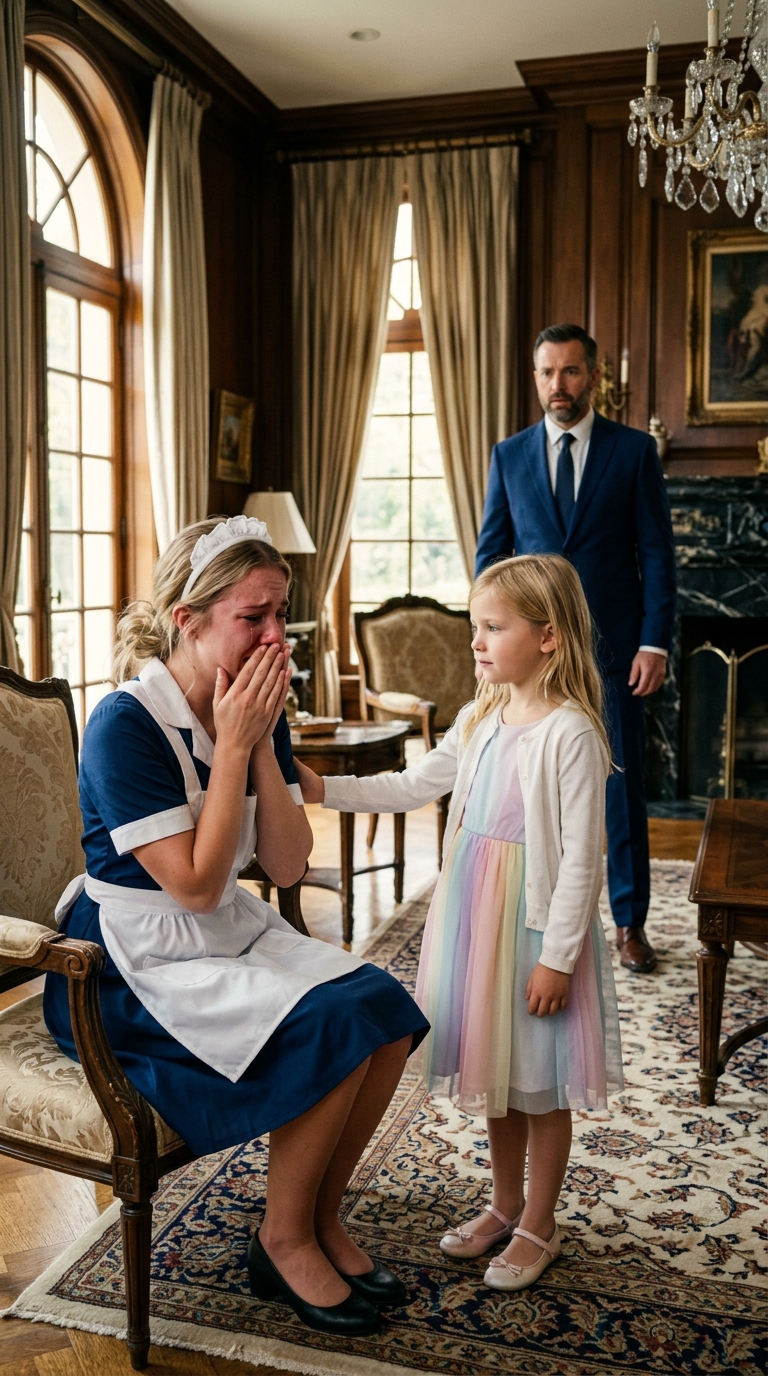
From the very first day I entered the Hawthorne estate, the warning was impossible to misunderstand.
“Do not approach the CEO’s daughter. She doesn’t connect with anyone.”
The words were delivered politely, but the meaning underneath them was firm, almost rehearsed, as though every employee in the mansion had repeated the same sentence for years.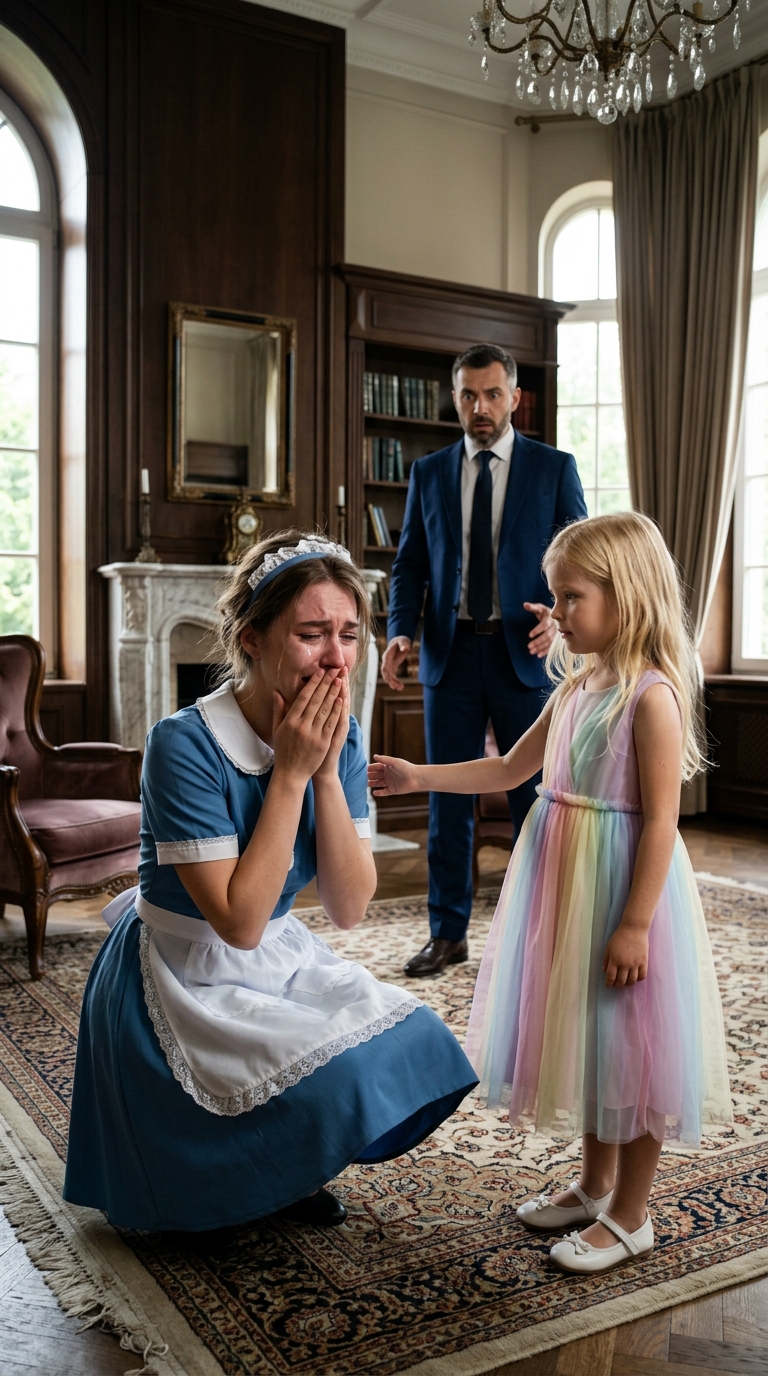
I remember standing in the enormous marble foyer with my suitcase still beside me, listening as the head housekeeper explained the rules in a careful voice. Outside, rain rolled softly against the towering windows of the estate. Inside, everything smelled faintly of polished wood, fresh linen, and silence.
Not ordinary silence.
Controlled silence.
The kind that exists in homes where emotions are kept behind locked doors.
The Hawthorne estate didn’t feel like a family home. It felt like a museum built around loneliness.
Every hallway was immaculate. Every object sat perfectly in place. Staff moved quietly across expensive carpets as though they feared disturbing something fragile.
Or someone.
I had been hired as a live-in tutor for Sophie Hawthorne, the six-year-old daughter of billionaire CEO Michael Hawthorne. The salary was generous enough to make anyone overlook the strange atmosphere, but even during the interview process, one detail had been repeated constantly:
Do not force interaction.
Do not interrupt her routines.
Do not attempt emotional engagement.
“She prefers to be alone,” one therapist had explained flatly over video call.
“She doesn’t connect with people,” another added.
At the time, I nodded politely, assuming they simply meant she was shy or withdrawn.
I didn’t understand yet how deeply everyone around Sophie had begun treating her isolation as permanent.
Sophie was autistic.
And somewhere along the way, the adults around her had confused difference with distance.
The first time I saw her, she was sitting in the far corner of the sunroom beneath a wall of tall windows that flooded the room with afternoon light. She wore soft gray headphones over her ears and sat cross-legged on the floor beside hundreds of wooden blocks.
Not toys.
Systems.
Every block was arranged with astonishing precision—organized by shape, then shade, then size. She worked silently, completely absorbed in patterns only she understood.
She never looked up when I entered.
Not even once.
“Just leave her be,” the housekeeper whispered beside me.
So I did.
For the first few days, I followed every instruction perfectly.
No greetings.
No questions.
No attempts to engage.
I simply remained nearby during scheduled learning hours while Sophie stayed inside her carefully ordered world.
And yet, even while obeying the rules, I couldn’t stop noticing her.
I noticed how sudden noises made her flinch violently.
How the slam of a distant cabinet door caused her shoulders to tense immediately.
How she pressed both hands over her ears whenever vacuum cleaners passed the hallway outside the sunroom.
I noticed the soft humming too.
At first, I thought it was random. Later, I realized it was rhythm—something she used to steady herself whenever the world became too loud.
Sometimes she hummed while stacking blocks.
Sometimes while staring at sunlight moving across the floor.
Sometimes while rocking slightly back and forth near the windows.
Nobody interrupted her.
Nobody joined her.
The staff tiptoed around Sophie with a strange mixture of caution and heartbreak, as though they had convinced themselves she existed behind invisible glass.
Even her father seemed uncertain around her.
Michael Hawthorne was exactly the kind of man newspapers admired—wealthy, controlled, intimidatingly successful. His face appeared regularly on business magazine covers beside headlines about billion-dollar acquisitions and corporate expansion.
But inside his own home, he looked exhausted.
I often saw him standing silently in the doorway of the sunroom late at night after meetings, watching Sophie from a distance.
Never approaching.
Never speaking.
Just watching.
There was grief in that silence.
Not because he didn’t love her.
Because he didn’t know how to reach her.
One evening during dinner, he sat across from me in the enormous dining room while untouched food cooled between us.
“She used to talk more when she was younger,” he admitted quietly.
The statement seemed difficult for him to say aloud.
“What happened?” I asked carefully.
Michael looked toward the dark hallway leading to the sunroom.
“The more people pushed her,” he said slowly, “the quieter she became.”
After that, I began paying even closer attention.
Not trying to change Sophie.
Trying to understand her.
I learned that she hated fluorescent lights but loved sunlight.
That she preferred instrumental music over voices.
That she memorized patterns faster than most adults could notice them.
That she became calmer when people sat beside her without expecting anything.
Weeks passed that way.
Quietly.
Carefully.
Then one rainy afternoon, everything changed.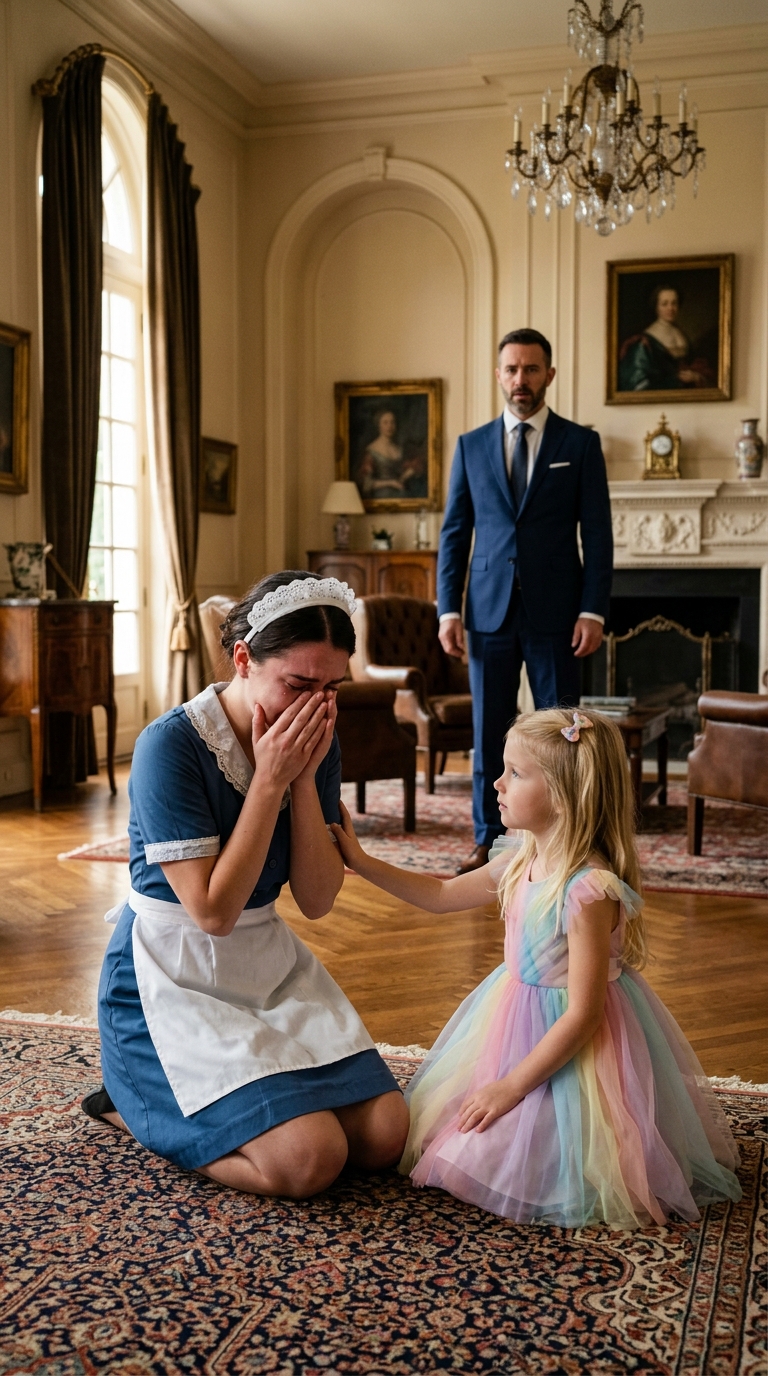
Soft piano music drifted through the sunroom from a speaker someone had accidentally left on in the adjacent hallway. It wasn’t loud. Barely more than background noise.
I was organizing books near the shelves when I noticed movement from the corner of my eye.
Sophie had stood up.
That alone was unusual.
She moved slowly across the room, her small hands clenched lightly at her sides. Every step looked deliberate, as though she were navigating invisible obstacles no one else could see.
Then she stopped directly in front of me.
For the first time since I arrived at the estate, she looked directly into my eyes.
Her expression was unreadable.
Not afraid.
Not nervous.
Focused.
The room suddenly felt impossibly still.
Then, in a voice barely above a whisper, she said:
“Dance with me.”
I froze.
Not because I didn’t want to.
Because I understood immediately what the moment meant.
Every warning echoed back through my mind.
“She doesn’t connect.”
“Do not approach.”
“Leave her alone.”
And yet here she was—
reaching out first.
I nodded slowly.
We didn’t touch.
That seemed important somehow.
Instead, we simply stood facing one another while the soft piano melody continued playing through the room. I swayed gently first, giving her space to choose.
A few seconds later, Sophie mirrored the movement.
Not perfectly.
Not performatively.
Intentionally.
Her humming slowly faded away.
The tension in her shoulders loosened.
For nearly an entire song, we moved quietly together beneath the afternoon sunlight pouring through the windows.
No one spoke.
No one interrupted.
When the music ended, Sophie stepped away calmly, returned to her blocks, and sat down exactly where she had been before.
But everything had changed.
That evening, Michael Hawthorne found me near the library.
For a moment, he simply stared at me as though struggling to believe what he had witnessed earlier.
Then he spoke softly.
“She talked.”
His voice cracked slightly.
“For the first time in months.”
I told him the truth.
There had been no special method.
No behavioral technique.
No breakthrough strategy.
Just patience.
Presence.
Permission.
Over the following weeks, Sophie didn’t suddenly transform into a different child.
She simply began allowing people closer.
On her terms.
Some mornings she handed me a wooden block before arranging the others.
Sometimes she sat beside me during reading time instead of across the room.
Sometimes she danced again when soft music played.
The therapists were stunned.
Not because her autism disappeared—it didn’t.
Because her trust appeared genuine instead of forced.
One afternoon, Michael sat beside me in the sunroom while Sophie quietly sketched patterns onto paper nearby.
“I spent years trying to make her communicate like everyone else,” he admitted quietly.
His eyes stayed fixed on his daughter.
“I thought connection meant talking.”
He paused.
“I didn’t realize it could mean listening without words.”
That sentence stayed with me.
Because Sophie had never truly been unreachable.
The world had simply refused to slow down enough to meet her where she was.
The rule about avoiding Sophie was never officially removed.
It simply stopped mattering.
Over the next two years, the Hawthorne estate changed slowly alongside her.
The silence inside the mansion softened.
Laughter appeared occasionally in hallways where there had once only been restraint.
Michael stopped watching his daughter from doorways and started sitting beside her on the floor while she arranged blocks.
Not speaking.
Just sharing space.
And Sophie?
She never became anyone else’s version of normal.
She became more herself.
She communicated through gestures, drawings, routines, patterns, eye contact, and sometimes words carefully chosen with intention.
Every interaction meant something.
Every invitation mattered.
And I learned something inside that quiet sunroom I will never forget:
Connection cannot be demanded.
It cannot be forced into existence through pressure or expectation.
Connection is an invitation.
And trust only grows where someone finally feels safe enough to offer it.
