

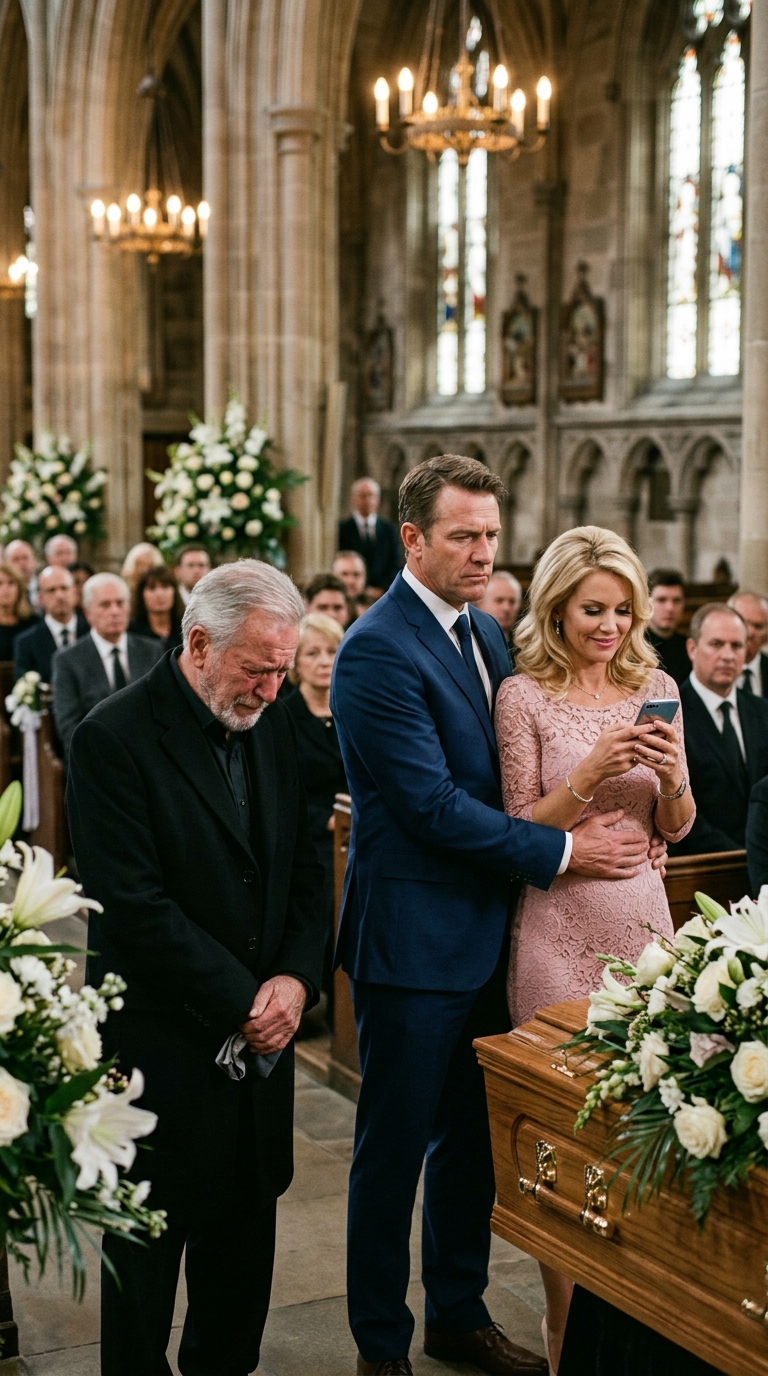
The sun burned overhead with an almost offensive brightness that felt completely wrong for the morning I was preparing to bury the woman who had been my entire world for more than thirty years. I stood beside the heavy oak entrance of St. Paul’s Cathedral, watching sunlight drift through the floating dust while my heart felt like a block of iron sinking into the polished wooden floor.
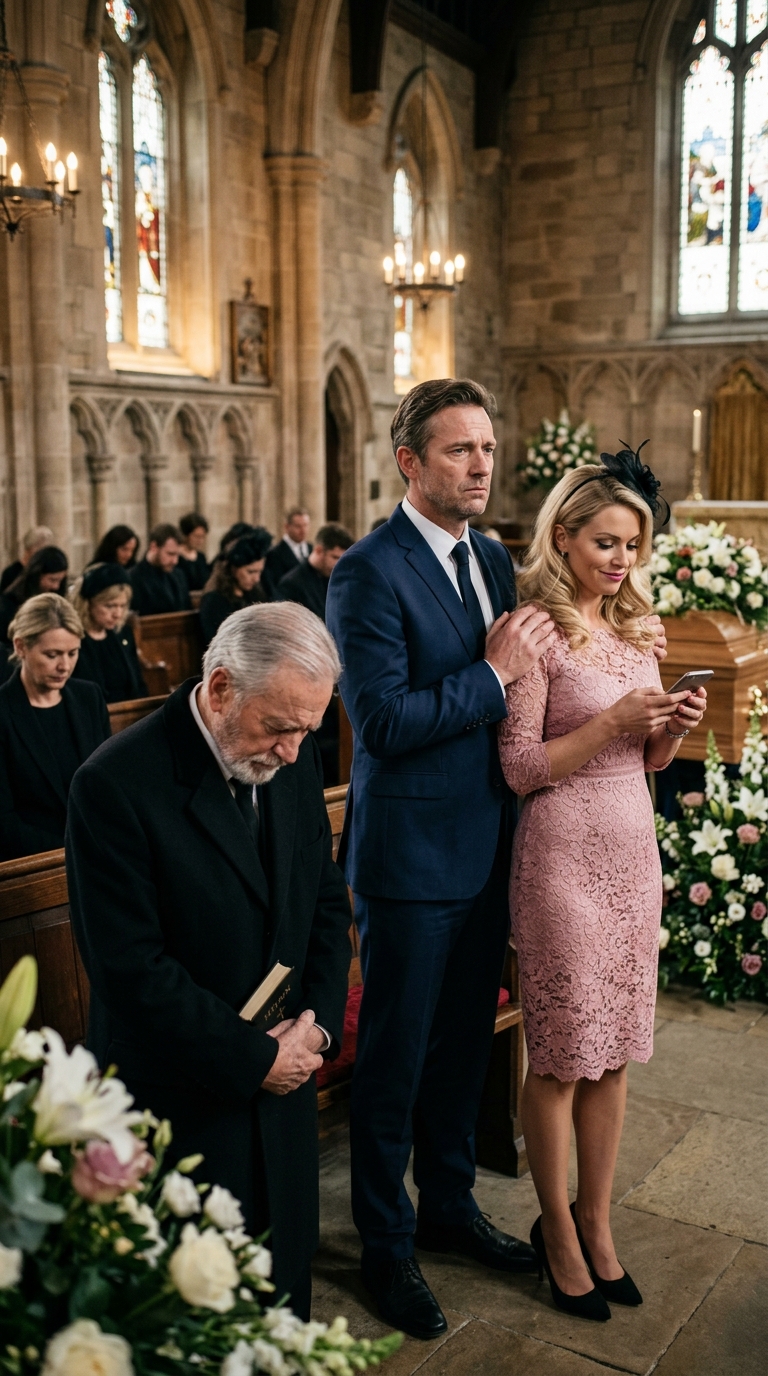
It was there, while Lydia rested peacefully inside her polished mahogany casket, that my daughter-in-law leaned toward my son and whispered something that turned my blood to ice. She didn’t realize I was standing only a few feet away behind a towering arrangement of white lilies when she quietly told him that the day felt more like a vacation than a funeral.
She said it without sadness or respect, using a lighthearted tone that sounded more suited to discussing a weekend getaway than mourning someone’s death. Those few careless words wounded me more deeply than any hollow sympathy I had heard all morning, and my hands froze against the cold stone wall of the church while my soul hardened into something sharp and heavy.
The morning itself was strangely beautiful as golden sunlight filtered through the stained-glass windows and painted the pews with colors that seemed to mock the darkness inside me. One by one, people approached to offer gentle condolences and soft phrases meant to comfort a kind of grief that words could never truly touch.
“She is finally at peace after such a long struggle,” one neighbor whispered while patting my hand in a gesture that felt kind yet completely powerless.
I simply nodded over and over because my chest was filled with a crushing pressure that made it almost impossible to breathe, let alone speak.
My son Caleb arrived nearly twenty minutes late with his tie crooked and his eyes swollen red from a sleepless night of silent crying. When he finally embraced me, I could feel his whole body shaking with the grief he had been trying desperately to hide.
“I am so sorry that I was not here sooner to help you with the arrangements, Dad,” he whispered into my shoulder while I held him tightly.
I wanted to tell him that just being there mattered more than anything, but the words stayed trapped in my throat like broken glass.
Amber followed behind him wearing a bright peach dress and high heels that clicked loudly against the floor as though she were attending an upscale brunch instead of a funeral service. Gold earrings sparkled beside perfectly styled waves of hair, and she looked more prepared for a social gathering than for honoring the woman who had welcomed her into our family.
While everyone else bowed their heads during prayer for Lydia’s soul, Amber checked her reflection in the dark screen of her phone and adjusted her eyebrows carefully. From the corner of my eye, I noticed the faint smile that crossed her lips whenever she thought no one was paying attention, and it confirmed every suspicion I had carried for the past year.
During the final months of Lydia’s illness, I learned a painful truth about how quickly people stop pretending to care once death begins approaching. Amber visited often, but she never arrived with flowers or any real intention of comforting Lydia.
Instead, she always carried a leather notebook and asked direct questions about the deed to the house or the status of our life insurance policies. She never talked about shared memories or gratitude for Lydia’s kindness. Every conversation revolved around assets, paperwork, and what would remain after Lydia was gone.
She never once called me by my first name or even referred to me as her father-in-law. I was always “Mr. Bennett,” spoken with the cold politeness reserved for strangers.
During the funeral itself, Caleb sat in silence, staring at the casket so intensely it seemed he was trying to force the past back into existence through sheer willpower.
When Amber leaned over to whisper her comment about the holiday atmosphere, I saw Caleb’s shoulders tense sharply, proving he had heard every word. But he said nothing in defense of his mother, reminding me that his greatest flaw had always been sacrificing his own dignity to keep the peace.
Eventually the service ended, and we moved to the cemetery where the scent of fresh earth and fading lilies hung heavily beneath the afternoon heat. I remained perfectly still until the final shovel of dirt struck the casket with a sound like a massive door slamming shut on the best years of my life.
I believed the hardest part of the day was finally over.
I was wrong.
As we walked toward the waiting cars, our longtime attorney, Franklin Miller, approached carrying his weathered leather briefcase and wearing an unusually grave expression.
“Samuel, I need to speak with you and the rest of the family because Lydia left some very specific instructions regarding her final wishes,” Franklin said while glancing directly at Caleb and Amber.
Amber’s eyes lit up for a split second with excitement she tried to hide beneath a mask of solemn sympathy, but I saw greed flicker there unmistakably.
Not long afterward, we gathered inside Franklin’s office where the air smelled faintly of stale coffee and old paper while shelves of thick law books lined the walls. Caleb sat silently in a leather chair with his head lowered while Amber crossed her legs and tapped her heel impatiently against the floor.
Franklin began by reviewing routine matters such as small inheritances for distant relatives and donations to the botanical gardens Lydia had adored. Amber pretended to be uninterested, though I noticed her straighten every time the lawyer mentioned property or finances.
Then Franklin paused, inhaled deeply, and removed a white envelope sealed with red wax from his desk drawer.
“Lydia requested that I read this particular letter first, and she was very clear that it was intended for both Caleb and Amber to hear,” he explained.
Caleb swallowed hard and gripped the chair so tightly his knuckles turned pale while Amber forced a thin smile that never reached her eyes.
The moment Franklin read the opening line, all the color drained from Amber’s face.
“Caleb, if you are hearing these words, it means that I am no longer there to protect you from the things you have spent the last year refusing to see,” Franklin read steadily.
Caleb jerked his head upward and stared at the letter as though it were alive, while the room suddenly felt much smaller and heavier.
The letter explained that during the past year Lydia had noticed several valuable belongings disappear from the house, including family jewelry and large sums of cash. At first she blamed her medication and questioned her own memory, but eventually she realized something far darker was happening.
Caleb’s breathing grew uneven as he listened to his mother describe the betrayal unfolding inside our home.
“What exactly is this supposed to mean, and why are we listening to these accusations right now?” Caleb whispered painfully.
Amber let out a nervous laugh and adjusted her dress before insisting the letter was ridiculous because Lydia had not been mentally well near the end.
“I am not finished reading the document, and I would appreciate it if you stayed seated until I have concluded,” Franklin interrupted firmly.
Lydia had not merely suspected wrongdoing. She had secretly hired a private investigator to follow Amber during the errands she claimed to be running. She did it not out of revenge, but because she needed to know whether the danger to our family was coming from outside or from within.
Franklin began placing evidence across the table, including pawn shop receipts for jewelry that had belonged to my grandmother for more than fifty years. There were also security photographs showing Amber entering a bank to deposit checks forged with Lydia’s weak signature.
The most devastating evidence was a series of recordings where Amber pressured Lydia to sign over ownership of the house while heavily sedated.
Caleb stared at one photo showing Amber smiling triumphantly at a jewelry counter, and his quiet denial shattered my heart.
“There must be some kind of mistake because I was only trying to help us manage the future expenses of the estate,” Amber snapped while standing abruptly.
She looked around wildly and insisted the house would eventually belong to them anyway, so it should not matter how ownership transferred.
“It was never going to be yours, Amber, and Lydia made certain of that in the final version of her will,” Franklin replied while tapping another set of documents.
He explained that Lydia had transferred all assets into a protected trust granting me the right to remain in the family home for the rest of my life.
Caleb would eventually receive the trust benefits, but the money could only be used for approved purposes like education or medical emergencies for future grandchildren.
The most shocking condition stated that if Caleb stayed married to Amber, all trust payments would remain frozen indefinitely unless a judge confirmed she had zero access to the funds.
Amber stared in disbelief and outrage, demanding to know how such an arrangement could even exist.
Franklin calmly added that Lydia had included another provision stating that anyone contesting the will without valid legal grounds would receive exactly one dollar.
For the first time since I had known her, Amber looked genuinely frightened.
Caleb stared at his wife as though he no longer recognized her, and the silence in the room became deafening.
“Did you actually do those things, and did you really take the rings that my mother promised to pass down to our children?” Caleb asked in a chillingly calm voice.
Amber burst into tears and reached toward him, insisting she only acted to protect their financial future.
“You stood in the church today and called my mother’s funeral a holiday, so I want to know if that was part of your grand plan for our protection as well,” Caleb replied while pulling his arm away.
She scrambled to apologize and blamed stress and pressure, but the damage had already gone too far.
The heavy chair crashed backward as Amber stepped away, realizing she could no longer manipulate the situation.
“Fine, you can keep your grieving family and your precious money because I am done pretending to be the perfect daughter-in-law for a woman who never liked me anyway,” she snapped while grabbing her designer bag.
She stormed out and slammed the office door behind her, but Caleb never moved to follow.
He remained seated in silence, clutching Lydia’s letter against his chest while looking completely lost inside his grief.
But Franklin still wasn’t finished.
He reached into his desk and removed a small silver key attached to a handwritten note.
“There is one more instruction that Lydia left for both of you, and it requires us to visit the downtown branch of First National Bank,” he said quietly.
We drove there surrounded by a silence so heavy it felt like fog, and I wondered what else my wife could possibly have hidden.
At the bank, the manager escorted us into a private vault room where we used the silver key to unlock Lydia’s safety deposit box.
Inside were several treasured personal items: her wedding band, original legal documents, a small USB drive, and one final handwritten note.
“If you are reading this note together, it means that we are still a family and that the truth has finally come to light,” the note began in Lydia’s elegant handwriting.
Caleb collapsed into deep sobs as he realized that even near the end of her life, his mother had been trying to give him the clarity he lacked.
The USB drive contained a video Lydia had recorded in our guest bedroom only two weeks before she died.
On Franklin’s laptop screen, Lydia appeared frail and thin, yet her eyes remained calm and determined.
“Caleb, I need you to understand that love does not mean closing your eyes to the harm that someone is causing to those you care about,” she said softly.
She explained that real love never uses pain as an excuse to hurt people or steal from a family that welcomed you with open arms.
Caleb cried harder than I had ever seen before, and I moved closer so I could place an arm around his trembling shoulders.
In the video, Lydia gave him a choice. He could allow Amber to leave peacefully if she returned everything she had stolen. But if she refused or challenged the legal arrangements, Lydia had gathered enough evidence on the USB drive for prosecutors to pursue criminal charges for elder fraud.
Caleb wiped his eyes, inhaled deeply, and picked up his phone to call the woman he once believed would stand beside him forever.
“I need you to return every single piece of jewelry and every cent you took, and then you are going to sign the divorce papers without making a scene,” he said with a firmness I had never heard from him before.
Amber tried manipulating him one final time by talking about their history and shared dreams, but Caleb remained unmoved by her tears and promises.
When she realized she had lost all control, her sadness disappeared and fury took its place as she shouted insults before finally agreeing to his terms to avoid prison.
Two days later, she met Franklin at a neutral location to sign the paperwork and return the stolen items using the money she had secretly hidden away.
There was no dramatic confrontation or public spectacle, only the quiet ending of a relationship that had been broken long before any of us realized it.
Months passed, the seasons changed, and Caleb slowly began rebuilding his life with therapy and support from our community. Together we honored Lydia’s memory by creating a scholarship fund in her name at the university where she had taught for many years.
During my first year as a widower, I learned something important.
Money and inheritance cannot destroy a truly strong family. They only reveal the real character of people who were already broken or hiding behind false affection.
I realized that losing Lydia would always remain a painful burden, but it was a cleaner and more honest pain than betrayal from someone we trusted.
Lydia saved our family from a predator, and in doing so, she taught us that the people who truly deserve a place in your life are the ones who honor you even when you are no longer there to witness it.
THE END
