

The reflection in the café window was deceptive. It showed a woman of immense power, wrapped in Italian silk and cashmere, silver hair arranged with geometric precision that projected control. It showed Evelyn Carter, head of Carter Logistics, a woman whose signature could redirect entire shipping fleets across the Pacific.
But I wasn’t watching ships anymore. I wasn’t watching the street or the autumn crowd rushing through Chicago’s wind. I was watching the wheelchair.
It was a sleek black machine, German-engineered and worth more than most homes. It hummed softly, responding before I could act, as if it owned my movements. It was a throne. It was a prison.
“Everything is handled, Evelyn,” Julian’s voice came through the phone, smooth and cold like polished stone. “The settlement covers your care for life. You don’t need to fight the board. You don’t need to fight anyone. Just… exist.”
I stared at the untouched gourmet sandwich on the porcelain plate. Roast beef, arugula, truffle oil. It smelled like indulgence I no longer belonged to.
“Just exist,” I repeated. “That’s a polite way of saying die quietly, Julian.”
“You’re being dramatic,” he sighed. “The legal team finalized the Settlement of Condition. It acknowledges your permanent state. It protects your assets. It’s closure, Evelyn.”
I ended the call without a goodbye.
Closure. A word used for a door already shut in my face years ago. A slow collapse began then, not a single moment. A spinal infection. A surgical mistake. A silence where signals used to be. Doctors called it “incomplete paralysis.” A severed connection. The hardware remained. The signal did not.
I looked down at my legs, hidden beneath tailored trousers that pretended nothing was wrong. I gripped my thigh hard enough to blanch my knuckles.
Nothing. No response. Only absence pretending to be flesh.
“Settlement,” I whispered. I had accepted it. I had accepted Julian’s narrative—that my body was finished, and so was I.
I signaled the waiter. He approached with pity softened into politeness.
“Take it away,” I said, nodding at the sandwich. “I’m not hungry.”
“You haven’t touched it, Ms. Carter. It’s the Wagyu you prefer.”
“Food is fuel,” I snapped. “A parked car doesn’t need fuel. Throw it out.”
He complied.
I turned back to the window. Outside, the world fought wind and time and gravity. I fought nothing. I was safe. I was wealthy. I was finished.
The café door chimed.
A shadow fell over my table.
I looked up expecting a lawyer, expecting Julian, expecting paperwork.
Instead, a boy stood there.
A gray hoodie hung loose on his frame, stained and oversized, as if borrowed from survival itself. His face looked worn beyond his years. He wasn’t looking at me. He was staring at the sandwich being carried toward the trash.
Hungry. Not politely. Not subtly. Desperately.
“Leave it,” I said, studying him. “You want it?”
He didn’t reach for the food. He stepped toward me.
The waiter stiffened. “Sir, you can’t—”
“Leave it,” I repeated sharply. Then I looked at the boy. “Take it. It’s charity.”
“I don’t want charity,” he said. His voice cracked but held. “And I don’t want money. I want the bag. And in exchange, I’ll wake your legs up.”
A laugh escaped me, sharp and disbelieving. “Are you a comedian or a thief?”
“Neither,” he said. “I’m a mechanic.”
“I’ve seen world-class neurologists,” I said coldly. “They all say the same thing. The signal is gone.”
“Doctors read charts,” he said, dropping to his knees despite the stares. “My mother was a rehab nurse. She said muscles remember. They don’t die. They sleep.”
“Get up,” I said, tension rising. “You’re making a scene.”
“YOU STOPPED ASKING YOUR MUSCLES TO ANSWER,” he whispered, reaching toward my leg. “I can wake them. But I need that sandwich.”
It was absurd. It should have been laughable. But his certainty held weight.
“Touch me and you’ll be arrested,” I warned, though I didn’t move.
“Give me one minute,” he said. “If nothing happens, call security. If something happens, I get the sandwich.”
“Do it,” I said.
He struck my leg.
Not gently. Not carefully. A sharp tap. Then another. Then pressure—precise, brutal, focused. He dug into the muscle behind my knee.
A shock shot through me.
I gasped.
Not imagined. Not phantom. Real. Electric. Alive.
“You feel that?” he asked.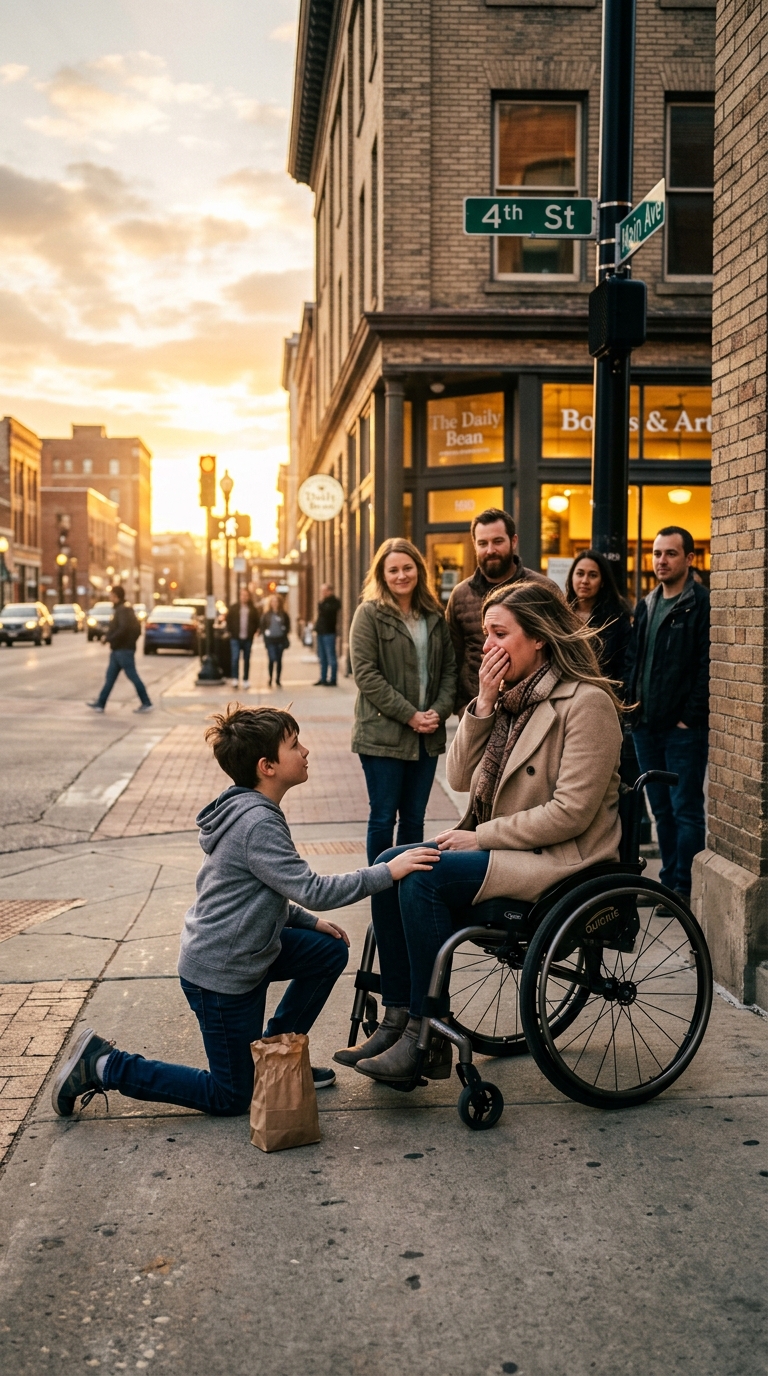
“Yes…” I breathed.
“Then it’s there. It’s just asleep.”
He pressed harder. My breath broke.
“Move your big toe,” he said. “Just that. No thinking. Just command.”
I stared down. Focused.
Move.
Something flickered.
My toe moved.
The world went silent.
“Again,” I whispered.
“First, the food,” he said.
I pushed the plate toward him. “Take it.”
He reached for it—
The café doors slammed open.
“GET YOUR HANDS OFF HER!”
Julian.
He stormed in with security behind him, face twisted in outrage. “Get away from her!”
“Stop,” I said sharply.
Julian froze.
He turned to me, shocked. “Evelyn, this boy is—”
“He is helping me,” I said calmly.
I looked at the boy. “Get in the car when I say.”
That night, everything split in two.
By day, I was the disabled CEO, managed and contained by Julian, who began selling off my empire piece by piece. By night, I was in the pool house with the boy—Marcus.
He refused comfort. He demanded work.
“You’re lazy,” Marcus said on the third night. “Your brain accepted the chair.”
“I can’t feel it,” I gritted.
“Good. Then it’s ready to wake.”
Pain became instruction. Fire became language.
Toes became movement. Movement became control.
But Julian was closing in—removing staff, tightening control, waiting for my collapse.
“You stopped asking your muscles to answer,” Marcus repeated every night. “So they stopped replying.”
Then one day, I stood.
Not fully. Not cleanly. But I stood.
And I collapsed immediately after.
Marcus saw the bruises on his own body in that moment—marks he had hidden.
“Who did this?” I demanded.
“No one,” he lied.
“It was the shelter,” he finally admitted. “The man there… takes payment another way.”
Cold fury replaced everything.
“You’re not going back,” I said.
He whispered, “They’re coming for me. Julian called them.”
The next morning, everything came to a head.
The board meeting.
Julian planned to finalize the sale of everything I built.
I arrived.
“Open it,” I told Marcus.
The doors slammed open.
Silence hit the room.
Julian smiled. “Evelyn, this is inappropriate—”
“I’m not finished,” I said.
I stood.
The room froze.
My legs shook violently. My body screamed. But I stood.
Gasps filled the air.
“I cancel the sale,” I said, voice breaking under strain. “And you are fired.”
Julian stepped back, pale.
Then everything collapsed.
My vision darkened. My body failed. I fell.
Blackness swallowed me.
I woke in a hospital.
“You’re neurologically active,” the doctor said. “This shouldn’t be possible.”
“Where is Marcus?” I asked immediately.
Silence.
“They took him,” the nurse said softly. “Child services.”
Something in me snapped.
“I want my lawyers. Now.”
Hours later, I walked into the holding facility using a cane.
I did not wait.
I signed papers. Claimed guardianship. Rewrote reality.
When Marcus saw me, he froze.
“You walked,” he whispered.
“I did,” I said. “Now come home.”
He ran into my arms.
One year later, the rehabilitation center I built was filled with movement, with recovery, with second chances.
Marcus stood beside me, taller now, stronger.
“You remember when I found you?” he asked.
“You looked like I was already gone,” I said.
“I thought you were.”
“But you pulled me back.”
We walked out together.
At a corner, Marcus stopped.
A man sat nearby, broken, unseen.
Marcus looked at me.
A question.
I nodded.
He walked over.
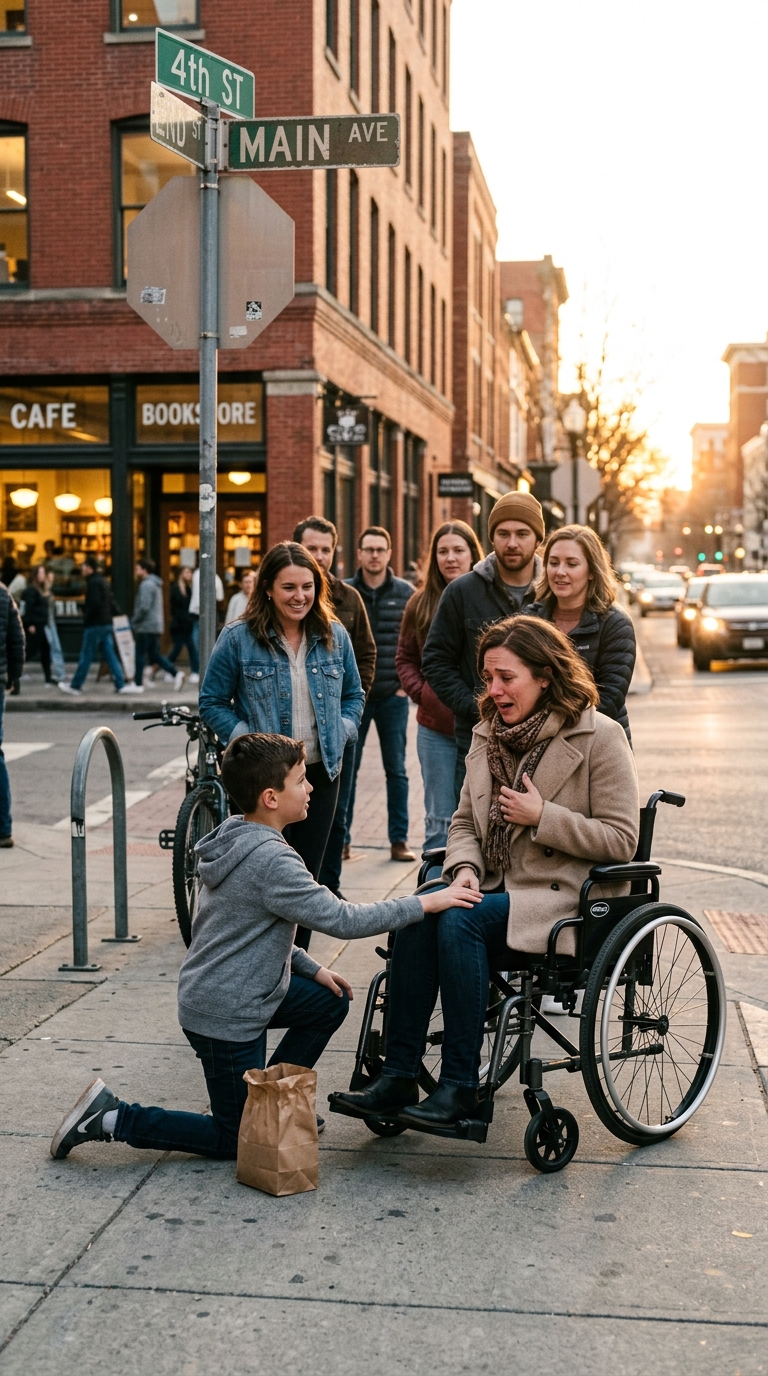
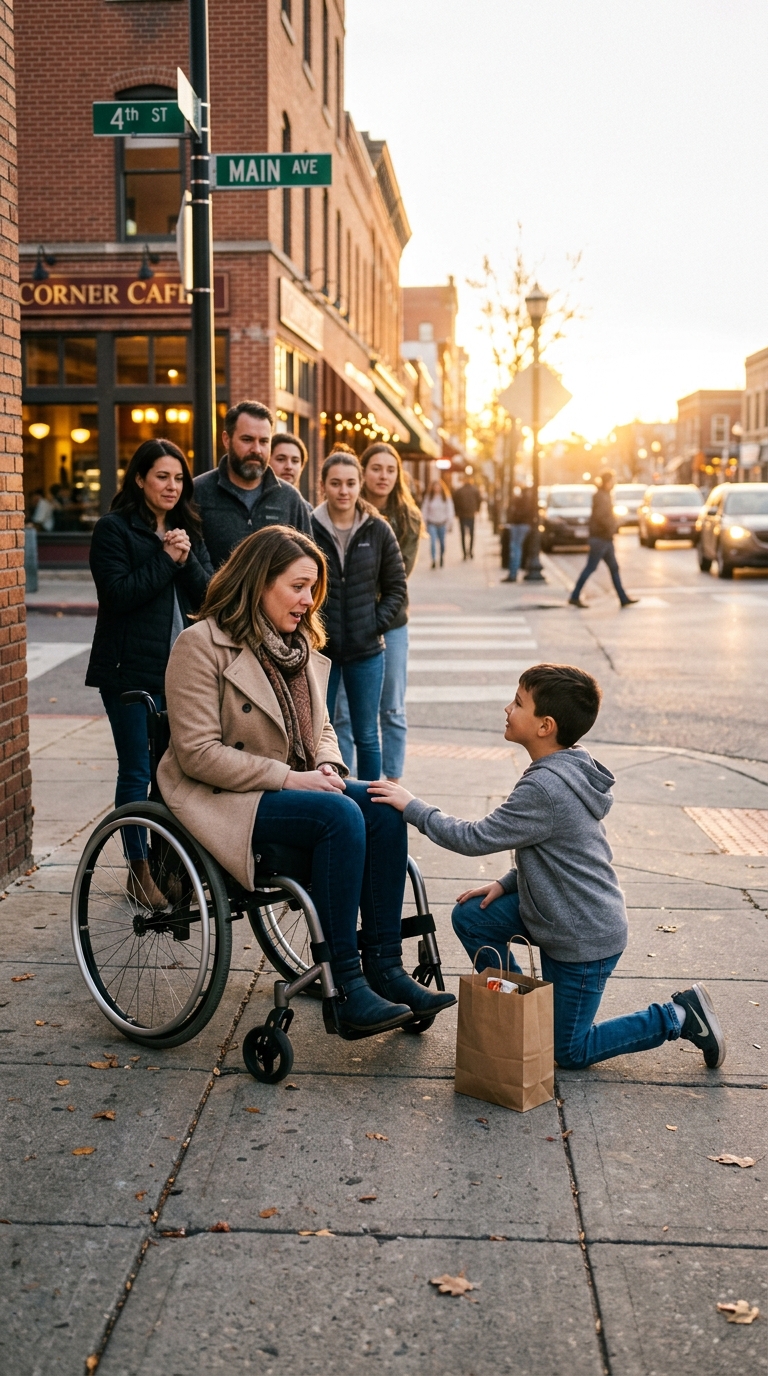
Knee to knee.
“No money,” he said gently. “But I can tell you something about that leg.”
And the cycle began again.
